Exploring the Business Advantages of Autonomous Robots in the Industrial Sector
- Published
- Source
- SupplyChainBrain
The rapid advancement of physical artificial intelligence is leading to the increased use of autonomous and semi-autonomous robots across various sectors, including warehousing, logistics, mining, construction, and agriculture. As manufacturers prepare to launch humanoid robots, the industrial sector is particularly poised for transformation due to a significant shortage of skilled labor, with projections indicating a rise in vacant manufacturing positions in the U.S. from 440,000 to 510,000 in early 2026 to between 1.5 million and 2 million by the early 2030s.
This labor shortage is driving industrial companies to adopt autonomous robots to enhance productivity and manage operational costs. The shift towards automation is expected to change the financial landscape of these businesses, converting operating expenses into capital expenditures and increasing their asset base. This could lead to a credit and financing boom as companies become more attractive to lenders, creating a feedback loop that encourages further investment in robotics.
Looking ahead, industrial companies must navigate several challenges, including determining the ownership models for robots, assessing their lifespan, and managing obsolescence risks. Key considerations will include whether to purchase or lease robots, the potential for secondary resale value, and the need for maintenance and upgrade commitments to ensure long-term viability in a rapidly evolving technological landscape.
Original report
The Business Benefits of Autonomous Robots in the Industrials Sector
SupplyChainBrainThis briefing is an independently written summary based on publicly available reporting and is provided for industry information and news discovery. The original report and source publication are credited and linked where applicable. RobotToday does not claim ownership of third-party source material.
Rights concerns? Contact [email protected] with the relevant URL and details. We will review the matter and take appropriate action where warranted.
More related news
- 1
- 2
- 3
-
4
RobotToday Weekly November 2 – 6, 2026 RobotToday · 2 days ago
- 5
- 6
- 7
- 8
- 9
- 10
- 11
- 12
Related Suppliers

MULA Autonomous Robots SL
Spain
MULA is a Navarra-based start-up building the MULA 1250, a 4WD electric autonomous carrier with 3-point hitch for orchards and woody crops.

Intuitive Robots
France
French robotics software company and official European distributor of Boston Dynamics Spot, deploying autonomous robots for industrial infrastructure.

ADEV Automation
United States
Ohio-based agricultural robotics company developing autonomous strawberry harvesting systems to address farm labor shortages.
Agrobot
Spain
Spanish agricultural robotics company based in Huelva developing autonomous strawberry harvesters and insect vacuum robots for labor-scarce farms.

KEBA Industrial Automation GmbH
Austria
Austrian automation specialist offering KeMotion robot control and Kemro X open platform for plastics, robotics, and machine-building industries since 1968.

ATS Industrial Automation
Canada
Automation and assembly systems integrator (part of ATS Corporation) building test and assembly platforms for eMobility, energy storage and nuclear markets.
Workr Robotics
Ireland
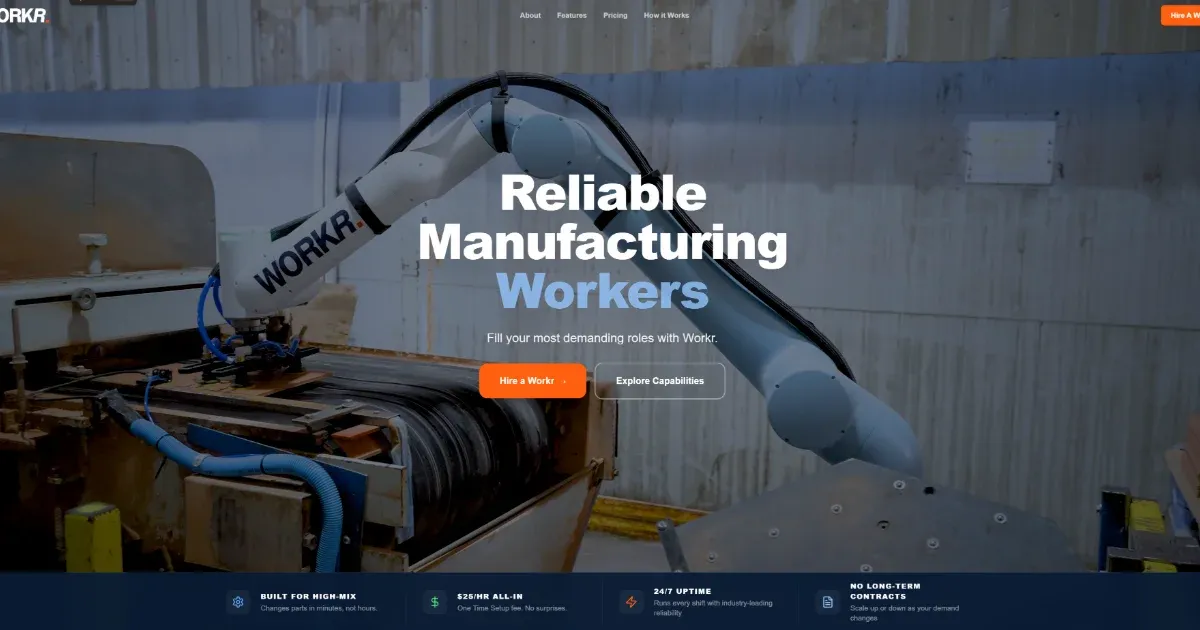
Irish RaaS startup delivering AI-powered robotic workforce to manufacturers at $25/hour with no capital expenditure required.

RSP Robot System Products
Sweden
Swedish manufacturer of industrial robot accessories — tool changers, grippers, hose packages — spun off from ABB in 2003, acquired by HCD Group in 2017.
Puloon Technology
Korea, Republic of (South)
Seoul, South Korea maker of ATM cash dispensers and coin recyclers, founded 1997 and listed on KOSDAQ under ticker 094940.

Alliance Automation, LLC
United States
Van Wert, Ohio robotic systems integrator founded 2008 in Delphos; builds assembly, material handling, and pallet-processing automation systems.

Shanghai Artificial Intelligence Laboratory 上海人工智能实验室
China
Shanghai-based national AI research institute founded 2020; develops the InternLM model family and the Intern-Robotics embodied-AI engine.

Beijing Institute for General Artificial Intelligence 北京通用人工智能研究院
China
Beijing non-profit AGI institute led by Zhu Songchun whose embodied-AI stack includes the TongBrain robot brain and the open-source TongSIM simulator.
Robotics needs a service framework.
RSF defines a common language for robot service capability, lifecycle operations, certification pathways, and service-provider networks.
Join the RobotToday community on LinkedIn
Daily robotics news, in-depth analysis, conference highlights, and discussions with professionals worldwide.