

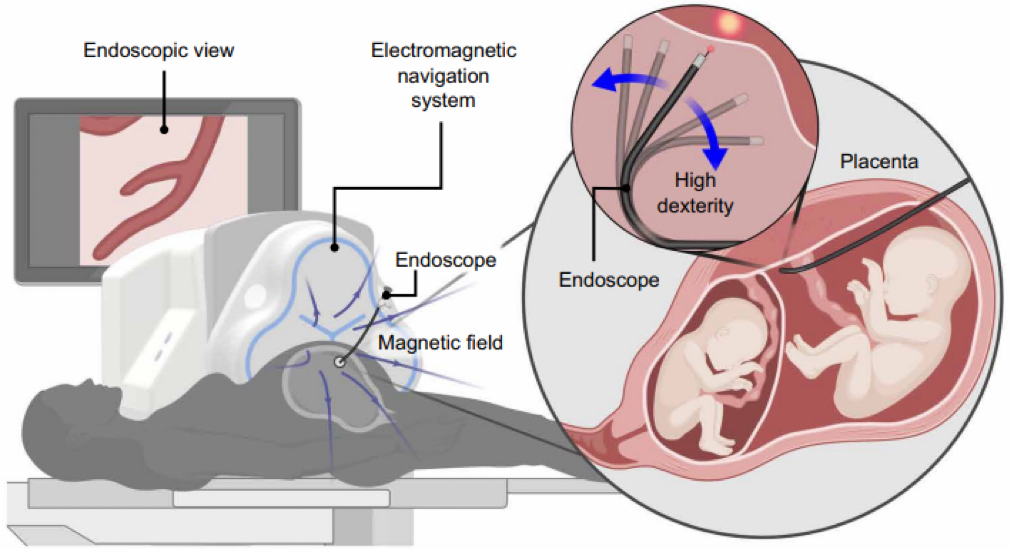
A research team from ETH Zurich has developed a magnetic-controlled flexible endoscope robot platform, successfully validating its navigation and ablation capabilities in a live sheep model for twin-to-twin transfusion syndrome (TTTS) laser surgery. This condition affects 10% to 15% of twin pregnancies sharing a placenta and is treated with fetal endoscopic laser coagulation (FLC). Current methods have a survival rate of about 70%, with significant risks of long-term neurological damage.
The new 3.2mm robotic endoscope offers improved access and ablation angles compared to traditional rigid endoscopes, which struggle with visibility and precision. The flexible endoscope's design allows it to navigate through a 10-Fr cannula, crucial for better clinical outcomes. It can bend up to 173° under a 25 mT magnetic field, achieving a 91% coverage rate for optimal ablation angles, significantly outperforming existing tools.
The team conducted in vivo experiments using a pregnant black goat, which closely resembles human placental and developmental characteristics. The robotic system demonstrated effective manual and automated navigation strategies, achieving high precision in targeting and image stitching. No further timeline was disclosed at the time of publication.
Editor's Note
The development of this robotic system represents a significant advancement in fetal surgery, particularly for complex cases like TTTS. The ability to navigate and perform precise ablation with a flexible endoscope could enhance surgical outcomes and reduce risks associated with traditional methods. As the technology matures, its potential applications in other surgical fields may also be explored.




























Leave a comment