

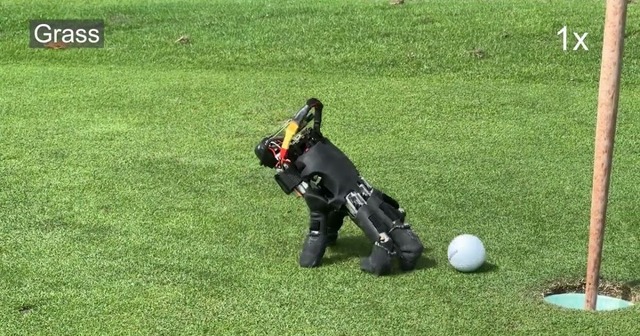
ETH Zurich's Soft Robotics Lab has introduced a novel technology that utilizes robot hand fingers as feet, enabling interaction with the environment. By employing reinforcement learning, the robot hand can support its own weight while moving and performing various tasks. A demonstration video showcasing these capabilities was released on September 16, 2026, on YouTube.
This research successfully applies reinforcement learning to teach the robot hand multiple movement skills, including crawling while supporting its weight, turning, recovering from falls, pressing keyboard keys, and pushing objects. Notably, these actions are achieved by using the fingers not just for gripping but as functional feet. The video illustrates the robot's movement across various indoor and outdoor surfaces, its recovery from falls, keyboard operation, and object pushing.
The research team utilized task-specific individual policies learned in a simulation environment to realize these diverse skills. Each action, such as crawling and turning, is controlled based on independently learned policies. The on-board processing allows for decision-making and execution without relying on external computational resources. This technology represents a significant step towards multifunctionality and versatility in robotics, warranting attention in the field.
Editor's Note
The integration of reinforcement learning in robotics is paving the way for more adaptive and versatile machines. This development by ETH Zurich highlights the potential for robot hands to perform complex tasks beyond traditional gripping, indicating a shift towards multifunctional robotic systems. As industries increasingly adopt such technologies, the implications for automation and intelligent manufacturing are profound.

























Leave a comment