

1. Three announcements in six days
Stratasys came to Chicago with three announcements. On September 9 it launched the F870, a large-format FDM machine built for factory tooling. On September 10 it listed what it would show at IMTS. On September 14, the morning the show opened, it said its additive manufacturing solutions will roll out across more than 20 General Motors plants in North and South America.
The GM news extends an old relationship. The two companies have worked together for years, and GM plants already run Stratasys FDM machines, including the F900, to make tooling, fixtures, jigs, factory aids and end-use parts. The release counts "dozens of manufacturing applications" across tooling, quality, safety and ergonomics. It gives no unit count and no dollar figure.
Yoav Zeif, Stratasys chief executive: "General Motors demonstrates what becomes possible when additive manufacturing is fully integrated into production operations. Together, we’ve created an approach that turns factory-floor innovation into enterprise-wide business value."
Doneen McDowell, manufacturing vice president for GM North America full-size truck and large SUV assembly operations, described how the work is organised:
"Our greatest asset is our people. If we can give people the tools so they can own the outcome within their footprint, and then take those solutions and replicate them across our footprint where they apply, we’ll get the best outcome."
In practice, a plant team finds a problem on its own line, designs a tool, prints it, checks that it works, and hands the file to other plants with the same problem. No central additive group approves requests. The corporate job is to copy what worked.
2. What is on the tables at Booth #338460
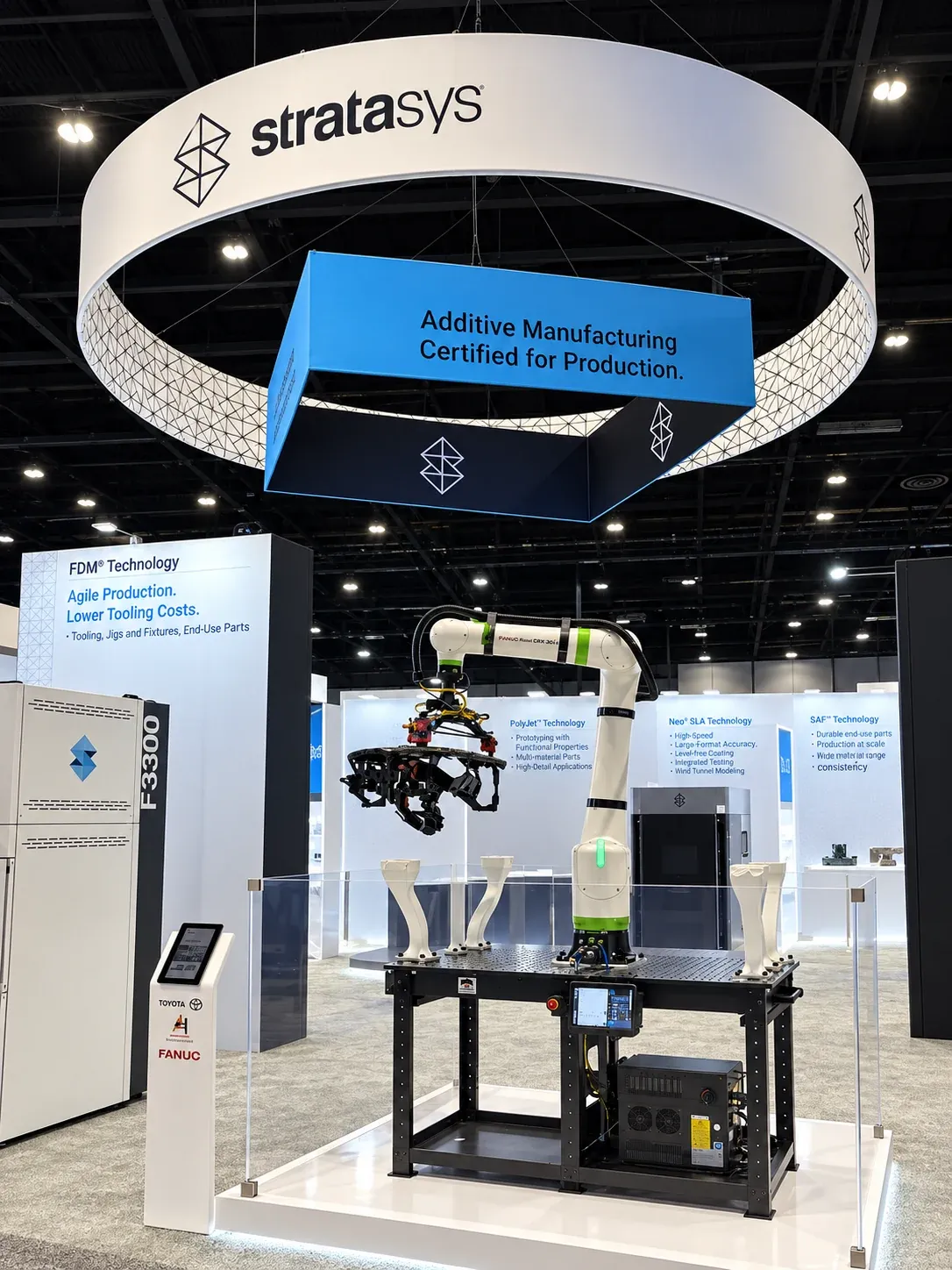
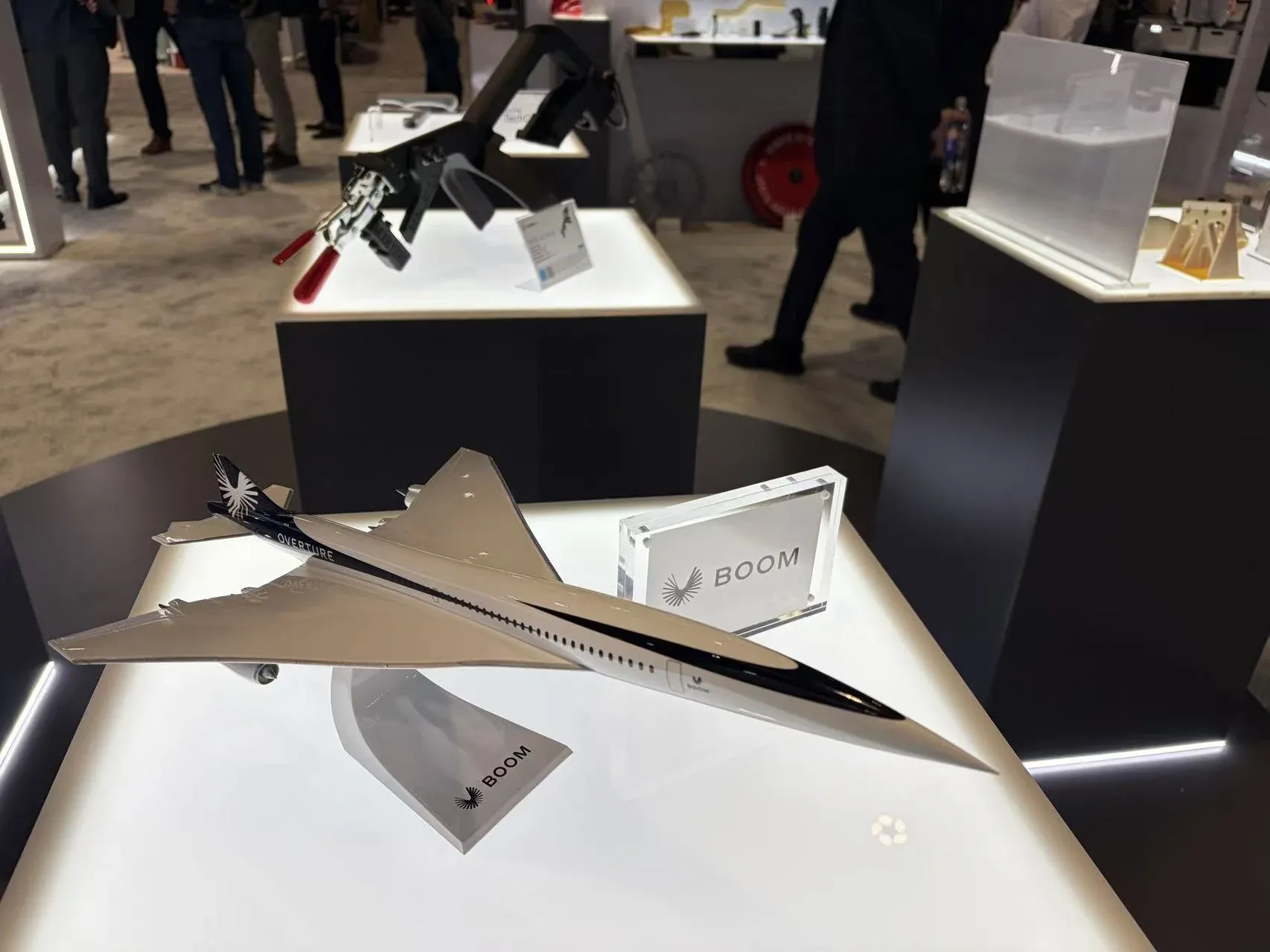
RobotToday walked the stand on the opening afternoon. It is laid out by process — FDM, PolyJet, Neo SLA and SAF — under a ring sign reading "Additive Manufacturing Certified for Production." An F3300 sits at the FDM end. At the other end is a glass cabinet of SAF parts, mostly small black production components, each labelled with its application. A Boom Supersonic Overture model marks the aerospace section.
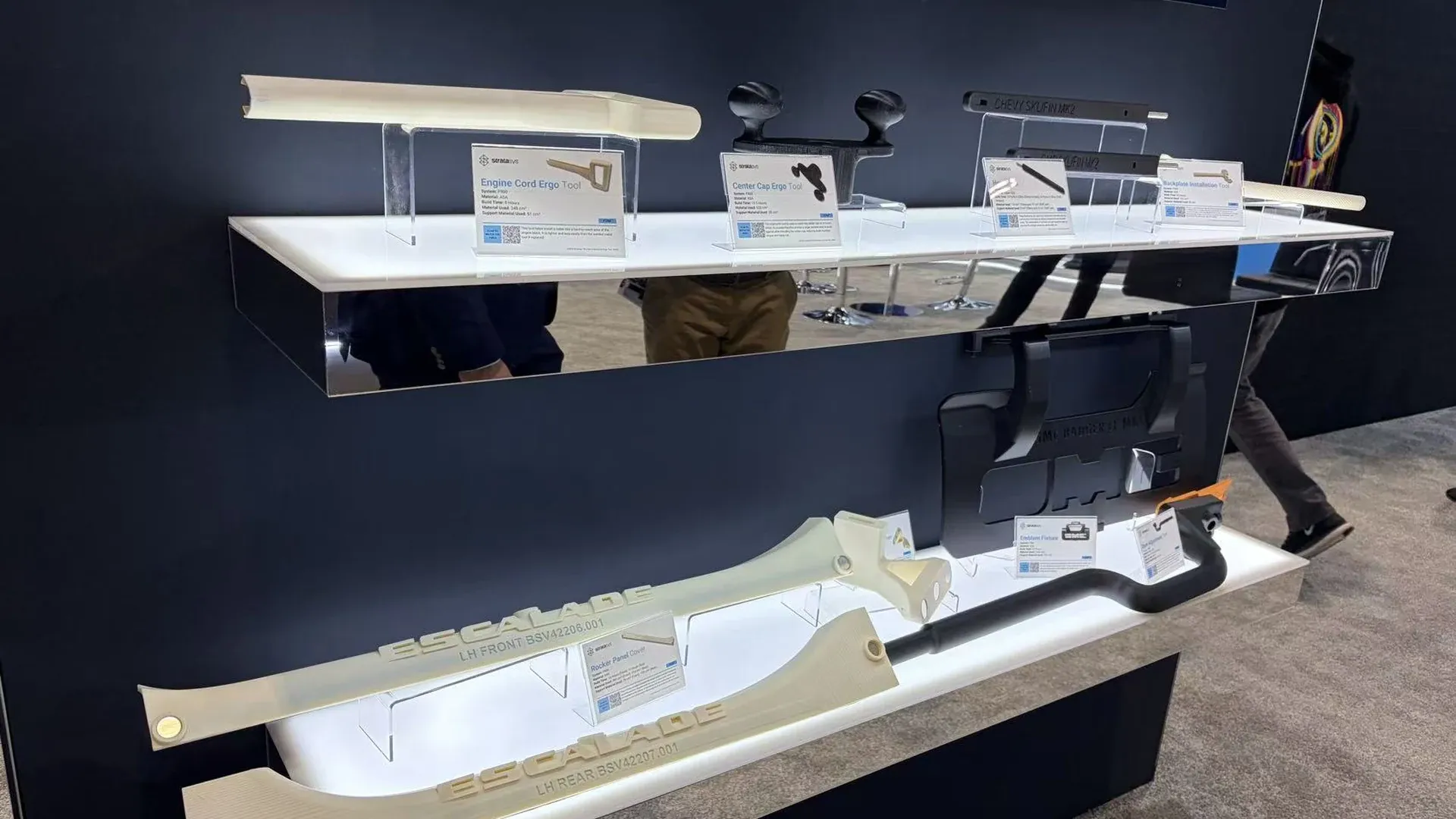
The GM display has a placard beside each part giving the machine, the material, the build time and the material used. From the placards:
— Engine Cord Ergo Tool. F900, ASA, 8 hours, 348 cm³ of model material and 51 cm³ of support. A hooked handle for routing a cable into a hard-to-reach area of the engine block. The card says it is lighter and cheaper than the welded metal tool it replaced.
— Center Cap Ergo Tool. F900, ASA, 13.5 hours. A two-lobed press tool for seating wheel centre caps.
— Composite Layup Tool. F900 with Fortus FDC, ULTEM 1010 resin, 60 hours 46 minutes, 2,789.1 cm³ (170.2 in³) of model material and 127.8 cm³ (7.8 in³) of support. A large gold layup surface in place of a machined mould.
— Also on the table: a Chevy Skidfin MK2, a backplate installation tool, an emblem fixture, a trim alignment tool, and two long Escalade rocker panel covers carrying GM part numbers (LH FRONT BSV42206.001, LH REAR BSV42207.001).
Only the rocker panel covers carry vehicle part numbers, and the release lists "protective components" among the applications. The rest are the tools a plant buys or makes all the time — handles, guides, fixtures — and rarely tracks as a programme. An eight-hour, 348 cm³ build is an overnight run on a machine the plant already owns. Across 20 plants, the number that moves is how often that happens without a purchase order.
3. The F870
The F870 has a 1,000 × 610 × 610 mm build chamber, heated throughout. Stratasys calls it the longest heated build capacity in its class. It runs Nylon 12CF, ASA and ABS, plus a new grey FDM ABS Draft for cheap iteration. Rich Garrity, chief business unit officer, described the target as "larger tooling, fixtures, and manufacturing aids on the factory floor."
A good deal of factory tooling is still machined because it will not fit in a printer. Rails, guards, long assembly aids and inspection gauges are simple shapes that sit just past the limit of most FDM machines, so they are printed in sections and bonded, or not printed at all. A metre-long chamber takes them in one piece.
Toyota Production Engineering in Georgetown, Kentucky, and Rivian in Plymouth, Michigan, are the first named users. Both are evaluating the machine for factory-floor tooling, manufacturing aids and prototyping: large fixtures, assembly tools and inspection gauges that would otherwise be machined. Dallas Martin, an additive manufacturing engineer at Toyota North America, said the F870’s "combination of build size, material performance and industrial features aligns with the kinds of manufacturing needs we’re looking to address."
Stratasys has not published a price. The release describes the systems as in customer evaluation ahead of commercial availability. Neither Toyota nor Rivian is described as having bought one.
4. The robot cell
A FANUC CRX-30iA collaborative arm stands on a fixture table in the middle of the stand. It picks an automotive instrument panel component with a large black printed end-of-arm tool fitted with vacuum cups and clamps. The pedestal in front carries Toyota and FANUC logos beside Stratasys’s own.
Fadi Abro, Stratasys’s senior global director for automotive and mobility, told RobotToday the robot is there because end-of-arm tooling is where additive and automation meet in an auto plant. The gripper on the stand would normally be welded steel with machined parts bolted on. That takes weeks, costs more and comes out heavy. A robot’s rated payload has to cover the gripper as well as the part, so a heavy gripper leaves less capacity for the product.
The tool is printed in Nylon 12 Carbon Fiber. Abro said Toyota is among the customers already printing end-of-arm tooling for large industrial robots, mostly where the gripper is complex, the geometry is awkward or the tool is a one-off.
The harder problem, he said, is trust. A plant that bolts a printed gripper onto a robot has not had a good way to know whether it will hold under load. Stratasys now runs the design through analysis software that checks strength against the part to be gripped and marks the areas likely to fail. The case Stratasys is designing against is a gripper that breaks halfway through a shift and stops the line.
End-of-arm tooling is part-specific. It is usually the last thing finished in commissioning and the first thing remade when the product changes. If the lead time drops to a night, and the mass drops enough to use a smaller arm, the cost of every cell moves. For a robotics reader this is the part of the Stratasys story that matters.
AMT’s July USMTO figures give some context. US manufacturing technology order value is up 37.1% year to date; units are up 13.0%. AMT puts most of the gap down to demand for additional automation on each machine. Printed tooling that lets a robot switch to a new part is part of that content.
5. Where Stratasys says the maths stops
Asked when 3D printing becomes the more expensive option, Abro answered in volumes. At a million parts, printing one at a time loses badly, because conventional manufacturing spreads mould, equipment and line costs across the run. At around 3,000 parts, additive starts to compete. At ten — his example was a type of tyre mould — printing wins, since the alternative is building expensive tooling for a handful of pieces and redoing it whenever the design changes.
He asked for the comparison to be made on the full set of costs: volume, part complexity, tooling, machining, material waste, labour, design changes and lead time. Unit price on its own, he said, misleads in both directions.
On payback, Abro said some applications recover the cost of the machine in about six months, after which the saved manufacturing cost is margin. RobotToday has not seen the figures behind that. It is reported here as his claim.
Temperature is not the limit for the tool on the stand, which lives indoors at plant temperature. Stratasys sells higher-temperature materials for aircraft, spacecraft and under-bonnet automotive use. The limit is set by the polymer, not the process.
On recycling, Abro said materials differ. Some of the white parts on the stand are printed in recyclable material. The black carbon-filled composites are harder to reprocess because of what is in them. He added that machining a large part starts from a bigger billet and throws most of it away, while printing adds material only where the part needs it, and that some Stratasys programmes turn waste from other processes into feedstock — in a few cases all of it.
6. Reading the claims
The GM release gives two quantities, "more than 20 facilities" and "dozens of applications," and neither says how many printers are installed. The savings evidence is at part level, from the customer’s own placards and from a six-month payback quoted in conversation, not from an audited total. The F870 has no public price and is not generally available. And the GM deal extends a relationship that already existed, so it says little about share between vendors.
What has changed is who makes the decision. Ten years ago a corporate additive team justified a printer to a finance director. Now a GM manufacturing vice president describes tool-making as something the plant team owns, with corporate there to copy it. A vendor already inside that loop is hard to replace.
7. Questions for follow-up
— How many machines are installed across the 20+ facilities, and does the budget sit with the plant or with corporate?
— What is the qualification path for a printed tool that touches a vehicle in-process, compared with one that never contacts it?
— Does the F870 sit beside the F900 at accounts like GM, or replace it for long-format work?
— Which applications are behind the six-month payback figure, and what is the spread across the rest?
— Of the "dozens of applications" at GM, how many are robot-facing — end-of-arm tooling, cell fixtures, part presenters?










Leave a comment