

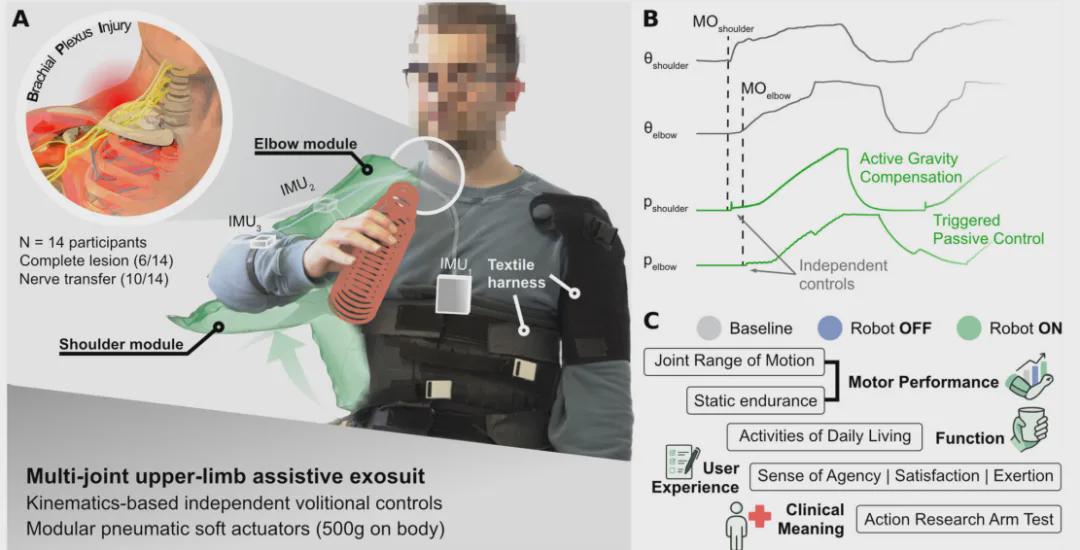
A team from the BioRobotics Institute of Scuola Superiore Sant'Anna, University of Turin, and CTO Hospital in Turin has developed a soft exosuit that significantly enhances arm mobility for patients with chronic brachial plexus injuries (BPI). The exosuit, weighing approximately 0.6 kg, was tested on 14 patients, resulting in an 80% to 180% increase in active range of motion and a 160% improvement in static endurance.
This advancement is crucial as BPI often leads to severe loss of sensation and motor control in the upper limb, primarily affecting young males under 30, with motorcycle accidents being the leading cause. The exosuit employs soft pneumatic actuators to assist shoulder and elbow movements, providing a novel solution that addresses the critical joint often overlooked in previous wearable robotics.
Future developments in this technology could further enhance rehabilitation for BPI patients. The study's findings indicate that the exosuit not only improves mobility but also reduces the effort required for movement, as evidenced by a significant decrease in muscle activity during use. No further timeline was disclosed at the time of publication.
Editor's Note
The development of soft exosuits represents a significant leap in assistive technology for rehabilitation, particularly for patients suffering from brachial plexus injuries. This innovation could reshape approaches to physical therapy and recovery, emphasizing the importance of addressing joint functionality in wearable robotics. As the demand for effective rehabilitation solutions grows, such advancements may attract increased investment and interest in the healthcare technology sector.




























Leave a comment