

Industry Briefing
A single destination for timely, editor-curated robotics news from around the world.

Shield AI and GE Aerospace Adapt 1990s Thrust-Vectoring Tech for X-BAT Drone's Vertical Flight
Shield AI and GE Aerospace have successfully integrated a 1990s thrust-vectoring technology, the Axisymmetric Vectoring Exhaust Nozzle (AVEN), with the GE F110-GE-129E engine for the X-BAT unmanned combat aircraft. This innovative approach allows the X-BAT to take off and land vertically without the need for a runway. The adaptation of AVEN, originally developed for improving fighter maneuverability, represents a significant advancement in controlling aircraft during vertical flight. Unlike traditional aircraft that rely on aerodynamic surfaces, the X-BAT's propulsion system becomes crucial for maintaining control during vertical operations, utilizing thrust vectoring to redirect engine exhaust. As Shield AI continues to develop the AI-piloted X-BAT, the integration of AVEN could enable operations from diverse locations, enhancing the aircraft's versatility. The teams have conducted extensive testing, including integration and engine light-off testing at GE Aerospace’s facility in Ohio. No further timeline was disclosed at the time of publication.
Military
Starmind's Satellite Technology Achieves 880 Billion Liters in Annual Water Savings
Starmind has announced that its satellite technology can save approximately 880 billion liters of cooling water annually at full scale. This figure is equivalent to the annual household water use of around 6.5 million Americans. The technology operates by utilizing a closed-loop liquid cooling system that eliminates the need for water during its operational life, contrasting sharply with traditional ground data centers that consume vast amounts of water for cooling. The significance of this achievement lies in the growing water consumption crisis faced by data centers, particularly as AI expansion drives demand. In 2025, U.S. data centers consumed nearly one trillion liters of water, highlighting the urgent need for sustainable solutions. Starmind's approach not only addresses direct water usage but also avoids indirect water consumption associated with electricity generation, marking a substantial shift in how computing can be conducted in a resource-efficient manner. Looking ahead, Starmind's deployment strategy includes a projected buildout of 100 GW of orbital compute per year, which could displace an additional 735 billion liters of ground water demand annually. The first tranche of 10,000 satellites is already operational, offsetting approximately 8.8 billion liters of water per year. No further timeline was disclosed at the time of publication.

SpaceX's Starmind Targets AI Labs with $6.3 Billion Compute Contracts
SpaceX's Starmind is designed to provide wholesale AI compute services to businesses, particularly AI labs and cloud customers, rather than individual consumers. The service operates similarly to AWS, where users benefit from applications running on Starmind without direct subscriptions. The compute capacity of a single AI1 satellite is comparable to one NVIDIA GB300 rack, emphasizing its enterprise-grade capabilities. The significance of Starmind lies in its positioning as a potential fourth hyperscaler, joining the ranks of AWS, Microsoft Azure, and Google Cloud. The Reflection AI contract, valued at $150 million per month, exemplifies the enterprise-focused model, with total payments potentially reaching $6.3 billion through 2029. This contract highlights the growing demand for AI compute resources, particularly from AI-native startups and labs. Looking ahead, the focus will remain on securing additional enterprise contracts as Starmind expands its offerings. No consumer-facing products or subscriptions have been announced, and the current strategy is to cater to businesses with substantial AI workloads. No further timeline was disclosed at the time of publication.
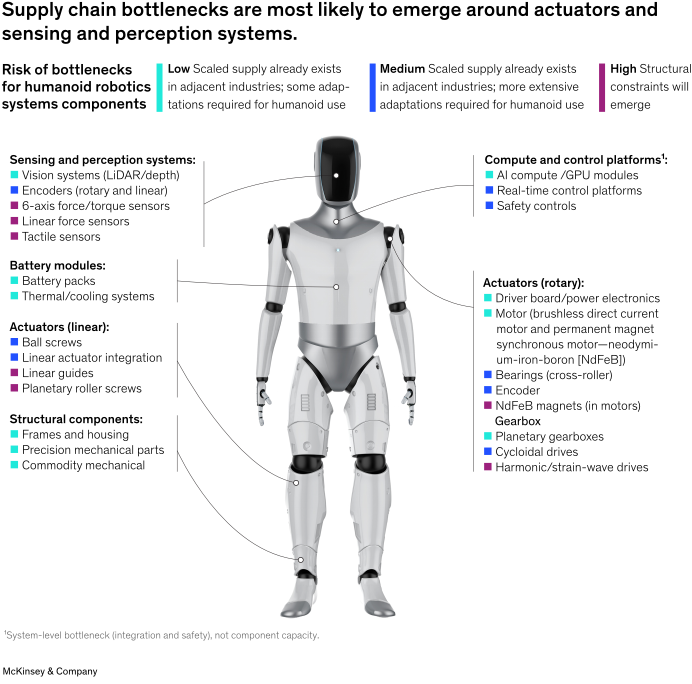
Morgan Stanley Sees Potential for China's Humanoid Robots to Mirror Electric Vehicle Success, McKinsey Offers Caution: Shift from Vertical Integration to Platformization
A recent report from Morgan Stanley indicates that China's humanoid robots may mirror the rapid growth seen in the electric vehicle sector, potentially enhancing the country's share of global exports. This development comes as China seeks to expand its technological footprint on the world stage. However, McKinsey has raised concerns about significant supply chain challenges that could hinder this progress. Despite China's strong manufacturing capabilities, the report highlights that the availability of essential components remains a critical obstacle. As the nation pushes forward in the robotics industry, addressing these supply chain issues will be crucial for realizing its ambitions in the global market.
Humanoid Robots Supply Chain Management Advanced Manufacturing AIRobotics needs a service framework.
RSF defines a common language for robot service capability, lifecycle operations, certification pathways, and service-provider networks.
Join the RobotToday community on LinkedIn
Daily robotics news, in-depth analysis, conference highlights, and discussions with professionals worldwide.







