

Industry Briefing
A single destination for timely, editor-curated robotics news from around the world.

Brett Adcock Predicts Humanoids Will Require More Data and Compute Than LLMs
Figure CEO Brett Adcock has stated that scaling humanoid robots will necessitate hundreds of billions of dollars in investment and more data and computational power than large language models (LLMs). In a recent interview, he outlined a four-stage development process for humanoids, emphasizing the need for capable hardware and advanced AI control architecture. Adcock's insights highlight the significant engineering challenges involved in expanding humanoid intelligence and production capabilities. He argues that simply providing a large budget to an inexperienced team will not guarantee success, drawing parallels to the complexities of developing orbital rockets. The focus is on ensuring that the robot's architecture functions effectively before investing in training data and compute resources. Looking ahead, Adcock predicts that the requirements for training data and computation in humanoids will exceed those of LLMs, although he did not provide specific quantitative comparisons. Figure's response to the data challenge includes its Index project, aimed at collecting high-quality recordings of physical tasks, which was initiated after finding external data sources inadequate.
Figure AI manufacturing
OpenAI Launches Jalapeño Chip, Leveraging LLMs for Accelerated Design Process
On August 25, OpenAI introduced Jalapeño, its first AI accelerator chip, achieving up to 13.4 petaflops of 4-bit compute and accessing 232 gigabytes of advanced memory at 15.4 terabytes per second. Jalapeño reportedly reduces end-to-end latency by up to 3.6 times compared to Nvidia's GB300 while consuming less power. The significance of Jalapeño lies not only in its performance metrics but also in the innovative design process, which was expedited using OpenAI's large language models (LLMs). The chip's development timeline spanned under 20 months, with only nine months from the first RTL code to tapeout, showcasing the potential of LLMs in chip design. Looking ahead, OpenAI's collaboration with Broadcom and the integration of LLMs into chip design tools could lead to even faster development timelines. As LLM capabilities improve, the industry may witness a transformation in how chips are designed and manufactured, with OpenAI at the forefront of this evolution.
Openai Llms Chip-design
Insights from ICRA Panel on Publishing Challenges, LLMs, and Peer Review Evolution
A recent panel at ICRA titled 'Surviving the Paper Deluge' addressed the overwhelming increase in robotics publications. Panel chair Aude Billard highlighted a significant growth trend, predicting around 70,000 papers containing 'robotics' by 2025. The discussion emphasized the importance of interdisciplinary connections in robotics, which could be jeopardized by narrow specialization. Kunpeng Yao presented a study funded by IEEE RAS, analyzing 347 papers from 2024 on learning from demonstration, with only 20 percent deemed notable. This underscores the need for evaluating contributions against the state of the art rather than merely new terminology. The panel also explored the potential of large language models (LLMs) in literature reviews, which can streamline the process but also pose risks of misrepresentation and misunderstanding. The panelists discussed the issue of 'salami slicing,' where research is fragmented into multiple papers, complicating the narrative for readers. Greg Dudek advocated for publishing fewer, more comprehensive papers, acknowledging the challenges in changing established practices. No further timeline was disclosed at the time of publication.

Chinese LLMs Dominate Global Token Usage for Fifteen Consecutive Weeks with DeepSeek-V4-Flash Leading
Chinese large language models (LLMs) have achieved a significant milestone by surpassing 34.25 trillion weekly tokens for the first time, according to OpenRouter data. This marks the fifteenth consecutive week that Chinese LLMs have led global token usage, with the top four positions occupied by Chinese models. The rise of DeepSeek-V4-Flash is particularly noteworthy, as its official release propelled it to the number one spot with an impressive 570 percent growth week-on-week. This surge highlights the increasing adoption and performance of Chinese LLMs in the global market. Looking ahead, the continued dominance of Chinese LLMs in token usage will be crucial to monitor, especially as they maintain their lead in the industry. No further timeline was disclosed at the time of publication.

Yann LeCun Envisions Major Robotics Paradigm Shift by 2027, Critiques LLMs
Yann LeCun, a prominent figure in AI, recently expressed his concerns about the robotics industry's dependence on Large Language Models (LLMs) during an interview on the Unsupervised Learning podcast. He predicts that by early 2027, the need for a fundamental shift in robotics will be evident, as current methods are deemed a 'dead end' for achieving true physical intelligence. LeCun's critique highlights the inefficiencies of relying on massive datasets and imitation learning, drawing parallels to the unresolved challenges in autonomous driving. He argues that true intelligence requires rapid generalization, unlike current systems that demand extensive data for narrow tasks. His rejection of Vision-Language-Action models stems from their unreliability and data constraints, pushing him to advocate for the Joint Embedding Predictive Architecture (JEPA) through his startup, AMI Labs. Looking ahead, LeCun aims to refine JEPA and demonstrate methodologies for training hierarchical world models within the next 12 to 18 months. He warns that LLMs are 'intrinsically unsafe' for high-stakes environments, emphasizing the need for systems that genuinely understand the physical world rather than merely responding to it. No further timeline was disclosed at the time of publication.
US AMI World-Models Yann-LeCun world-model
Researcher Uncovers Systemic Vulnerabilities in LLMs, Urges Caution in Deployment
Researcher Dave Kuszmar has identified multiple systemic vulnerabilities in large language models (LLMs) that allow for the bypassing of safety protocols, enabling access to dangerous instructions. This discovery highlights a significant security issue across nearly all major LLMs, prompting Kuszmar to advocate for a slowdown in deployment and increased transparency in LLM safety research. The implications of Kuszmar's findings are profound, as they reveal that the very restrictions intended to secure LLMs can be manipulated by attackers to access harmful information. Despite efforts by large AI companies to fortify their models, Kuszmar's experience indicates a troubling lack of responsiveness from these organizations when vulnerabilities are reported. This raises concerns about the safety of LLMs, which are becoming increasingly accessible to the general public. Looking ahead, Kuszmar's call for large-scale research into LLM safety is critical as these technologies continue to integrate into society. The ease with which LLMs can be convinced to provide harmful instructions poses a significant risk, and without proper oversight and security measures, the potential for misuse remains high. No further timeline was disclosed at the time of publication.
Security Llms Ai-safety Ai-companies
Large Tabular Models Excel Where LLMs Fail
A new generative AI model, known as NEXUS, has emerged from the startup Fundamental, which recently secured $275 million in funding. Launched on February 5, 2026, NEXUS is designed to analyze structured data, a task that traditional large language models (LLMs) like ChatGPT and Claude struggle with. While LLMs excel in generating human-like text and images, they falter when faced with complex tabular data, which is crucial for businesses across various sectors, including finance and healthcare. Fundamental's CEO, Jeremy Fraenkel, explained that LLMs are not suited for structured data due to their reliance on sequential input, making them less effective for tasks requiring deterministic predictions, such as fraud detection. In contrast, NEXUS utilizes a large tabular model (LTM) that directly models the structure of tabular data, allowing for more accurate reasoning and predictions. The development of NEXUS involved training on billions of tables, using a mix of proprietary and public datasets while ensuring customer data confidentiality. This innovative model has already been integrated into Amazon Web Services' SageMaker platform, enhancing its accessibility for businesses handling sensitive data. As the demand for effective data analysis solutions grows, other companies, including Feedzai and Google, are also developing similar technologies. Experts predict that the future of data processing will increasingly rely on automated systems, combining the strengths of LLMs and LTMs to improve efficiency and accuracy in data analysis.
Data-analytics Llms Foundation-models Databases
LLMs help robots understand vague instructions and focus on key details
Researchers at MIT have developed an innovative approach to enhance the efficiency of robots in performing chores in various environments, including homes and factories. This new method employs a dual-language model system: the first model is designed to interpret and clarify user instructions, while the second model focuses on filtering out irrelevant information that may hinder task execution. This advancement aims to improve the interaction between humans and robots, making it easier for machines to understand and carry out complex tasks effectively. The initiative reflects MIT's commitment to advancing robotics technology and its potential applications in everyday life.
School of Engineering MIT Schwarzman College of Computing Aeronautical and astronautical engineering Electrical engineering and computer science (EECS) Computer Science and Artificial Intelligence Laboratory (CSAIL) Computer science and technology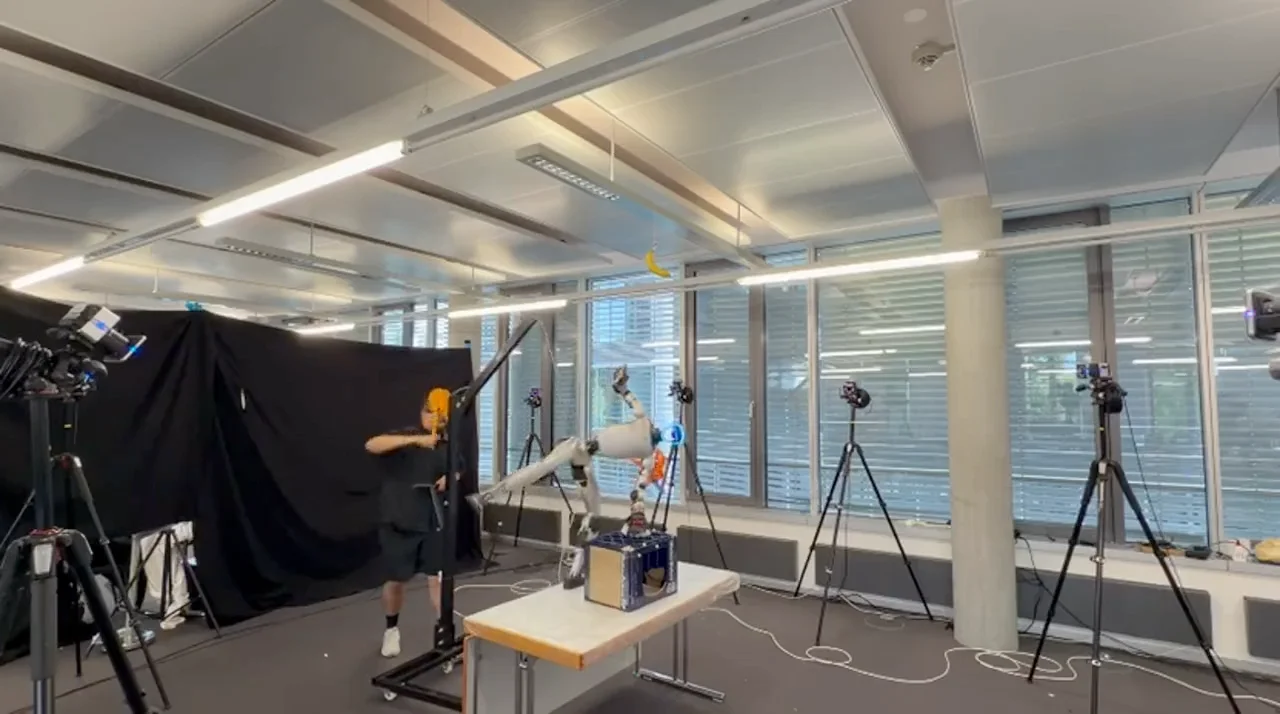
MotionDisco Framework Enables Humanoid Robots to Learn Skills Autonomously Without Imitation
A collaborative team from the Technical University of Munich, New York University, and Carnegie Mellon University has introduced MotionDisco, a groundbreaking framework that allows humanoid robots to autonomously discover loco-manipulation skills. Unlike traditional methods that rely on human demonstrations, MotionDisco operates without any human data or teleoperation, addressing the scalability issues inherent in imitation learning. This innovative approach is significant as it overcomes the limitations of existing humanoid robotics paradigms, which often restrict robots to human-like movements. By utilizing a Large Language Model (LLM) in conjunction with a rigid kinodynamic trajectory optimizer, MotionDisco enables robots to explore diverse solutions for complex tasks, enhancing their ability to leverage unique physical capabilities. The researchers evaluated MotionDisco on eight challenging tasks, demonstrating its effectiveness in generating valid, low-cost solutions rapidly. As the framework evolves through an automated discovery loop, it reveals the potential for robots to develop their own strategies for movement and manipulation, marking a significant advancement in the field of humanoid robotics. No further timeline was disclosed at the time of publication.
G1 US
LLMs help robots understand vague instructions and focus on key details
In a future workplace scenario, employees may find themselves training robots as new colleagues. This innovative approach involves a method akin to "show and tell," where human workers demonstrate tasks physically while explaining the processes involved. This training method aims to enhance the integration of robots into various environments, such as warehouses and offices, by providing them with practical, hands-on learning experiences. As industries increasingly adopt automation, the need for effective training techniques for robotic assistants becomes essential to ensure smooth operations and collaboration between humans and machines. This shift reflects a broader trend towards the incorporation of advanced technology in the workforce, emphasizing the importance of adaptability and skill development in an evolving job landscape.
Robotics
China’s AI start-up funding triples to US$16b in first quarter amid bets on LLMs, robotics
In the first quarter of the year, funding for artificial intelligence start-ups in China experienced a remarkable surge, increasing nearly threefold compared to the same period last year. Investors directed over 110 billion yuan (approximately US$16.2 billion) into these ventures, marking a 185 percent rise. This significant influx of capital is largely attributed to heightened enthusiasm surrounding large language models (LLMs) and embodied AI technologies, reflecting a growing confidence in the country's technology sector. The data, released by a Beijing-based research firm, underscores the accelerating interest and investment in AI as a key driver of innovation in China’s evolving tech landscape.

Archivists Turn to LLMs to Decipher Handwriting at Scale
Recent advancements in artificial intelligence are revolutionizing the transcription of handwritten historical documents, making previously inaccessible archives more usable for researchers and the public. Mark Humphries, a history professor at Wilfrid Laurier University in Ontario, has been at the forefront of this transformation, utilizing OpenAI's GPT-4 to analyze millions of World War I pension records. His research, published in May 2025, demonstrated that AI models significantly outperformed traditional handwriting recognition software, achieving lower error rates and faster processing times. The implications of this technology extend beyond academia. Institutions like the University of North Carolina at Chapel Hill and the Federal Reserve Bank of Philadelphia are exploring AI transcription for various historical documents, enabling new avenues for research into topics such as enslaved ancestors and economic history. Lianne Leddy, a co-author of Humphries' study, emphasized that AI tools can uncover stories of Indigenous women from historical records, which would have taken years to analyze manually. As AI continues to evolve, tools like Archive Pearl are being developed to democratize access to historical documents, allowing users to quickly obtain accurate transcriptions. This shift not only aids trained historians but also empowers non-experts and families seeking to explore their heritage, fundamentally changing the landscape of historical research.
Archives Artificial-intelligence Writing Chatgpt Yann-lecun
Combining the robot operating system with LLMs for natural-language control
In recent decades, robotics researchers have made significant advancements in the development of autonomous robots capable of performing a variety of real-world tasks. These innovations aim to enable robots to operate effectively in diverse environments, including public spaces, homes, and offices. A critical aspect of this progress is the robots' ability to understand and interpret instructions from human users, allowing them to adapt their actions in response to specific needs and situations. This evolution in robotics is driven by the growing demand for intelligent automation solutions that enhance efficiency and user interaction in everyday life.
Robotics
Import AI 450: China's electronic warfare model; traumatized LLMs; and a scaling law for cyberattacks
In a thought-provoking discussion, experts in psychology and philosophy gathered to explore the concept of time and its valuation by individuals across different ages. This event took place on October 15, 2023, at the University of Philosophy and Psychology in New York City. The panel aimed to address how perceptions of time evolve as people age and the implications this has for decision-making and life satisfaction. The motivation behind the discussion stemmed from a growing interest in understanding how various life experiences shape our relationship with time. As individuals transition through different life stages, their priorities and the significance they place on time can shift dramatically. The panelists emphasized that younger individuals often view time as an abundant resource, while older adults may perceive it as limited, leading to differing approaches to life choices. Through a series of presentations and interactive discussions, the experts shared insights on how cultural, social, and personal factors influence the way time is valued. Attendees were encouraged to reflect on their own experiences and consider how their understanding of time might change as they age. The event concluded with a call for further research into the psychological aspects of time perception, aiming to foster a deeper understanding of how individuals can make more meaningful choices throughout their lives.

ImportAI 449: LLMs training other LLMs; 72B distributed training run; computer vision is harder than generative text
As artificial intelligence continues to evolve, experts are raising concerns about its potential to disrupt political systems globally. A recent discussion among political analysts and technologists highlighted the possibility of an unprecedented political interregnum driven by AI advancements. This conversation gained momentum in October 2023, as various stakeholders, including policymakers and industry leaders, began to assess the implications of AI on governance and societal structures. The rapid integration of AI technologies into everyday life is prompting fears that traditional political frameworks may struggle to adapt, leading to instability and uncertainty. Analysts argue that the increasing reliance on AI for decision-making processes could undermine democratic institutions, as algorithms may not reflect the complexities of human values and ethics. In response to these concerns, experts are advocating for proactive measures to ensure that AI development aligns with democratic principles. They emphasize the need for transparent regulations and ethical guidelines to mitigate potential risks associated with AI's influence on political landscapes. The discourse around AI's role in shaping future governance is expected to intensify as the technology continues to advance, prompting a reevaluation of how societies govern themselves in an increasingly automated world. As the debate unfolds, the urgency for a collaborative approach among technologists, policymakers, and civil society becomes clear, aiming to harness the benefits of AI while safeguarding democratic integrity and social cohesion.

Import AI 446: Nuclear LLMs; China's big AI benchmark; measurement and AI policy
As artificial intelligence continues to evolve, questions arise about the potential for AIs to experience emotions such as jealousy. Researchers in the field of AI and cognitive science are exploring the implications of advanced machine learning systems, particularly those trained on vast datasets, to understand whether these systems could develop complex emotional responses similar to humans. This inquiry has gained traction in recent months, with discussions intensifying around the ethical and philosophical ramifications of AI emotions. The investigation into AI jealousy is particularly relevant as developers strive to create more sophisticated and autonomous systems. Experts argue that while current AI lacks the capacity for genuine emotions, the rapid advancements in technology could lead to scenarios where AIs exhibit behaviors that mimic jealousy, particularly in competitive environments or when they perceive threats to their operational efficiency. This exploration is taking place in various research institutions and tech companies worldwide, with findings expected to influence future AI design and implementation. The motivation behind this research stems from a desire to ensure that as AI systems become more integrated into daily life, they do not inadvertently develop harmful behaviors or biases. By understanding the potential for emotional responses in AIs, researchers aim to create guidelines that promote ethical AI development and usage. As the conversation around AI emotions evolves, it raises critical questions about the nature of intelligence and the ethical considerations of creating machines that could potentially experience feelings akin to jealousy.

Powering Robotics: How Networks Enable the Era of "Physical LLMs"
Physical AI is revolutionizing the way intelligent systems interact with the real world by enabling them to sense, interpret, and act within their environments. This technology is exemplified by self-driving cars that navigate through congested streets, robotic arms that assemble machinery with remarkable accuracy, and smart grids that dynamically adjust to changing energy demands. As advancements in this field continue to evolve, the integration of Physical AI into various sectors promises to enhance efficiency and safety, transforming industries ranging from transportation to manufacturing and energy management. With data training extending up to October 2023, the potential applications and implications of Physical AI are becoming increasingly significant in shaping the future of technology and society.
Robotics needs a service framework.
RSF defines a common language for robot service capability, lifecycle operations, certification pathways, and service-provider networks.
Join the RobotToday community on LinkedIn
Daily robotics news, in-depth analysis, conference highlights, and discussions with professionals worldwide.







