Industry Briefing
A single destination for timely, editor-curated robotics news from around the world.

Sav Secures $3.5 Million Pre-Series A Funding to Enhance AI Financial Platform for Expats
Sav, a fintech company based in the GCC, has successfully raised $3.5 million in Pre-Series A funding to enhance its AI-driven financial platform aimed at expatriates. This funding round was led by Phoenix Venture Partners, with contributions from various investors, bringing Sav's total funding to $5.5 million since its inception in 2022. The significance of this funding lies in Sav's mission to streamline the financial management of approximately 35 million expatriates in the GCC, whose finances are often fragmented across different countries and currencies. The platform leverages AI to provide personalized financial insights and recommendations, expanding its offerings beyond its original card product to include money intelligence and public-market investing. Looking ahead, Sav plans to utilize the new funding to launch a credit product and expand its services across the GCC and globally. The company has already attracted over 100,000 users and established partnerships with major entities like Visa and Emirates Gold, indicating strong market potential and growth opportunities in the financial technology sector.
AI Funding & Investment AI AI-driven platform capital markets funding Phoenix Venture Partners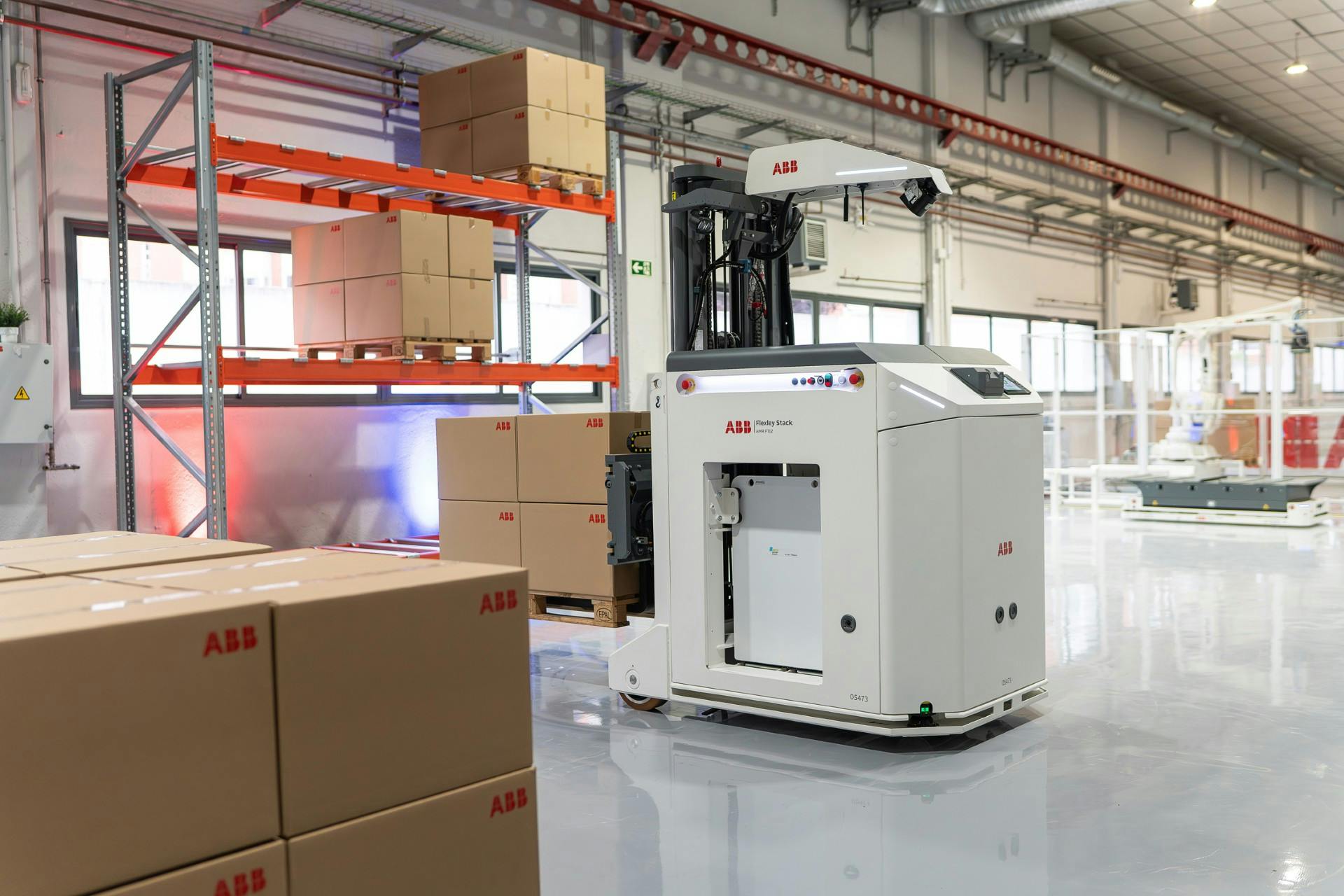
ABB Robotics Introduces Flexley Stack F712 Platform for AI-Driven Autonomous Forklifts
ABB Robotics has launched the Flexley Stack F712 platform, enhancing its AMR portfolio with AI-powered visual technology for autonomous forklifts. This innovation facilitates pallet transport and high-density storage, creating a cohesive ecosystem among ABB’s Visual SLAM AMR types, aimed at improving efficiency in material handling and warehouse operations across various industries, including automotive manufacturing. The introduction of the F712 is significant as it addresses the growing demand for faster and more flexible goods movement in intralogistics, particularly under constraints of limited labor availability. Marc Segura, president of ABB Robotics, emphasized the need for businesses to adapt to increased processing demands while leveraging advanced vision, mobility, and intelligence in their operations. Looking ahead, the Flexley Stack F712 can manage diverse load types and sizes, allowing customers to implement mixed fleets of Visual SLAM-powered vehicles on a unified navigation and fleet management platform. No further timeline was disclosed at the time of publication.
Factory / Analytics
KoiReader Technologies Introduces KoiVision Platform for Supply Chain Yard Automation
KoiReader Technologies, Inc. has announced the general availability of its KoiVision™ Platform Yard Intelligence Suite. This full-stack Physical AI system aims to enhance global supply chain yard operations by providing automated gate processing, continuous yard visibility, and dock-level execution intelligence. The introduction of the KoiVision Platform is significant as it targets one of the least digitized areas in the supply chain, potentially transforming yard operations. By integrating advanced technologies, KoiReader seeks to improve efficiency and visibility, which are critical for modern supply chain management. Looking ahead, industry stakeholders should monitor the adoption and impact of the KoiVision Platform in various supply chain environments. No further timeline was disclosed at the time of publication.

Vention Showcases Unified Platform Integrating Physical AI and Agentic AI at IMTS 2026
Vention is set to demonstrate its unified industrial automation platform at IMTS 2026, featuring both Physical AI and Agentic AI. The platform combines these two layers of intelligence to enhance robotics and machine operations, showcasing innovations such as the MachineAgent agentic cell. The significance of this development lies in its potential to streamline manufacturing processes through an interactive, end-to-end automated workflow. Attendees can witness live demonstrations of Physical AI capabilities, including Rapid Operator AI for deep bin picking and goal-driven collision-free path planning, which utilize advanced autonomous perception and robotic motion. Looking ahead, industry professionals should monitor how Vention's integration of these AI technologies influences manufacturing efficiency and automation trends. No further timeline was disclosed at the time of publication.
BitLyft Cybersecurity Unveils Agentic Managed Detection and Response Platform with AIR Engine
BitLyft Cybersecurity has officially launched the BitLyft Agentic Managed Detection and Response (AMDR) platform, which is powered by the company's autonomous security operations platform, BitLyft AIR®. This new offering enhances traditional security measures by not only providing quicker alert summaries but also by actively investigating, resolving, and documenting routine cases. The introduction of AMDR is significant as it allows experienced analysts to maintain control over critical decisions that require human judgment and contextual understanding. This approach aims to streamline security operations while ensuring that complex issues are handled by skilled professionals, thereby improving overall cybersecurity effectiveness. Looking ahead, the focus will be on how AMDR integrates with existing security frameworks and the impact it has on operational efficiency. No further timeline was disclosed at the time of publication.

Antioch Secures $32 Million in Series A Funding to Enhance Physical AI Simulation Platform
Antioch has successfully raised $32 million in Series A funding, led by Greylock, to advance its simulation platform tailored for robotics and autonomous systems. This funding will enable Antioch to enhance product development, hire additional engineering talent, and expand simulation capabilities across various physical AI applications, including drones and industrial automation. The significance of this funding lies in Antioch's innovative approach to high-fidelity simulations, which allows physical AI teams to build, test, and validate systems before deploying them in real-world scenarios. By calibrating simulations to customer hardware and leveraging cloud-scale processing, Antioch aims to overcome the limitations of existing simulation platforms, thereby accelerating the development cycle for autonomous systems. Looking ahead, Antioch is already collaborating with notable physical AI teams, including Amazon's Ring, and has established partnerships with Nvidia and cloud provider Nebius. The company, which previously raised $8.5 million in seed funding, is set to utilize this latest investment to further its mission of transforming physical AI testing and deployment through advanced simulation technologies. No further timeline was disclosed at the time of publication.
AI AI Funding & Investment Robotics A* Antioch Box Group
Bechtel and Cyberhawk Strengthen Partnership for AI-Driven Drone Monitoring in Construction
Bechtel Corporation and Cyberhawk have formalized an expanded collaboration focused on drone-based construction monitoring. This partnership aims to enhance the iHawk platform's capabilities for capturing, processing, and utilizing construction data across complex engineering, procurement, and construction (EPC) projects. The significance of this collaboration lies in its potential to provide near real-time site intelligence, which is crucial for scaling AI, robotics, and autonomous systems in construction environments. Since their initial partnership in 2018, the companies have worked together to integrate aerial data with the iHawk platform, facilitating data-driven project execution. Looking ahead, both companies are actively deploying and testing innovative approaches on live projects, emphasizing autonomous data capture and AI-assisted site analysis. No further timeline was disclosed at the time of publication.
Construction Drone News Drone News Feeds News AI construction artificial intelligence
Jaipur Robotics Secures €4.3M Seed Funding to Enhance AI Platform for Waste-to-Energy Operations
Jaipur Robotics has successfully raised €4.3 million in seed funding, led by EquityPitcher Ventures and High-Tech Gründerfonds, to enhance its AI and automation platform tailored for waste-to-energy plants. The company’s advanced computer-vision system processes over 5 million tons of waste each year and utilizes a dataset of more than 50 million labeled images to achieve a 99% accuracy rate in hazardous material detection. This funding round is significant as it will allow Jaipur Robotics to expand its operations into new regions and enhance its product offerings, thereby increasing its customer base across Europe. The company aims to revolutionize plant operations by leveraging data to improve safety, combustion efficiency, and crane automation, which are critical for modern waste management. Looking ahead, Jaipur Robotics plans to continue developing tools for hazard detection, waste mixing, and crane automation. The company is also in the process of hiring for various roles, including AI and engineering positions, to support its growth. No further timeline was disclosed at the time of publication.
AI AI Funding & Investment Robotics automation EquityPitcher Ventures Europe
Physical Superintelligence Secures $58 Million to Advance AI Physics Platform Development
Physical Superintelligence (PSI) has successfully raised $58 million in seed funding, led by Breakthrough Energy Ventures, to develop its AI-based physics platform named Emmy. This funding will enable PSI to recruit top talent and enhance its computational models aimed at optimizing data centers. The significance of this funding lies in PSI's ambition to revolutionize the discovery of new physics, particularly in optimizing terrestrial and orbital data centers. CEO Matt Pines emphasized that the initial focus on data centers will pave the way for tackling long-standing physics challenges, making advanced research more accessible. Looking ahead, PSI plans to utilize the funding for expanding its team of physicists and AI researchers, developing Emmy's capabilities, and exploring applications in energy and computing. No further timeline was disclosed at the time of publication.
AI Funding & Investment AI Breakthrough Energy Ventures capital markets funding funding round
Fugro Expands Singapore Innovation Hub with AI-Driven Marine Digital Twin Development
Fugro has announced the expansion of its innovation hub in Singapore by developing an AI-driven marine digital twin capability. This initiative is a significant milestone in Fugro's global growth strategy, enhancing Singapore's position as the Asia Pacific hub for marine Geo-data innovation. The new platform aims to help clients make quicker, more informed decisions regarding offshore and coastal developments. The AI-enabled platform will integrate various data types, including geophysical survey data and geotechnical site investigation results, into a unified digital analytics environment. By automating data integration and analysis, the platform seeks to improve efficiency and provide deeper insights from complex marine Geo-data. This advancement is expected to enhance decision-making for offshore projects, ultimately benefiting clients worldwide. Fugro anticipates creating new roles in Singapore focused on AI, data science, and digital engineering as the platform scales. The expansion reflects confidence in Singapore's R&D ecosystem and aims to deepen local capabilities in applying AI to marine developments. No further timeline was disclosed at the time of publication.
fugro innovation hub ai digital twin
Dronetag Integrates Remote ID into Airwise Platform for Enhanced Drone Operations
Dronetag and Airwise Solutions have formed a strategic partnership to integrate Dronetag's Remote ID infrastructure into Airwise's airwiseOS platform. This collaboration aims to provide a comprehensive view of low-altitude airspace, enhancing the safety and management of Beyond Visual Line of Sight (BVLOS) operations for various enterprise users, including public safety agencies and critical infrastructure operators. The integration allows operators to access real-time Remote ID data alongside telemetry and sensor inputs within a single dashboard, streamlining the monitoring process. This unified operational environment is particularly beneficial as drone fleets expand and more autonomous missions are conducted, enabling faster decision-making and improved coordination among teams. The integration is now available for Airwise customers using Dronetag transmitters or receivers. Dronetag, which operates the largest commercial drone detection network globally, aims to extend its Remote ID ecosystem into enterprise mission management, while Airwise seeks to support the next generation of autonomous aviation through a unified operational platform.
News
NVIDIA and MediaTek Strengthen Partnership for Advanced AI Edge to Cloud Platforms
NVIDIA and MediaTek have announced an expansion of their collaboration to develop next-generation AI computing platforms, focusing on AI infrastructure, local AI computing, and automotive applications. MediaTek will integrate NVIDIA's NVLink Fusion™ platform to facilitate the creation of custom XPUs for hyperscalers and cloud service providers. This partnership is significant as it combines NVIDIA's strengths in accelerated computing and AI software with MediaTek's expertise in custom silicon and power-efficient system-on-chip design. The collaboration aims to enhance the development of AI systems that can scale across various markets, as highlighted by NVIDIA CEO Jensen Huang. Looking ahead, the NVLink Fusion platform will serve as a foundation for customers to create custom AI accelerators, streamlining the transition from silicon to production-ready systems. No further timeline was disclosed at the time of publication.

MiniMax Reports 703% Revenue Growth in Enterprise AI and Open-Platform Services for H1 2026
Chinese AI company MiniMax announced a remarkable 703.1% increase in revenue from its open platform and enterprise AI services for the first half of 2026, reaching US$73.9 million. This segment now represents 63.4% of the company's total revenue, a significant rise from 30.3% in the same period last year. The surge in revenue is attributed to the growing demand for AI solutions, with revenue from AI-native products also seeing a substantial increase of 100.9% to US$42.6 million. Additionally, MiniMax's gross profit soared by 464.8% to US$20.8 million, highlighting the company's strong performance in the AI sector. Looking ahead, MiniMax's focus on expanding its enterprise AI and open-platform services could further enhance its market position. No further timeline was disclosed at the time of publication.
News Feed
Goodfire Launches Silico Platform to Enhance AI Interpretability and Research Access
Goodfire, an AI lab based in San Francisco, has made its Silico platform publicly available, aiming to improve AI interpretability. This initiative includes a $1 million grant program for academic and nonprofit researchers to utilize Silico's tools, which focus on mechanistic interpretability to understand AI models better. The significance of this development lies in its potential to democratize access to advanced interpretability techniques, previously limited to elite labs. By enabling researchers and startups to explore AI model behaviors, Goodfire seeks to foster safer and more powerful AI systems, addressing the urgent need for transparency in AI decision-making processes. Looking ahead, the widespread adoption of Silico could transform how AI models are developed and understood. As researchers like Cameron Berg leverage these tools to accelerate scientific inquiry, the implications for trust in AI and its applications across various fields could be profound. No further timeline was disclosed at the time of publication.
Ai-interpretability Ai Science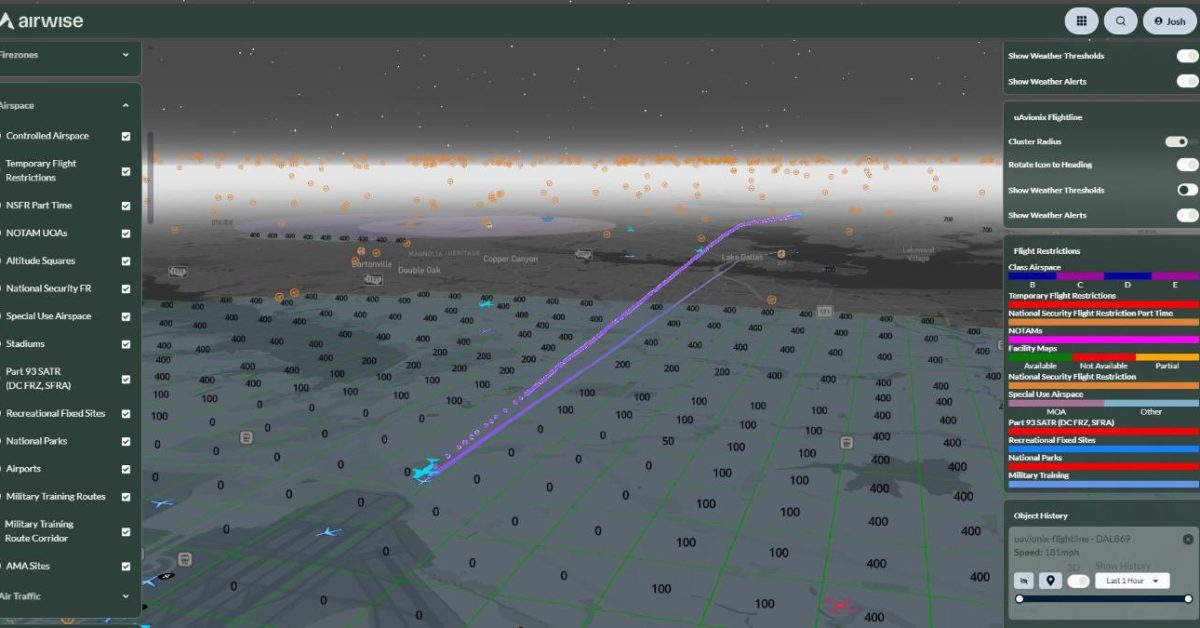
uAvionix and Airwise Solutions Integrate Real-Time Aircraft Tracking into Drone Platform
uAvionix and Airwise Solutions have partnered to enhance drone operations by integrating uAvionix's FlightLine surveillance service into the Airwise drone platform. This collaboration aims to improve safety in shared airspace by providing real-time visibility of cooperative aircraft, which is crucial for Beyond Visual Line of Sight (BVLOS) operations. The integration of FlightLine into Airwise's enterprise platform allows drone operators to access reliable airspace traffic data without the need for additional infrastructure. This development is significant as it supports safer and more scalable drone operations, particularly in complex environments where situational awareness is essential. As the demand for BVLOS operations grows, the partnership is expected to facilitate the deployment of Uncrewed Traffic Management (UTM) capabilities more efficiently. No further timeline was disclosed at the time of publication.
News
AI Enhances Software-Driven Automation by Reducing Operational Bottlenecks
Recent insights reveal that industrial automation is evolving beyond traditional definitions, which included PLCs, sensors, and robotics. Today, a significant challenge in manufacturing and engineering is not just physical bottlenecks but also delays caused by inefficient information workflows. Teams often wait for data to be manually rebuilt or reformatted, leading to operational inefficiencies. This shift in focus towards software-driven workflows highlights a critical opportunity for industrial organizations. While investments in physical automation have made machines faster and smarter, the surrounding workflows remain largely manual. The disconnect between various systems—such as engineering platforms and asset-management systems—creates unnecessary delays, as data handoffs often rely on human intervention. Going forward, organizations should prioritize connecting existing systems rather than seeking new software platforms. By addressing these software-driven bottlenecks, companies can unlock significant improvements in operational efficiency and streamline their processes. No further timeline was disclosed at the time of publication.
Factory / Sensors
Seeing Machines Introduces Physical AI Platform for Advanced Humanoid Robotics
Seeing Machines Limited has launched its Physical AI Platform, which aims to enhance humanoid robots by leveraging its expertise in human sensing technology. This new platform is designed to facilitate safe and intuitive interactions between humans and machines, building on the company's established leadership in the automotive sector. The introduction of the Physical AI Platform is significant as it represents a shift towards integrating advanced computer vision capabilities into robotics and industrial automation. By applying its Human-Centred AI design philosophy, Seeing Machines is poised to redefine how robots interact with humans, potentially improving safety and efficiency in various applications. Looking ahead, industry stakeholders should monitor the development and deployment of the Physical AI Platform, as it may set new standards for human-robot interaction. No further timeline was disclosed at the time of publication.

Mars Leverages 4flow’s AI Platform to Enhance Logistics Optimization
Mars is utilizing 4flow’s AI platform to optimize its logistics operations amidst ongoing supply chain challenges. The company faces pressures from disruptions, rising costs, and heightened service expectations, which necessitate a more integrated approach to decision-making. The importance of this initiative lies in addressing the fragmented systems and functional silos that hinder effective supply chain management. Despite significant investments in digitalization and AI, many organizations, including Mars, struggle with reactive execution rather than proactive strategies. Looking ahead, it will be crucial to monitor how Mars's implementation of 4flow’s AI platform impacts its logistics efficiency and overall supply chain resilience. No further timeline was disclosed at the time of publication.

Data-Driven Review of Hexapod Locomotion on Various Terrains: Modeling and Control Insights
A recent review published in the Journal of Field Robotics examines hexapod locomotion across both structured and unstructured terrains. The study highlights advancements in modeling, control strategies, and validation techniques for hexapod robots, providing a comprehensive overview of current methodologies. This review is significant as it consolidates various approaches to hexapod locomotion, emphasizing the importance of adapting to different terrain types. Understanding these locomotion strategies is crucial for enhancing the performance and versatility of hexapod robots in real-world applications. Looking ahead, researchers and developers in the field should monitor ongoing advancements in hexapod locomotion technologies and their potential applications in diverse environments. No further timeline was disclosed at the time of publication.
SURVEY ARTICLE
Celona Introduces Orion, a Unified Wireless Platform for Physical AI and Robotics
Celona has unveiled Celona Orion, a unified agentic wireless platform that integrates private 5G, Wi-Fi, public cellular, and satellite communications into a single network fabric. This innovative platform is designed to meet the connectivity needs of physical AI applications, including autonomous vehicles (AVs) and autonomous mobile robots (AMRs). The launch of Orion signifies a transition from traditional device-centric networks to a more intelligent, multi-network architecture tailored for automated enterprise operations. By offering private 5G and Wi-Fi 7 access points under a single subscription model, Celona aims to simplify infrastructure management for robotics manufacturers, enabling them to provide enhanced connectivity solutions for their clients. Looking ahead, Celona Orion's key innovation lies in its control-plane and data-plane convergence, allowing seamless network transitions for robots. This capability, along with built-in security features, positions Orion as a significant advancement in the robotics connectivity landscape. No further timeline was disclosed at the time of publication.
6-Axis Artificial Intelligence Autonomous Mobile Robots (AMRs) Networking / Connectivity News Self-Driving Vehicles
Emerson Unveils DeltaV Automation Platform for AI-Scale Data Center Management
Emerson has introduced its DeltaV Automation Platform for Data Centers, which features an automation portfolio tailored for AI-scale data centers. This platform integrates thermal, mechanical, and electrical subsystems within a scalable architecture, enhancing the monitoring and control of data center infrastructure. The significance of this development lies in its ability to reduce engineering efforts, simplify integration, and improve consistency across commissioning, operations, and maintenance. Nathan Pettus, president of Emerson’s process systems and solutions business, emphasized that data center performance is increasingly reliant on the collaboration of critical systems rather than individual components. Looking ahead, the DeltaV Automation Platform aims to provide operators with unified visibility and coordinated control, enabling predictable project commissioning and reliable large-scale operations. Emerson's platform includes the DeltaV distributed control system and DeltaV programmable logic controllers, both of which leverage AI technologies for enhanced integration of optimization models.
Factory / Analytics
Avnet and Weston Robot Collaborate to Launch AI-Powered Autonomous Inspection Platform
Avnet and Weston Robot have partnered to develop an AI-powered autonomous inspection platform designed for complex industrial environments. This platform utilizes quadruped robots equipped with advanced computing architecture to perform real-time inspections, enhancing operational efficiency and safety. The significance of this collaboration lies in its potential to revolutionize inspection processes in industrial settings. By integrating edge AI with robotics, the platform allows for low-latency AI inference and real-time data processing, which can lead to earlier detection of operational issues and reduced inspection costs. Looking ahead, the partnership aims to expand the capabilities of the inspection platform by integrating it with Weston’s fleet management software. This will enable the robot to autonomously patrol and inspect designated areas, further enhancing operational resilience and safety in industrial operations. No further timeline was disclosed at the time of publication.
Artificial Intelligence Artificial Intelligence / Cognition Autonomous Mobile Robots (AMRs) Design / Development News Robots / Platforms
Yusen Logistics Collaborates with Destro to Implement AI-Driven Human-Robot Collaboration in Transload Operations
Yusen Logistics (Americas) Inc. has formed a strategic partnership with Destro AI to deploy an AI-powered human-robot collaboration platform aimed at enhancing transload operations. This initiative is part of Yusen's commitment to investing in intelligent warehouse technologies that boost operational efficiency and execution consistency. The collaboration with Destro is significant as it represents a step forward in integrating advanced AI solutions within logistics operations. By leveraging Destro's Physical AI platform, Yusen aims to streamline processes and provide increased value to its customers, reflecting a broader trend in the logistics industry towards automation and technological innovation. Looking ahead, the focus will be on the effectiveness of this deployment and its impact on Yusen's operational metrics. No further timeline was disclosed at the time of publication.

Five Key Physical AI Infrastructure Platforms Influencing Robotics by 2026
The article discusses five significant platforms that are shaping the physical AI infrastructure stack, essential for robotics development by 2026. These platforms address critical bottlenecks and provide reusable infrastructure for various robotics developers, moving beyond traditional computing capacity to encompass simulation, validation, and continuous learning. NVIDIA is highlighted as the foundational company in this space, with its Isaac platform offering a comprehensive ecosystem for robot development, simulation, and training. Its ability to integrate computation, world generation, and model training positions it as a pivotal player in the physical AI landscape, raising questions about the openness of its ecosystem as it expands. Applied Intuition is noted for its end-to-end platform that validates autonomous machines across diverse operating conditions. Its focus on simulation and evaluation is crucial for sectors like automotive and defense. Observers should watch how its strengths in autonomous mobility may translate to other areas of robotics, particularly in manipulation and humanoid tasks, where challenges differ significantly from navigation.
Artificial Intelligence Artificial Intelligence / Cognition Sponsored Content Lightwheel sponsored
SoftBank and NTT Collaborate on Cross-Industry AI and Data Sharing Platform in Japan
SoftBank Corp. and NTT are spearheading a collaborative effort involving numerous Japanese companies and research groups to develop a cross-industry platform for artificial intelligence and data sharing across Japan. This initiative aims to enhance the infrastructure necessary for AI-powered data integration, positioning Japan to compete with leading nations in AI technology. The collaboration is significant as it seeks to address Japan's ambition to strengthen its presence in the global AI landscape, particularly against competitors like the US and China. By fostering a nationwide data-sharing ecosystem, the initiative could unlock new opportunities for innovation and efficiency in various sectors, thereby enhancing Japan's technological capabilities. Looking ahead, stakeholders will be keen to observe the progress of this initiative and its impact on Japan's AI landscape. No further timeline was disclosed at the time of publication.

Sapphire Technology Introduces EDGE+ Apex Robotics Platform Powered by AMD Ryzen AI Processors
Sapphire Technology has launched the EDGE+ Apex System-on-Module (SOM) and Carrier Robotics Platform, which is powered by AMD Ryzen AI Embedded X100 Series processors. This production-ready hardware platform is designed to enhance the development and deployment of physical AI in autonomous robotics, showcased at AMD Advancing AI 2026 in San Francisco. The EDGE+ Apex platform is engineered for rugged, always-on robotics applications, featuring a COM-HPC module with up to 128GB of LPDDR5x memory. It combines CPU, GPU, and NPU acceleration to support real-time perception and autonomous decision-making, making it suitable for demanding edge AI deployments. Sumit Shah from AMD emphasized that this platform unifies AI and industrial reliability, enabling the next generation of autonomous systems. Developers can leverage an open software ecosystem with familiar AI frameworks while utilizing AMD ROCm and Ryzen AI software. Paul Smith from Sapphire noted that the EDGE+ Apex aims to provide a complete foundation for robotics builders, facilitating a faster transition from prototype to production in challenging environments. No further timeline was disclosed at the time of publication.
Computing Robotics ai at the edge amd amd ryzen ai embedded x100 amd ultrascale+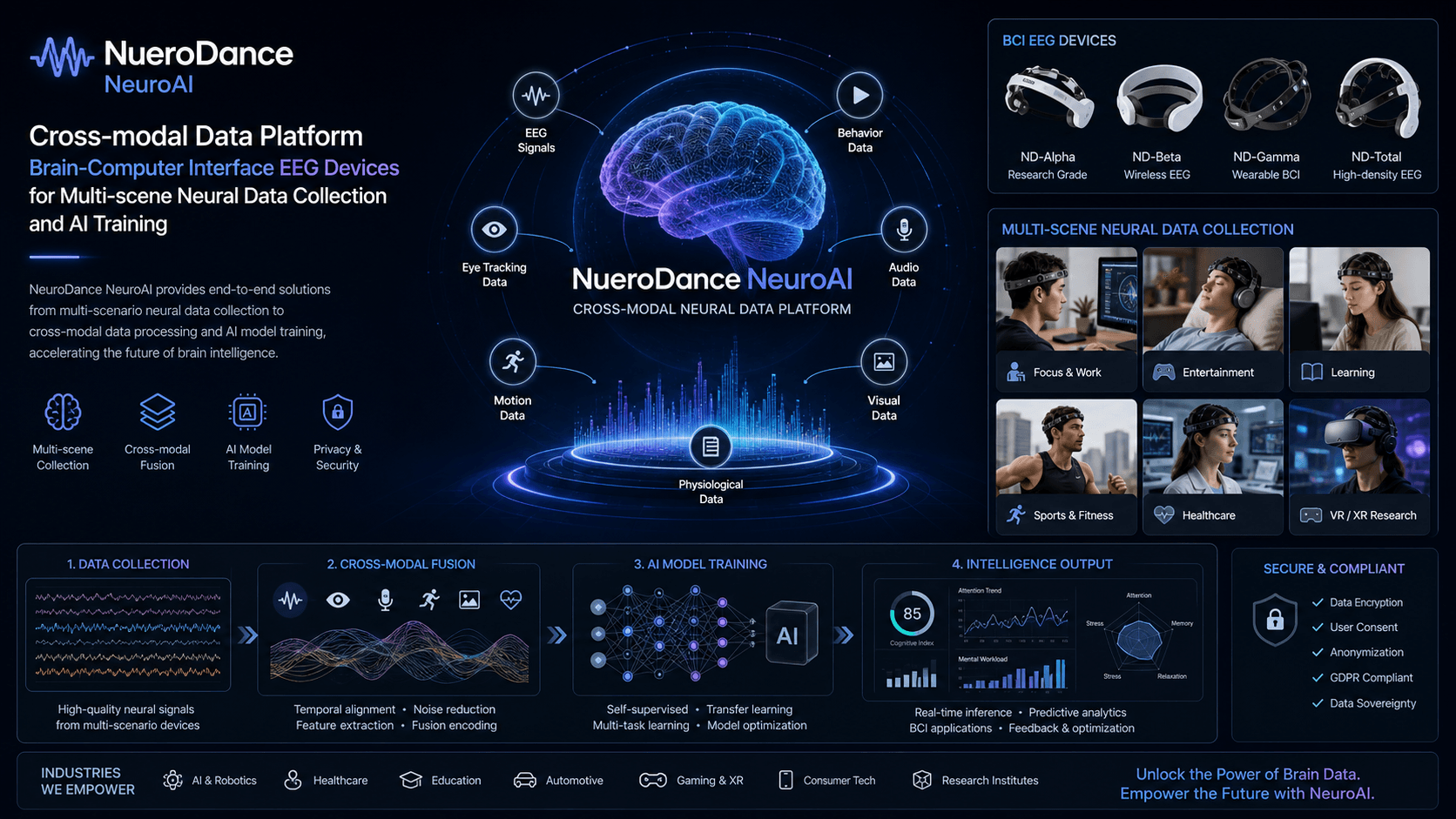
NueroDance Introduces ND1000 and ND8 EEG Devices Alongside NeuroAI Data Platform
NueroDance has launched its ND1000 and ND8 series EEG devices, along with the NeuroAI group cross-modal data platform, during an event in Beijing. This initiative aims to establish a neural data infrastructure that extends the capabilities of AI beyond traditional text and image processing. The introduction of these EEG devices and the NeuroAI platform signifies a strategic move by NueroDance to position itself at the forefront of the evolving AI landscape. By focusing on cross-modal data, the company seeks to unlock new applications and insights from neural data, potentially transforming how AI systems interact with human cognitive processes. As the demand for advanced AI solutions grows, the development of a robust neural data infrastructure will be crucial. Observers should watch for how NueroDance's offerings will influence the AI sector and whether they can successfully integrate brain-computer hardware with multi-scene neural data applications. No further timeline was disclosed at the time of publication.
Technology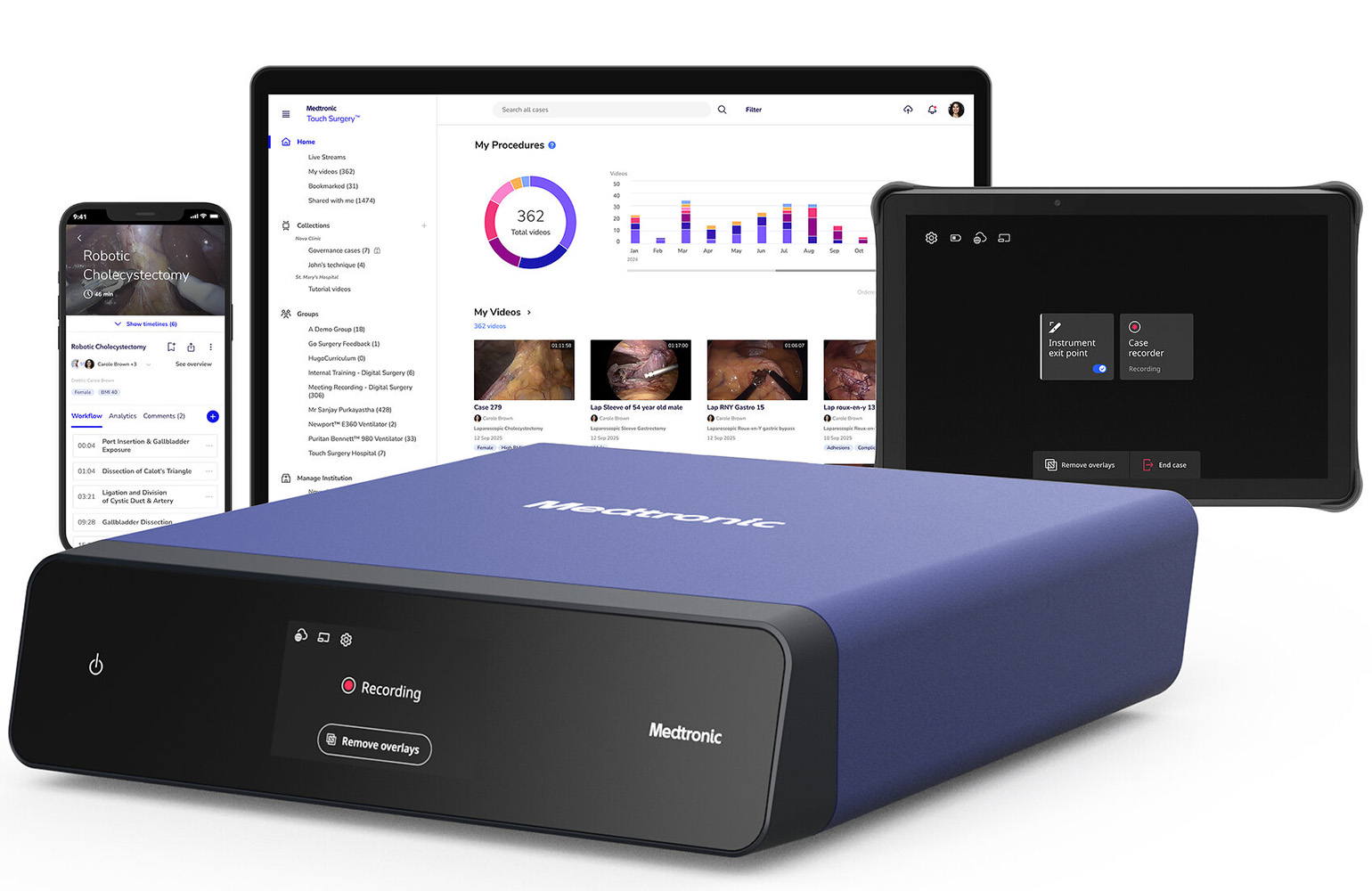
Medtronic Unveils AI Compute Platform Touch Surgery Aide for Operating Rooms
Medtronic PLC recently introduced its AI-powered compute platform, Touch Surgery Aide, designed for the operating room. This platform enhances the Touch Surgery Ecosystem by connecting pre-operative planning, intra-operative support, and post-operative insights, thereby simplifying surgical workflows and expanding access beyond individual operating rooms. The significance of Touch Surgery Aide lies in its ability to provide real-time AI-driven support during surgeries, offering actionable insights that enhance clinical decision-making. According to Jim Peichel, Medtronic's chief technology officer, this platform represents a fundamental evolution in surgical support, enabling teams to work more efficiently and effectively. Touch Surgery Aide will be showcased at the Society of Robotic Surgery (SRS) 2026 Annual Meeting in Hollywood, Florida. The platform incorporates NVIDIA's advanced computing technologies and is designed to support future expansion into laparoscopic surgery, with the Instrument Exit Point (IEP) application already receiving FDA clearance for use with the Hugo robotic-assisted surgery system.
Artificial Intelligence Artificial Intelligence / Cognition Design / Development Healthcare Robotics Markets / Industries News
Medtronic Unveils Real-Time AI Platform for Hugo Surgical Robots to Rival Da Vinci
On July 21, Medtronic announced the development of a real-time AI computing platform, the Touch Surgery assistance platform, for its Hugo surgical robot. This platform integrates NVIDIA's computing infrastructure and runs Medtronic's FDA-approved AI application, Instrument Exit Point (IEP), which alerts surgeons when instruments are at risk of going out of view during procedures. This advancement is significant as it redefines safety boundaries in surgical procedures, allowing for enhanced real-time monitoring and decision-making. Medtronic's Chief Technology Officer, Jim Pecher, emphasized that real-time AI represents a fundamental evolution in surgical support, shifting from merely assisting surgeons to enabling smarter, faster actions that have a greater impact. Looking ahead, Medtronic plans to showcase the Touch Surgery platform at the upcoming robotic surgery conference in Florida. While IEP currently offers basic functionality, the company aims to expand its capabilities into laparoscopic surgery and integrate additional AI applications, marking a pivotal step towards cognitive assistance in surgical robotics.
Surgical Robots AI in Healthcare Robotic Surgery Medical Technology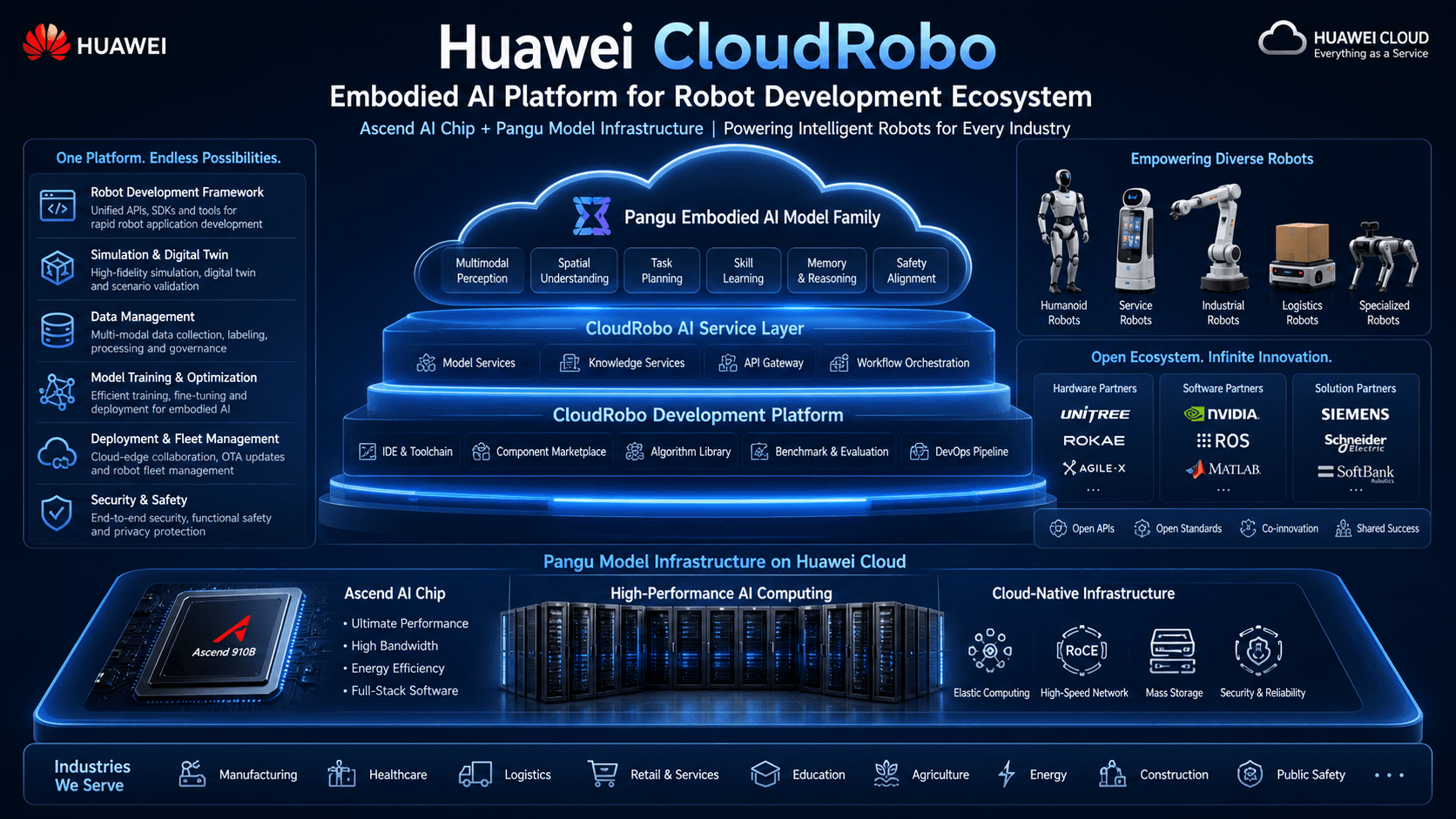
Huawei Launches CloudRobo, a Comprehensive Embodied AI Development Platform
Huawei Cloud has introduced CloudRobo, a comprehensive platform for embodied AI development that encompasses data production, model development, simulation, and robot deployment. This initiative is supported by partnerships with over 20 companies, including Youibot. The launch of CloudRobo is significant as it marks Huawei's entry into the embodied AI sector, potentially replicating the success seen with its SERES smart car initiative. By providing a full-stack solution, Huawei aims to streamline the development process for companies venturing into AI-driven robotics. Looking ahead, industry observers will be keen to see how CloudRobo evolves and whether it can achieve similar milestones as Huawei's previous ventures. No further timeline was disclosed at the time of publication.
Technology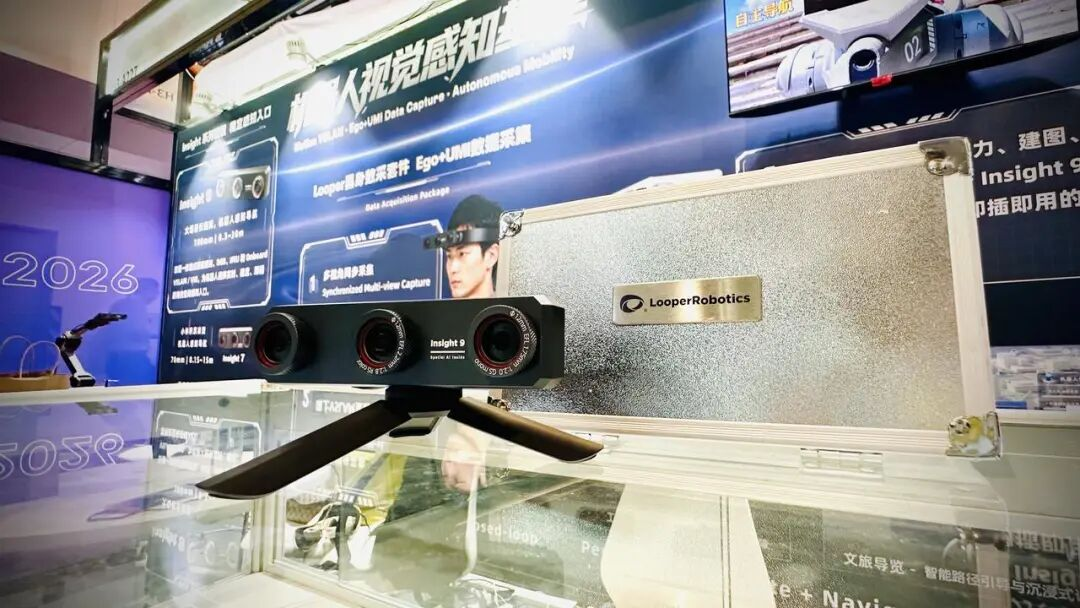
WAIC Highlights Embodied Intelligence with Data-Driven Innovations and New Players
Embodied intelligence emerged as a leading focus at this year's WAIC, attracting significant attention at the Expo Center. Numerous familiar companies showcased their production lines and scenarios, while new entrants like Guanglun Intelligent and Wuwen Zhike displayed data streams and algorithm demonstrations, drawing industry professionals eager to address data challenges. The shift in competition from 'building bodies' to 'establishing foundations' emphasizes the critical role of data in embodied intelligence. However, the industry faces a substantial bottleneck due to a lack of high-quality data. Chen Yilun, founder of Shizhi Hang, highlighted that at least 10 million hours of qualified data is needed for embodied operations, ten times that required for autonomous driving, with only about 500,000 hours available globally by early 2026. Looking ahead, the demand for data is projected to increase dramatically, with companies like Guanglun Intelligent leading the charge. The company, founded in 2023, aims to scale data collection and has already achieved a valuation exceeding 15 billion yuan. As the industry evolves, the need for effective data solutions will continue to create opportunities for innovation and growth.
Data Collection Embodied Intelligence AI Technology Robotics Data Analytics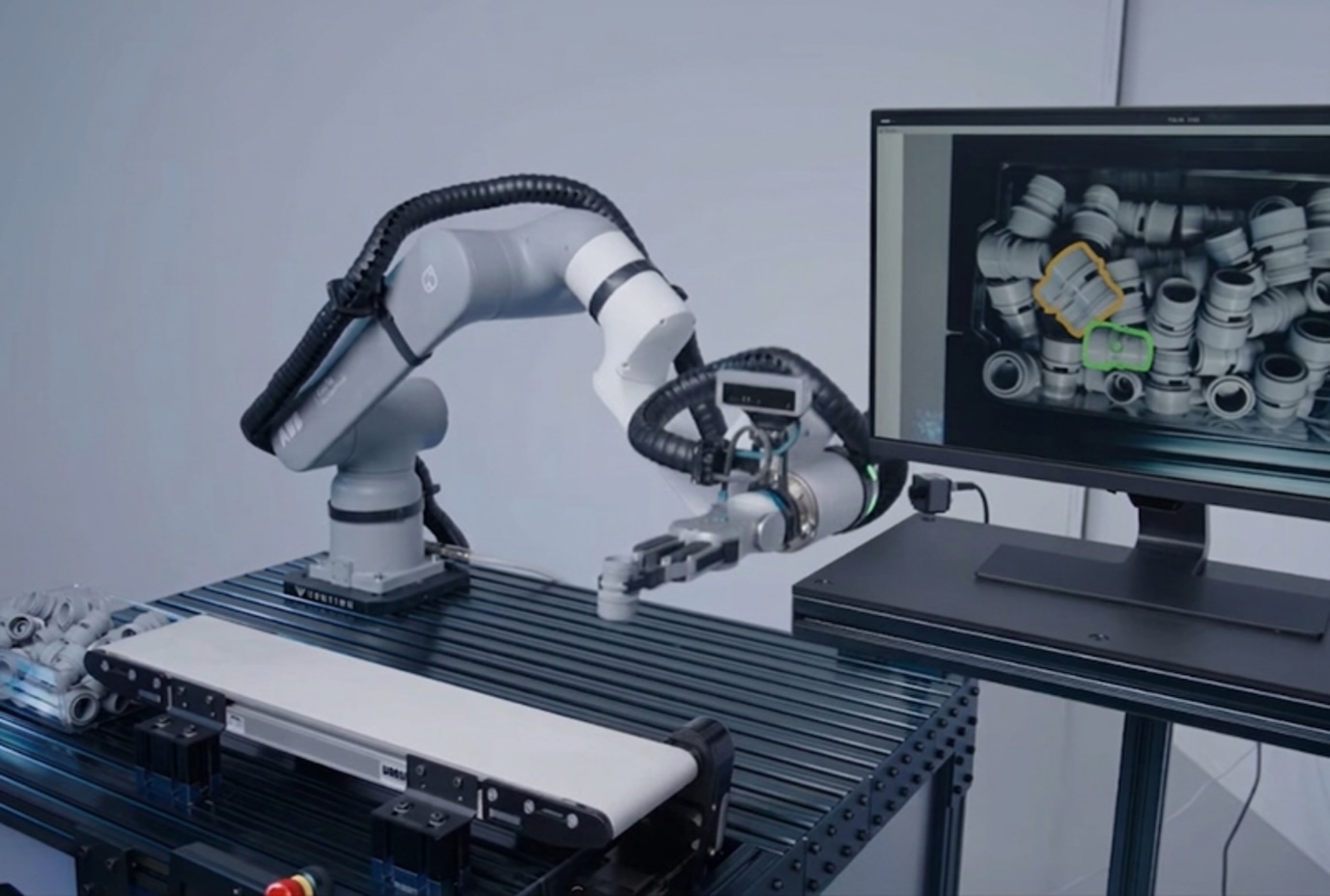
IAI Introduces Ellyon, Advanced Electronic Attack and Intelligence Gathering Platform
Israel Aerospace Industries (IAI) has unveiled Ellyon, a next-generation platform designed for electronic attack and intelligence gathering. This innovative system is said to represent a significant technological advancement, integrating stand-off operations with enhanced capabilities to sense, understand, and influence the electromagnetic battlespace. The introduction of Ellyon is crucial as it addresses the evolving demands of modern warfare, where electronic warfare plays a pivotal role. According to Dror Bar, CEO of IAI subsidiary Elta Systems, this platform enhances operational effectiveness by providing comprehensive situational awareness and control over the electromagnetic spectrum. Looking ahead, the defense sector will likely monitor the deployment and operational integration of Ellyon closely. As military strategies increasingly rely on advanced electronic capabilities, further developments in this area may emerge. No further timeline was disclosed at the time of publication.
Air Warfare Global Networks & Digital Warfare Air Force cyber security Drones
Applied Intuition Unveils Dana, an Innovative Platform for Physical AI Development
Applied Intuition, Inc. has launched Dana, the first agentic platform designed for the development, testing, deployment, and operation of physical AI systems across various industries. This platform integrates agentic AI capabilities with nearly a decade of Applied Intuition's expertise in tooling, data, and infrastructure. The introduction of Dana is significant as it aims to expedite the safe development of intelligent machines that operate in the physical world. By leveraging Applied Intuition's extensive engineering knowledge, Dana provides a unified system that enhances the efficiency of creating advanced AI solutions. Looking ahead, the industry will be keen to observe how Dana influences the landscape of physical AI development and its adoption across different sectors. No further timeline was disclosed at the time of publication.
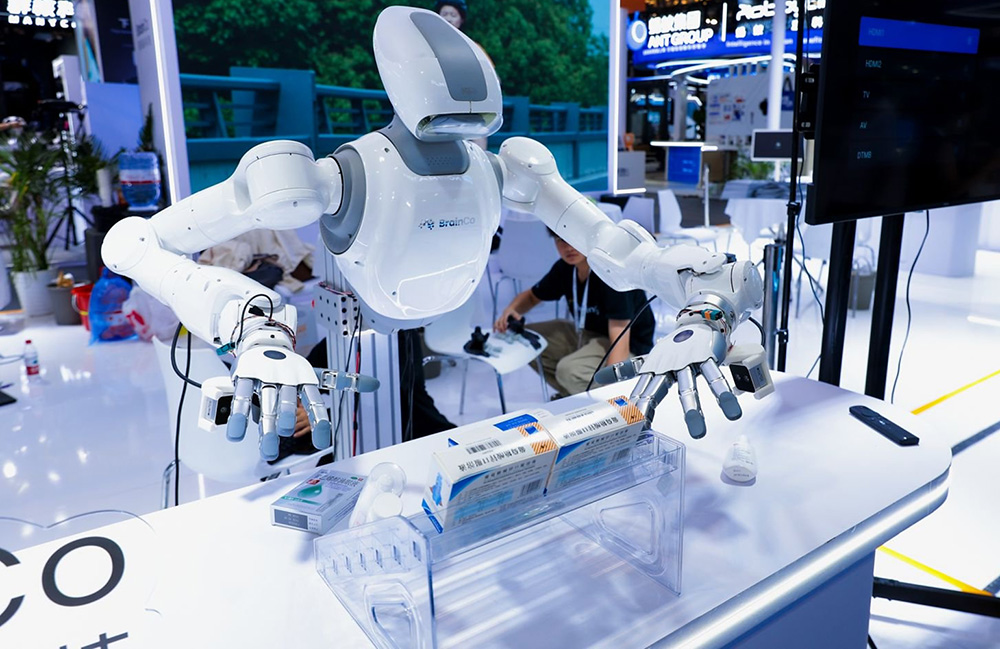
BrainCo Unveils Brain-Controlled Robot AI Platform at 2026 WAIC
BrainCo showcased its innovative brain-controlled robot AI platform at the 2026 World Artificial Intelligence Conference. Users can direct a robotic arm using neural signals captured by a lightweight EEG headset, enabling actions like grasping objects with precision. This technology, developed over a decade, integrates brain-computer interfaces and AI to enhance human-machine collaboration. The significance of this platform lies in its ability to decode user intent and translate it into machine actions in under 200 milliseconds. BrainCo's approach, termed 'neuro-embodied-AI,' allows for compatibility with various commercially available robots, facilitating integration into existing research and development frameworks without the need for proprietary hardware. Looking ahead, BrainCo also introduced its Embodied AI Data Collection Solution, addressing the challenge of obtaining high-quality training data for complex robotic tasks. This system captures both human actions and EEG data, providing a comprehensive dataset for training robots in dexterous tasks. No further timeline was disclosed at the time of publication.
Arms / Manipulators Artificial Intelligence Artificial Intelligence / Cognition Design / Development Healthcare Robotics Human Robot Interaction / Haptics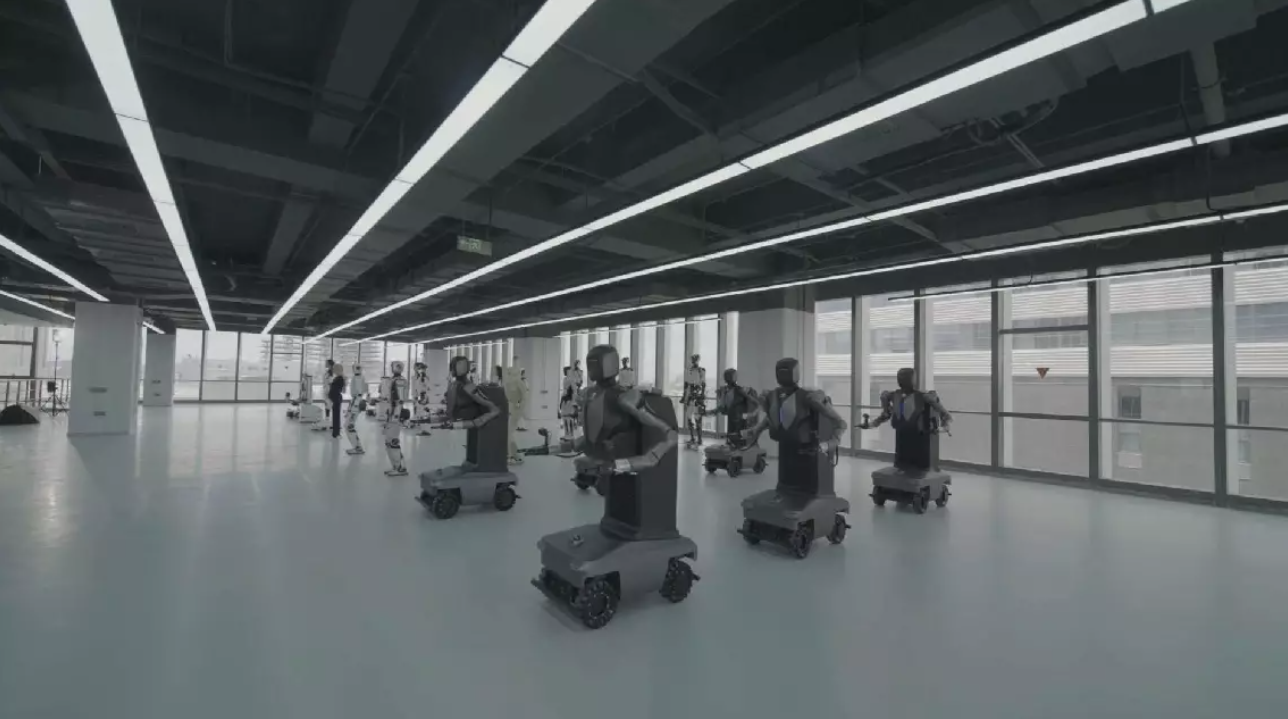
Shanghai Unveils Testing Platform for Humanoid Robot Mass Production
On July 18, during the 2026 World Artificial Intelligence Conference (WAIC), Shanghai launched a humanoid robot testing platform in the Zhangjiang Robot Valley of Pudong. This 6,800 square meter facility aims to bridge the gap between research and mass production, addressing the challenges faced by humanoid robots transitioning from lab to market. The platform features two modular flexible production lines capable of accommodating various robot configurations, with an annual production capacity of 2,000 units. Additionally, it includes a precision component assembly line and a dedicated testing area equipped with advanced testing equipment, enabling comprehensive performance validation of over 400 components and complete robots. Operated by a collaborative humanoid robot innovation center, the platform supports small and medium-sized enterprises with process transformation and production line optimization. It also offers financial incentives and collaborates with over 480 suppliers to develop industry standards, facilitating the rapid integration of humanoid robots into various sectors, including homes and supermarkets.
Humanoid Robots Mass Production Robotics Testing AI Development
Humanoid Robots Enter Rapid Scaling Phase at WAIC with New Dual-Core Platform
During the 2026 World Artificial Intelligence Conference, a forum on humanoid robots and embodied intelligence was held in Shanghai. This event marked a significant milestone as it showcased the first national training site for embodied intelligence, alongside strategic partnerships in six major scenarios and eight industry chains. The forum highlighted the transition of domestic humanoid robot technology from research to large-scale production. The importance of this development lies in its potential to enhance the industrial landscape in Shanghai, with the city leveraging its resources in the Zhangjiang Robot Valley and Zhangjiang AI Innovation Town. The local government emphasized the need for standardization and a comprehensive service system to support high-quality industrial growth. The conference underscored the rapid advancements in embodied intelligence, which is now a key focus area for China's technological development. Looking ahead, the National and Local Joint Innovation Center for Humanoid Robots aims to scale production significantly, targeting an annual output of 2,000 humanoid robot modules across various sectors, including public welfare and automotive. No further timeline was disclosed at the time of publication.
Humanoid Robots Embodied Intelligence AI Innovation Industrial Automation
BrainCo Launches Innovative Brain-to-Robot Platform for Thought-Controlled Machines
BrainCo has introduced a groundbreaking 'brain-to-robot' platform at the World Artificial Intelligence Conference in Shanghai. This system enables users to control robots solely through brain signals, utilizing a non-invasive brain-computer interface (BCI) that interprets electrical signals from the brain via an EEG headset. This development is significant as it addresses a major challenge in robotics: understanding human intentions. Nyx He, senior vice-president of BrainCo, emphasized that while robots have advanced in autonomous actions, the next frontier is enhancing their ability to comprehend human commands. The platform also aims to generate high-quality training data essential for training intelligent machines. Looking ahead, BrainCo's platform is compatible with various third-party hardware, including humanoid robots and robotic arms. The potential for this technology extends beyond mere control, as it could significantly improve the training processes for future robots, addressing the critical need for real-world interaction data in embodied AI applications. No further timeline was disclosed at the time of publication.
AI and Robotics Innovation
BrainCo Unveils First Brain-to-Robot AI R&D Platform at WAIC 2026
BrainCo, a brain-computer interface company, introduced the world's first integrated brain-to-robot AI research and development platform at the WAIC 2026 in Shanghai. This groundbreaking technology enables humans to control robots solely through neural signals, addressing a significant challenge in the robotics sector. The introduction of this platform is crucial as it targets a persistent issue in the robotics industry: the lack of high-quality training data. By leveraging neural signals for robot control, BrainCo aims to enhance the efficiency and effectiveness of robotic systems, potentially transforming how robots are trained and utilized. Looking ahead, industry observers will be keen to see how this innovative platform impacts the robotics landscape and whether it can successfully mitigate the training data shortage. No further timeline was disclosed at the time of publication.

BrainCo Launches Innovative Brain-Controlled Robot Platform at World AI Conference in China
BrainCo, based in Hangzhou, has introduced a groundbreaking robot platform that allows users to control robots using only their thoughts through EEG headsets. This advancement signifies a major step forward in embodied AI technology, where artificial intelligence is integrated into physical machines, enabling them to interact with the real world. The significance of this development lies in its potential to revolutionize human-robot interaction. By utilizing electroencephalogram (EEG) headsets, BrainCo's platform captures brain signals and employs AI algorithms to decode these signals, translating user intentions into robotic actions. This capability could enhance various applications across industries, making robots more intuitive and responsive to human commands. Looking ahead, the platform's compatibility with diverse third-party hardware, including humanoid robots and robotic arms, suggests a wide range of potential use cases. As the competition among global technology firms intensifies in the realm of embodied AI, BrainCo's innovation will be crucial to monitor for its impact on the future of robotics and AI integration. No further timeline was disclosed at the time of publication.

Tombot's AI-Driven Robotic Dog Receives Over 23,000 Preorders for Senior Emotional Support
Tombot, a robotics company based in Los Angeles, has announced the completion of a $7 million Series A3 funding round led by Caduceus Capital Partners and Wavemaker 360. This brings the company's total funding to over $13 million, with more than 23,000 preorders for Jennie, an AI-driven robotic Labrador puppy, already secured before product delivery. The significance of Jennie lies in its potential to address the growing issue of loneliness among seniors, particularly those suffering from dementia and mild cognitive impairment. With over 300 million individuals globally affected by these conditions, Tombot aims to provide a medical-grade emotional support device that requires no feeding, walking, or maintenance, thus offering a viable companionship option for the elderly. Looking ahead, Tombot's focus will be on continuous updates to Jennie's behavior and voice commands through an accompanying mobile app. The response from investors and the market indicates a serious consideration of robotic companions as a solution to the pressing challenges of aging populations and caregiver shortages. No further timeline was disclosed at the time of publication.
Emotional Support Robots Elderly Care Technology AI Companions Robotics
Alipay Introduces AI Open Platform to Enhance Ant Group's AI Commerce Infrastructure
Alipay has launched an AI open platform that enables merchants to package their services as plug-ins for AI agents. This initiative is part of Ant Group's strategy to enhance its AI commerce infrastructure, which has been developed over the past three months. The introduction of this platform is significant as it allows for greater integration of services across various devices, including phones, cars, and terminals. This move is expected to streamline commerce and improve user experiences, aligning with the growing trend of AI-driven solutions in the financial technology sector. Looking ahead, it will be important to monitor how merchants adopt this platform and the impact it has on their service offerings. No further timeline was disclosed at the time of publication.
Technology
InDro Robotics Introduces Axiom Humanoid Platform to Enhance Physical AI Research Accessibility
InDro Robotics has launched the Axiom, a modular humanoid-style robotic platform aimed at facilitating Physical AI research. Announced on July 10, 2026, this budget-friendly solution is designed to lower the barriers for researchers and academic institutions in developing advanced robotics applications. Initial customer units are already being shipped, indicating strong market interest. The Axiom platform is significant as it democratizes access to humanoid robotics, which has traditionally been limited to well-funded organizations. By providing a more affordable option, InDro Robotics is positioning itself to capture a wider audience in the research community, potentially accelerating advancements in Physical AI technologies. This move aligns with the growing demand for accessible robotics solutions across various sectors. Looking ahead, InDro Robotics aims to expand its customer base and enhance the Axiom's capabilities based on user feedback. No further timeline was disclosed at the time of publication, but the initial shipping of units suggests a proactive approach to market engagement and product iteration.

Thales reveals AAR platform for Gladiator trainer at Eurosatory 2026.
A new AI platform designed for military applications has been finalized and is set to be officially launched at the Eurosatory defense exhibition. The platform has already undergone trials with various armies, although specific details about these military tests have not been disclosed. The launch at this prominent defense event highlights the growing interest in advanced technology for enhancing military capabilities. The introduction of this AI solution aims to improve operational efficiency and decision-making processes within armed forces. As defense organizations increasingly seek innovative tools to maintain strategic advantages, this platform represents a significant step forward in the integration of artificial intelligence into military operations.
News
Roblox Enhances Game Creation with AI and Expands Cross-Platform Play Options
At the Roblox Developer Conference, the company unveiled new features aimed at enhancing game creation and accessibility. This includes expanded NPC capabilities and the ability to make games available across multiple platforms, including the web. The generative AI feature 'Build' is being rolled out to Serbia and Singapore, allowing users to create games using natural language prompts. These developments are significant as they not only simplify the game creation process but also broaden the reach of games developed on the platform. Roblox aims to allow creators to publish their games as standalone apps on mobile, PC, and consoles, enhancing user engagement. Additionally, new features such as an offline mode and improved discovery algorithms will cater to diverse player preferences. Looking ahead, Roblox plans to introduce a new prompt-based scene generation feature and a Roblox Card for creators to manage their earnings. With over $5 billion earned by game makers since 2013, these initiatives reflect Roblox's commitment to fostering a vibrant developer community while increasing player engagement across various platforms. No further timeline was disclosed at the time of publication.
Apps Gaming Roblox
Humanoid Robots Enhance Mobility with AI-Driven Sprinting and Spin Kicks
Recent advancements in humanoid robots have led to the development of systems capable of sprinting and executing spin kicks, utilizing AI trained on human motion data. This progress signifies a leap in the capabilities of humanoid robots, which have traditionally been limited in their movement repertoire. The ability of humanoid robots to perform complex movements like sprinting and spin kicks is crucial for their potential application in assisting humans with manual tasks across various environments. Enhanced mobility could enable these robots to engage more effectively in real-world scenarios, thereby increasing their utility and acceptance in society. Looking ahead, the focus will likely be on further refining the movement capabilities of humanoid robots and exploring their practical applications in industries such as healthcare, logistics, and personal assistance. No further timeline was disclosed at the time of publication.
Robotics
Fanuc and Google Collaborate on AI-Driven Welding Robots for Enhanced Automation
Japanese industrial automation firm Fanuc has partnered with Google to create an AI-automated welding system. This innovative solution utilizes robots equipped with artificial intelligence that can interpret blueprints directly, thus removing the need for manual programming. Deliveries of this advanced system are expected to commence in December 2026. This collaboration is significant as it represents a leap forward in automation technology, potentially streamlining manufacturing processes and improving efficiency in welding tasks. By enabling robots to read blueprints autonomously, Fanuc and Google aim to reduce labor costs and enhance productivity in industrial settings, which is crucial for maintaining competitiveness in the global market. Looking ahead, industry stakeholders should monitor the rollout of this AI-driven welding system, particularly its impact on manufacturing workflows and labor dynamics. The anticipated deliveries in December will be a key milestone, and the performance of these robots in real-world applications will be critical to assessing their effectiveness and adoption in various sectors.
Palladyne AI and Fanuc America Collaborate on AI-Enhanced Robotics for Industry
Palladyne AI and Fanuc America have established a strategic partnership to advance AI-driven robotic automation tailored for manufacturing, warehousing, and logistics sectors. This collaboration aims to integrate Fanuc's industrial robots with Palladyne IQ, focusing on enhancing motion planning, adaptive behavior, and human-assisted learning capabilities. The significance of this partnership lies in addressing challenges faced by manufacturers and logistics operators, such as skilled labor shortages and the need for increased productivity. By combining their technologies, the companies aim to create more adaptable robotic systems that can efficiently respond to dynamic environments, ultimately streamlining deployment processes across various operations. Looking ahead, the collaboration will also emphasize joint customer validation and the development of standardized deployment workflows, which are expected to simplify the introduction of robotic automation. No further timeline was disclosed at the time of publication.
AI AI Funding & Investment Capital Markets Robotics automation Fanuc
YYForce Establishes Facadevision AI to Enhance Drone and AI-Driven Facade Inspection Services
YYForce Inc. has launched Facadevision AI Pte. Ltd., a joint venture aimed at improving integrated facility management (IFM) services in Singapore. This new entity will focus on drone-enabled facade inspection and maintenance, enhancing safety and operational efficiency in the commercial real estate sector. The establishment of Facadevision AI is significant as it marks YYForce's commitment to integrating advanced technologies like drones and AI into its service offerings. This move is expected to streamline facade maintenance processes, reduce risks associated with manual inspections, and ultimately improve service delivery for clients in the region. Looking ahead, YYForce's focus on expanding its IFM capabilities through this joint venture will be crucial in a competitive market. The effectiveness of drone technology in facade inspections will be a key area to monitor, as it could set new standards for safety and efficiency in building maintenance. No further timeline was disclosed at the time of publication.

China Achieves World-First with AI-Driven Ultrasound Robot for Heart Surgery
A groundbreaking achievement in cardiology occurred when a Chinese medical team successfully utilized an AI-driven, ultrasound-guided robot to perform a transcatheter closure for congenital heart disease in a 48-year-old patient. This milestone was reached at the Sixth Medical Center of the Chinese PLA General Hospital, also known as 301 Hospital, marking a significant advancement in surgical techniques. The importance of this development lies in its potential to enhance surgical precision and transform cardiovascular care. Unlike existing surgical robots that require direct human control, this innovative system employs deep learning algorithms to autonomously navigate and perform the procedure, significantly reducing radiation exposure for both patients and medical staff. Looking ahead, the implications of this technology are profound, as it could facilitate the expansion of specialized healthcare access globally. The intelligent automation of complex ultrasound-guided procedures may streamline workflows, reduce human error, and ultimately improve patient outcomes in cardiovascular interventions. No further timeline was disclosed at the time of publication.
Science
Cognizant Introduces Physical AI Platform to Integrate Agentic and Physical Systems
Cognizant has launched a physical AI platform-as-a-service called Intelligence Spine, designed to unify physical systems and agentic AI in manufacturing environments. This platform aims to connect various physical elements, such as sensors and robots, with an agentic layer that can reason and act, creating a cohesive system for ownership and governance. The significance of this launch lies in its potential to overcome the challenge of fragmented intelligence in manufacturing settings, where different AI agents operate independently. By providing a central nervous system-like framework, Cognizant's platform enables manufacturers to scale their AI capabilities across multiple plants and assembly lines, thereby enhancing operational efficiency and data sharing. Looking ahead, Cognizant's platform can be deployed across eight industries, including utilities, manufacturing, and healthcare. As manufacturers increasingly adopt AI technologies, the effectiveness of Cognizant's solution in fostering integration and collaboration among diverse AI systems will be crucial for its success in the market. No further timeline was disclosed at the time of publication.
Factory / AnalyticsRobotics needs a service framework.
RSF defines a common language for robot service capability, lifecycle operations, certification pathways, and service-provider networks.
Join the RobotToday community on LinkedIn
Daily robotics news, in-depth analysis, conference highlights, and discussions with professionals worldwide.