Industry Briefing
A single destination for timely, editor-curated robotics news from around the world.

Yale's Tribar Robot Survives 5.7-Meter Fall, Redefining Robotic Resilience
On October 10, a team from Yale University published results in Nature: Machine Intelligence showcasing Tribar, a rolling robot that autonomously moved after falling 5.7 meters onto asphalt. This height marks the highest recorded fall for tensegrity robots. Tribar's design, inspired by architect Buckminster Fuller, utilizes continuous tensile elements and discrete compressive elements to maintain stability. This allows it to absorb impact energy without a rigid shell, making it capable of withstanding high external loads without heavy armor. The research team validated Tribar's performance across various terrains, including grass and ice, and demonstrated its ability to climb slopes and navigate complex paths. The robot's impact resistance and sensor capabilities suggest potential applications in environments where traditional robots struggle. No further timeline was disclosed at the time of publication.
Robotics Impact Resistance Autonomous Systems Disaster Response Planetary Exploration
Xpeng Reports G9L SUV Testing Across 26 Countries and 6.74 Million Kilometers
Xpeng announced that its G9L SUV has completed extensive road testing across 26 countries and regions, accumulating over 6.74 million kilometers since the project's inception three years ago. The testing encompassed a variety of complex road conditions and extreme environments to ensure the vehicle's performance and reliability. This extensive testing is significant as it highlights Xpeng's commitment to delivering a robust and capable flagship SUV. The G9L, designed as a global five-seat vehicle, is poised to enter the market soon, although a specific launch date has yet to be disclosed. Its specifications include a length of 5.12 meters and a wheelbase of 3.1 meters, showcasing its spacious design. Looking ahead, industry observers will be keen to see the official launch date for the G9L SUV and how it performs in the competitive electric vehicle market. With its dual-motor system producing a combined peak output of 430 kilowatts, the G9L aims to attract consumers seeking high performance and advanced technology in their vehicles. No further timeline was disclosed at the time of publication.
News Feed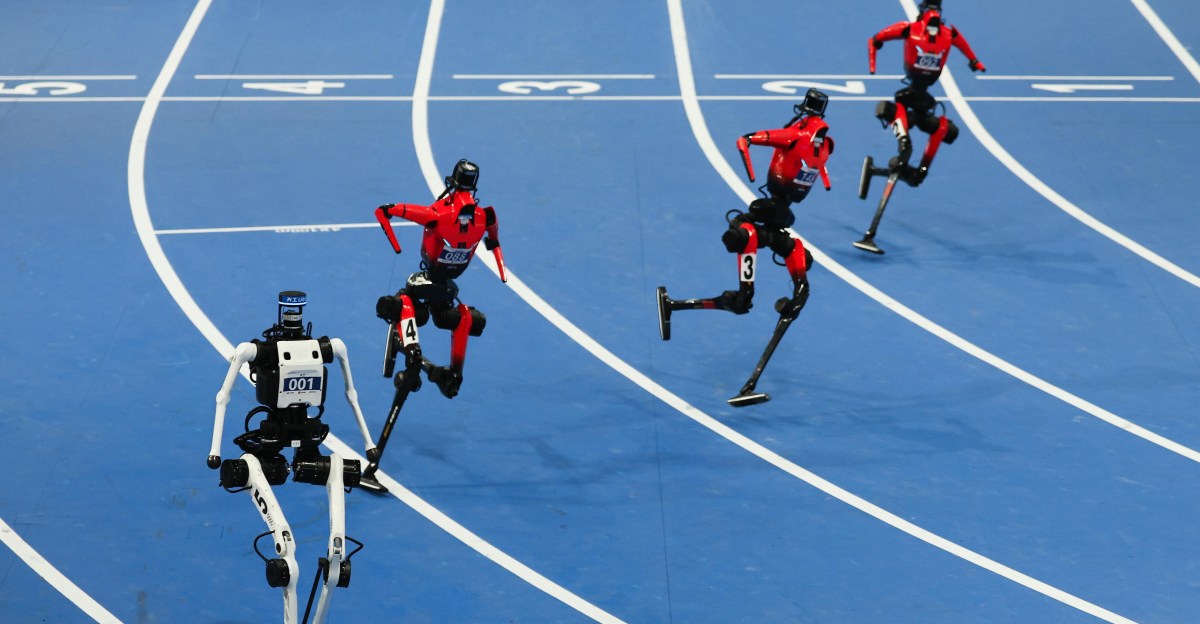
Chinese Robots Break Usain Bolt's 100-Meter Record at World Humanoid Robot Games
Chinese robots have surpassed Usain Bolt's 100-meter dash record during the World Humanoid Robot Games in Beijing. The Tiangong Ultra, developed by the Beijing Humanoid Robot Innovation Center, completed the race in 9.39 seconds, while the Honor-developed Lightning followed closely at 9.47 seconds. This achievement is significant as it highlights the advancements in bipedal robot technology, showcased at an event likened to an annual robot Olympics. The World Humanoid Robot Games, launched in 2025, features 2,056 robots from 16 countries competing in various categories, including sprinting and jumping. Looking ahead, the event continues to attract attention for its innovative displays of robotics. Tiangong Ultra also set a record in the 400-meter race, finishing in 38.16 seconds, outperforming the previous record held by Wayde van Niekerk. No further timeline was disclosed at the time of publication.
Entertainment News Robot Sports Tech
PI Expands Direct-Drive Vertical Translation Stages Portfolio with V-571.Z Family
PI (Physik Instrumente) has announced the expansion of its direct-drive vertical translation stages with the introduction of the V-571.Z family. This new product line combines dynamic performance with nanometer precision, catering to the growing demand for high-precision motion control solutions. The significance of the V-571.Z family lies in its ability to meet the stringent requirements of various applications, including those in research and industrial settings. By integrating advanced magnetic counterbalance technology, these stages offer enhanced stability and accuracy, which are critical for precision tasks. Looking ahead, industry professionals should monitor the adoption of the V-571.Z family in sectors requiring high-precision motion control. No further timeline was disclosed at the time of publication.

SpaceX Unveils AI1 Satellite Specs for Starmind Constellation with Key Thermal Challenges
SpaceX has introduced the AI1 satellite, the inaugural component of its Starmind constellation, which stands 20 meters tall and has a wingspan of 70 meters. This orbital compute node is designed to deliver computing power equivalent to one NVIDIA GB300 server rack, utilizing a unique cooling system with deployable liquid radiators. The satellite's specifications were revealed during a presentation on June 8, 2026, ahead of SpaceX's IPO. The significance of the AI1 satellite lies in its role as a compute platform rather than a traditional satellite, focusing on running AI inference workloads. The satellite's cooling system, which is critical for its operation in the vacuum of space, is designed to reject heat through infrared radiation. However, independent engineers have raised concerns about the feasibility of the thermal and mass claims made by SpaceX, suggesting that the cooling requirements may exceed practical limits. Looking ahead, SpaceX plans to launch two AI1 prototypes in early 2027, with full-scale production expected to commence later that year at its Gigasat facility in Bastrop, Texas. The ongoing debate regarding the satellite's thermal management capabilities will be crucial to monitor as the project progresses, with no further timeline disclosed at the time of publication.
Robotics needs a service framework.
RSF defines a common language for robot service capability, lifecycle operations, certification pathways, and service-provider networks.
Join the RobotToday community on LinkedIn
Daily robotics news, in-depth analysis, conference highlights, and discussions with professionals worldwide.