

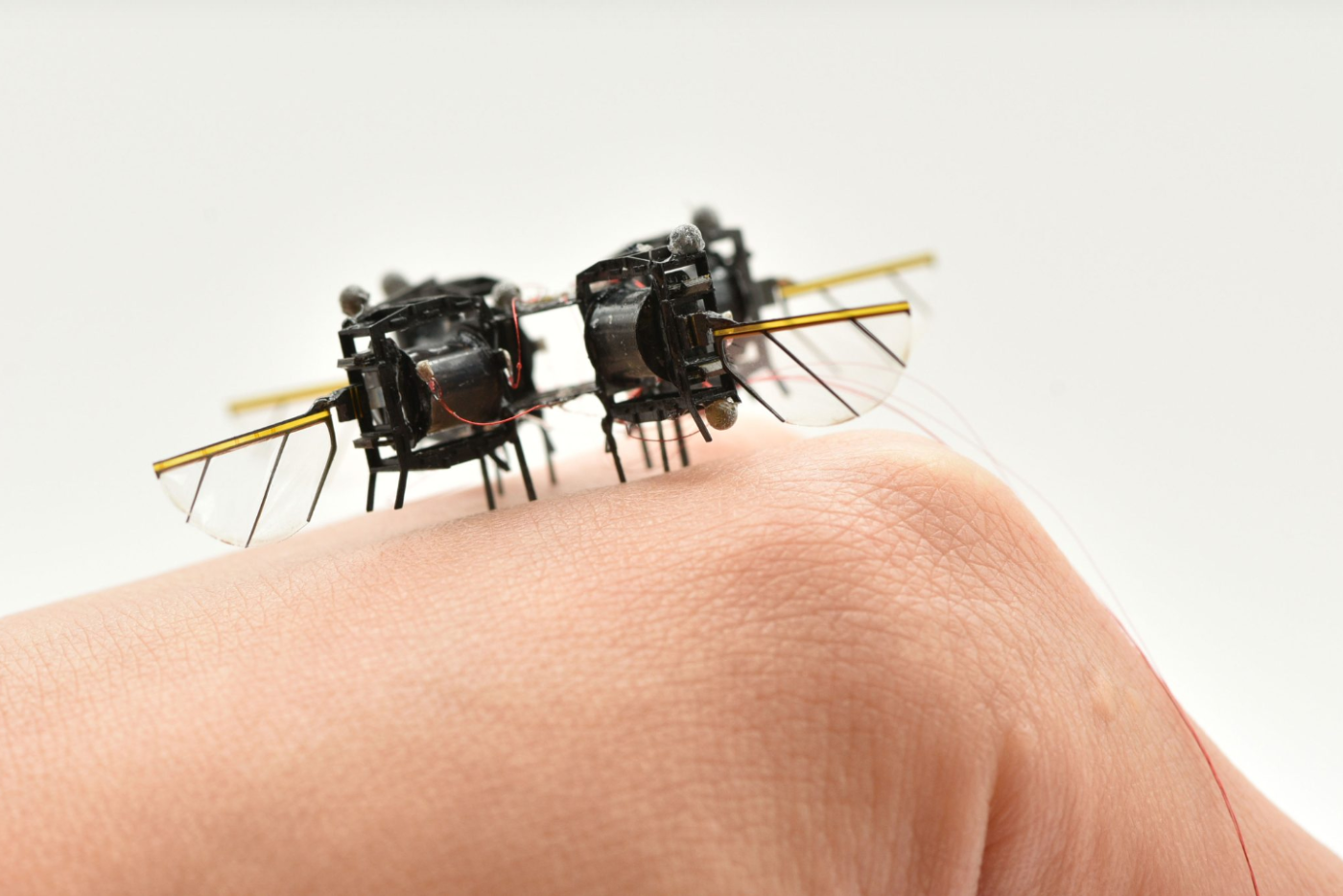
Researchers at the Massachusetts Institute of Technology (MIT) have developed a flying robot that weighs less than a paperclip and is the size of a cassette tape, capable of navigating through tight spaces in disaster scenarios. Published on July 21 in 'Science Advances', this micro flying robot achieves insect-level speed, acceleration, and maneuverability, including continuous flips and sharp turns.
The significance of this development lies in its advanced artificial intelligence control system, which enables the robot to perform complex flight maneuvers in real-time despite its lightweight design. The new control system has improved the robot's flight speed by 447% and acceleration by 255%, allowing it to execute ten consecutive backflips in just 11 seconds with minimal deviation.
Looking ahead, the research team aims to integrate lightweight cameras and sensors into the robot, enabling it to autonomously navigate through real-world debris and tight spaces. This bionic flight behavior will enhance its ability to locate survivors in disaster situations, potentially transforming rescue operations from traditional probing methods to direct visual assessments.
Editor's Note
The development of lightweight, agile flying robots like MIT's insect-scale model represents a significant advancement in disaster response technology. As these robots become capable of navigating complex environments autonomously, they could greatly enhance search and rescue operations, providing critical support in scenarios where traditional methods fall short. The integration of AI and advanced sensors will be key to their effectiveness in real-world applications.






























Leave a comment