

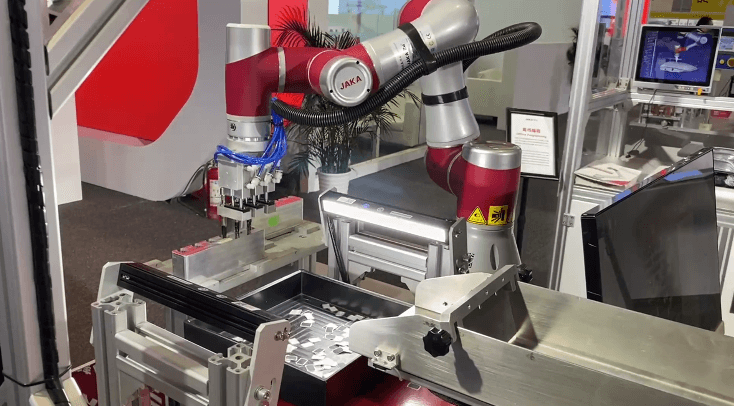
Recycling facilities face ongoing challenges in maintaining material purity due to the variability of recyclables, which complicates manual sorting processes. To address this issue, JAKA is proposing the implementation of automated sorting robots designed to integrate seamlessly into existing workflows. These collaborative robots, or cobots, are equipped with advanced vision-guided systems that can identify and separate diverse materials based on visual or spectroscopic signals.
The robots are engineered to operate effectively in the dynamic environments of recycling plants, where safety is paramount. JAKA's cobots feature multiple safety mechanisms, including force sensing and collision detection, allowing them to work alongside human operators without the need for extensive safety barriers. Their compact design enables installation in tight spaces, making them suitable for retrofitting in current facilities.
Successful deployment of these sorting robots relies on a well-coordinated system that includes high-resolution cameras or near-infrared sensors for accurate material identification, as well as adaptive grippers or vacuum cups for handling various materials. JAKA emphasizes intuitive programming, allowing technicians to quickly adjust the robots for different material streams, thus minimizing downtime.
By incorporating JAKA's sorting robots into recycling quality inspection processes, facilities can significantly enhance material purity and throughput. This strategic move not only improves operational consistency but also supports the essential work of modern recycling, ensuring a more efficient and effective waste management system.























Leave a comment