


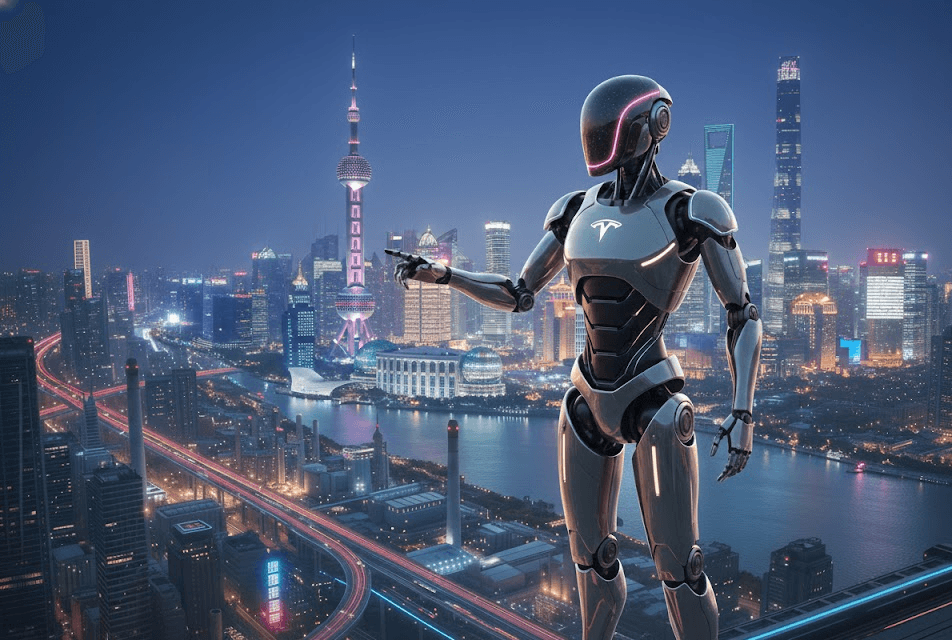
As Tesla pushes its Optimus humanoid robot toward industrial deployment, a striking pattern has emerged: nearly every high-volume, technically mature supplier in its early supply chain is clustered in China’s Yangtze River Delta (YRD). Sanhua (thermal management), Tuopu (actuators), XCC/Wuzhou Xinchun (planetary roller screws), Zhenyu (linear actuators), MOONS’ (hollow-cup motors), Zhaowei (micro-drives), Rongtai (insulation materials), LeaderDrive (harmonic reducers), Maxon Suzhou (frameless motors), and TBI Motion China all lie within 90–300 km of Tesla’s Lingang Gigafactory.
This is no coincidence—it is an expression of deep industrial inevitability. And critically, this same ecosystem is now reshaping the global humanoid robotics industry far beyond Tesla.
A Robotics Manufacturing Cluster That the World Cannot Easily Replicate
The YRD is the only region capable of producing the full stack of high-precision hardware required for humanoid robots: ultra-tight-tolerance transmission systems, harmonic reducers, high-efficiency servo motors, hollow-cup motor assemblies, miniature gearboxes, robot-grade bearings, thermal-safety materials, and high-density electronics.
Zhejiang’s Ningbo–Taizhou belt is globally dominant in precision reducers, planetary screws, actuator machining, and robot bearings. Jiangsu’s Suzhou–Wuxi corridor is a dense cluster of high-performance servos, controllers, and frameless motors. Shanghai provides the electronics, integration expertise, testing infrastructure, and Tesla’s engineering presence.
“No other region combines transmissions, motors, electronics, materials, and rapid iteration at this density,” said an industry analyst specializing in humanoid robotics. “If you want to build humanoids at global scale, the Yangtze River Delta is the default.”
Why Tesla Must Build Optimus Near This Cluster
Optimus is not a fixed mechanical architecture—it is a fast-iterating mechatronic platform. Tesla redesigns actuators, motor cores, harmonic drives, PCB topology, thermal shielding, lubrication systems, and motor windings every few months. Only suppliers physically close to Lingang can support this iteration cadence.
Humanoid robots demand extreme integration: torque density, thermal stability, actuator life, and transmission efficiency all interact in tightly constrained volumes. The YRD’s proximity and precision infrastructure allow Tesla to modify designs rapidly, test them locally, and ramp manufacturing at speeds impossible in North America or Europe.
Why the Rest of the Humanoid Industry Is Moving Here Too — Neura as the Case Study
Tesla is not the only company drawn into this gravitational field. Neura Robotics, one of Europe’s most advanced AI-robotics companies, selected Hangzhou, Zhejiang as its major Asia manufacturing hub—explicitly because the YRD offers unmatched actuator supply, robot-component machining, motor vendors, and cost-scalable system integrators.
Chen Yufeng, a robotics-supply-chain advisor to several Chinese OEMs, frames it bluntly:
“If Tesla depends on this supply-chain cluster, everyone else eventually will,” noted a robotics supply-chain advisor involved in several OEM projects. “You simply cannot mass-produce humanoids in the West without leveraging the actuator and transmission ecosystem built here.”
From U.S. startups developing bipedal locomotion, to Korean firms targeting warehouse humanoids, to Japanese OEMs exploring service-robot replacements for labor shortages, the logic is converging: the YRD is becoming the world’s base-layer infrastructure for humanoid hardware manufacturing.
A Long-Term Industrial Center for Humanoid Mass Production
As humanoid robots scale from prototypes to tens of thousands—and eventually millions—of units, the core constraints will be actuator cost curves, gearbox yield, motor efficiency, safety materials, and supply-chain coherence. The Yangtze River Delta is the only region where these factors reinforce one another at industrial depth.
For Tesla, Optimus will remain anchored here. For Neura, it has already become the manufacturing foundation. For every future global humanoid company, the YRD is increasingly the only viable path to scale.
The geography of humanoid robotics is not changing—it is consolidating. And the Yangtze River Delta is becoming the planet’s humanoid manufacturing capital.
Tesla’s Humanoid Robot Supply Chain coverage articles:
- Tesla’s Humanoid Robot Supply Chain Comes Into Focus
Overview of Tesla Optimus' emerging supply chain, highlighting key partners, production challenges, and broader implications. - How Sanhua Became Tesla’s Key Humanoid Robot Actuator Candidate: Inside the Optimus Supply Chain
Explores why Sanhua Intelligent Controls stands out as a leading candidate for supplying critical actuators to Tesla's Optimus.. - Wuzhou Xinchun The Rising Mechanical Power Behind Tesla‘s Optimus Humanoid Robot
Highlights Wuzhou Xinchun's growing role as a key mechanical component (likely motors or drive elements) supplier powering Optimuss. - Rongtai‘s Surge In The Tesla Optimus Supply Chain
Details Rongtai's rapid rise and specialized contribution (e.g., in materials or safety-related parts) within the Optimus ecosystem. - Tesla Supply Chain: How Zhaowei Powers Optimus Humanoid Gearboxes
Examines Zhaowei's strategic position as a vital provider of precision gearboxes and micro-drives for Optimus joints. - How Tuopu Became a Core Player in Tesla’s Emerging Humanoid Robot Ecosystem
Covers Tuopu Group's ascent to a central role, particularly in actuators, motors, or related joint technologies for Optimus. - Tesla Optimus Supply Chain Analysis: Moons' Strategic Role in Motion Control and Mini Actuators
Analyzes Moons' important involvement in delivering motion control systems and compact actuators tailored for Optimus. - How Zhenyu Technology Is Becoming a Key Linear Actuator Supplier Candidate for Tesla’s Optimus Humanoid Robot
Discusses Zhenyu Technology's emergence as a strong contender for supplying linear actuators essential to Optimus movement. - Why the Tesla Supply Chain for Optimus is Consolidating in Chinese Yangtze River Delta
Explains the geographic and industrial reasons behind the heavy concentration of Optimus suppliers in China's Yangtze River Delta region.
Continue exploring Optimus coverage for updates on mass production timelines, Gen 3/4 progress, or comparisons with Chinese humanoid competitors (e.g., Unitree, Agibot). For broader context, check recent industry reports on the "Optimus chain" and how Chinese suppliers (50-70%+ of core components) shape Tesla's humanoid ambitions despite U.S. final assembly plans.
- Tesla Launches Final Audits of Potential Suppliers for Optimus (Mass Production I)
- Why Tesla's Audit Standards Redefine Humanoid Manufacturing (Mass Production II)
- China VS TESLA Two Paths to Humanoid Robot (Mass Production III)




Leave a comment