

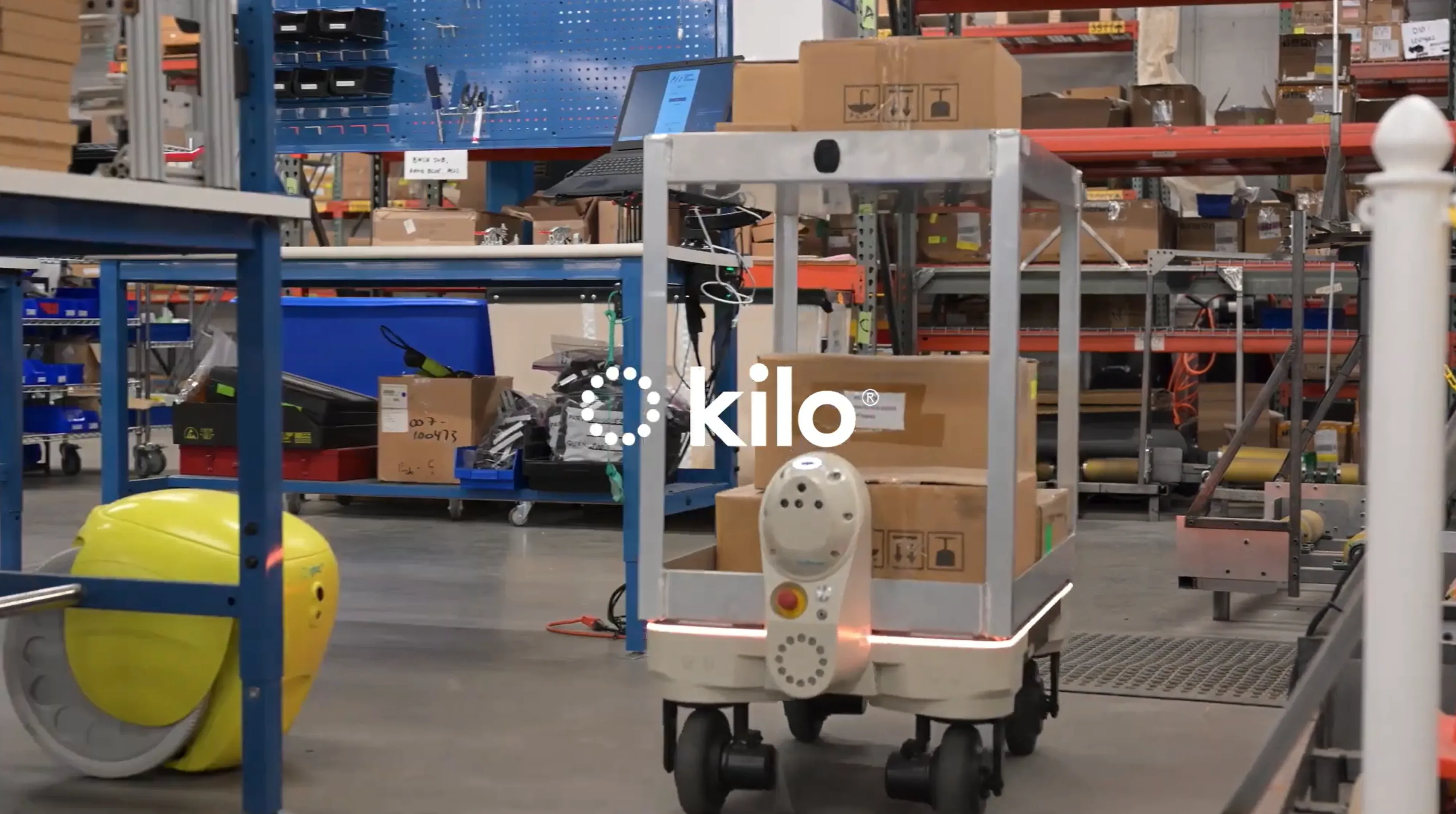
Piaggio Fast Forward (PFF), the technology arm of Italy’s Piaggio Group — the maker of iconic brands including Vespa, Aprilia, and Moto Guzzi — is showcasing its next-generation collaborative mobile robot, kilo®, at Automate this year.
Founded in 2015, PFF develops mobility and autonomous-following technology for industrial environments. Its flagship product, kilo®, is a four-wheel flatbed autonomous mobile robot (AMR) built with smart-following technology. Designed for real-world warehouse and factory settings, kilo® requires no fixed infrastructure — no magnetic tape, beacons, or facility modifications — allowing it to be deployed quickly and moved wherever material-handling demand shifts.
Product Overview: kilo® Collaborative Mobile Robot
kilo® is a Collaborative Mobile Robot (CMR) engineered to work alongside people rather than in caged, fully automated zones. Built for facilities where full automation is neither practical nor cost-effective, it moves at pedestrian speed in shared indoor and outdoor spaces — leading, following, or stepping aside as the operator needs. Because it runs on PFF’s proprietary in-house technology, kilo® works out of the box with no magnetic tape, beacons, facility mapping, or advanced operator training, and helps eliminate the repetitive-motion strain of pushing, pulling, and manually maneuvering heavy loads.
The platform is highly configurable: its flatbed can be fitted with industry- or facility-specific carts or shelving using eight mounting points, so a single robot adapts to manufacturing, warehousing, logistics, facilities management, and last-100-meters delivery tasks.
Key Capabilities
Smart Following (hands-free): pair and walk — kilo® follows the operator naturally, indoors or outdoors, with no controller or wearable tag required.
Forward Following: kilo® can travel in front of the operator as easily as behind. Walking toward or away from the robot sets its direction, keeping the load and its contents in the operator’s line of sight.
Trips (Travel on Known Paths): record a route once by walking it with the robot, then dispatch kilo® to run that path autonomously. There is no limit on the number of saved trips.
PFF Pro Tools: a cloud-based fleet-management app for recording trips, managing routes, and coordinating human-robot collaboration across a fleet.
Zero-turn maneuverability: independent swerve-drive wheel modules give a zero turn radius, and ground clearance lets kilo® climb ramps and drive over small obstacles.
360° safety: a 360° 2D LiDAR plus eight ultrasonic sensors let kilo® operate safely in unmapped, dynamic environments shared with people.
The Smart Behaviors Library
kilo®’s collaborative behavior is grounded in PFF’s Smart Behaviors Database — the largest known motion-capture dataset of people moving with other people and objects in built environments, with over 10,000 sequences and 22.6 million frames of 3D motion data. PFF applies AI and machine learning to this dataset to produce predictable, tested, and repeatable robot behavior, enabling kilo® to anticipate human movement and act as people expect in crowded, shared spaces.
Technical Specifications
| Robot type | Collaborative Mobile Robot (CMR) / autonomous mobile robot (AMR) |
| Unit dimensions (L×W×H) | 37 × 22 × 23 in (94 × 56 × 58 cm) |
| Bed dimensions (L×W) | 32 × 22 in (82 × 56 cm) |
| Bed height | 12 in (30.5 cm) |
| Unit weight | 145 lb (66 kg) |
| Max payload | 300 lb (136 kg) |
| Max speed | 3 mph (4.8 km/h) — pedestrian speed |
| Max grade | 5 degrees |
| Run time | 8–10 hours |
| Charge time | 3 hours |
| Drive system | Independent swerve modules; zero turn radius |
| Sensors | 360° 2D LiDAR + 8 ultrasonic sensors (360° safety) |
| Navigation | Smart Following, Forward Following, and Trips (record & replay known paths); operates in unmapped environments |
| Software | PFF Pro Tools cloud fleet management (PFF Pro app) |
| Customization | 8 mounting points for carts / shelving |
| Infrastructure | None required — no tape, beacons, or facility mapping |
| Environments | Indoor and outdoor |
Specifications per the PFF kilo product sheet (2026). Figures subject to change; confirm against the current PFF spec sheet before publishing.
New Sales Leadership
Ahead of the show, PFF appointed Jason Nehf as Senior Vice President of Sales. Nehf, an A3 member, brings two decades of experience in the robotics industry. He will be available for media interviews at the booth throughout Automate.
Jason Nehf on the AMR Market
“The AMR market is at an inflection point. For years, automation was reserved for the largest operators who could afford to re-engineer their facilities around it. That era is ending. Solutions like kilo® that require zero infrastructure are what will bring flexible automation to the vast majority of warehouses and factories that have been left behind — and that’s where the real growth is.
I’ve spent twenty years in this industry, and I’ve never been more confident about where it’s headed. The demand is real, the labor pressures aren’t going away, and the technology has finally caught up to the promise. PFF is bringing something genuinely different to the floor, and I can’t wait to show people what collaborative mobility looks like when it just works — right out of the box, alongside the people already doing the job.”
— Jason Nehf, SVP of Sales, Piaggio Fast Forward
About Piaggio Fast Forward
Piaggio Fast Forward was founded in 2015 by the Piaggio Group as its technology branch, and is based in Boston. The company designs autonomous mobility solutions that move with people and goods in warehouses, factories, and beyond — building on the first-of-its-kind following technology behind its gita and gitamini consumer robots. Learn more at piaggiofastforward.com.
Media Contact
Danny O’Loughlin, Account Executive,
Hollywood Agency









Leave a comment