



Physical AI Landscape
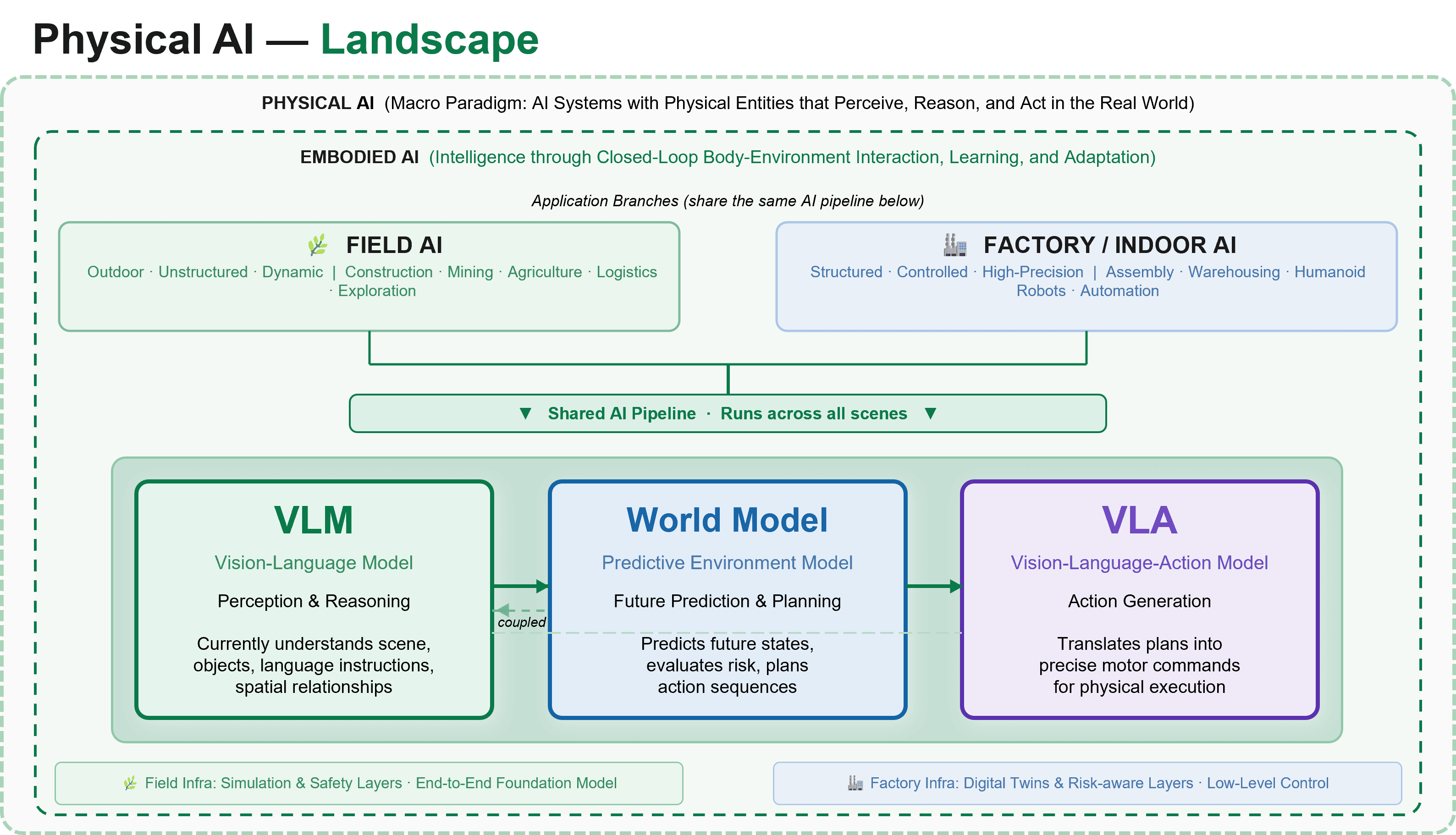
Layer reading: Physical AI (Macro Paradigm) → Embodied AI (Methodology) → Field AI / Factory AI (Application Branches, shared pipeline) → VLM ⇄ World Model → VLA (Shared coupled technology pipeline)
Executive Summary
Since 2025, Physical AI has become one of the most strategically significant keywords in the global technology industry. NVIDIA CEO Jensen Huang declared at CES 2025:
"The next frontier of AI is physical AI — AI that can perceive, reason, plan and act."
This report systematically maps the core conceptual framework of the Physical AI field, covering:
6 Core Concepts: Precise definitions and industry consensus on Physical AI, Embodied AI, Field AI, Factory/Indoor AI, VLM, World Model, and VLA
20+ Key Companies: Research and product landscape from NVIDIA, Google DeepMind to Figure AI and FieldAI
Architecture Logic: Hierarchical nesting and technology flow relationships between concepts (see Figure 1 for the overall landscape)
Industry Debates: Core controversies including Sim-to-Real gap, VLM hallucination, control frequency realities, VLA vs WAM route competition
References: 30+ academic papers and industry reports
1. Physical AI: Macro Paradigm Definition
1.1 Definition and Industry Consensus
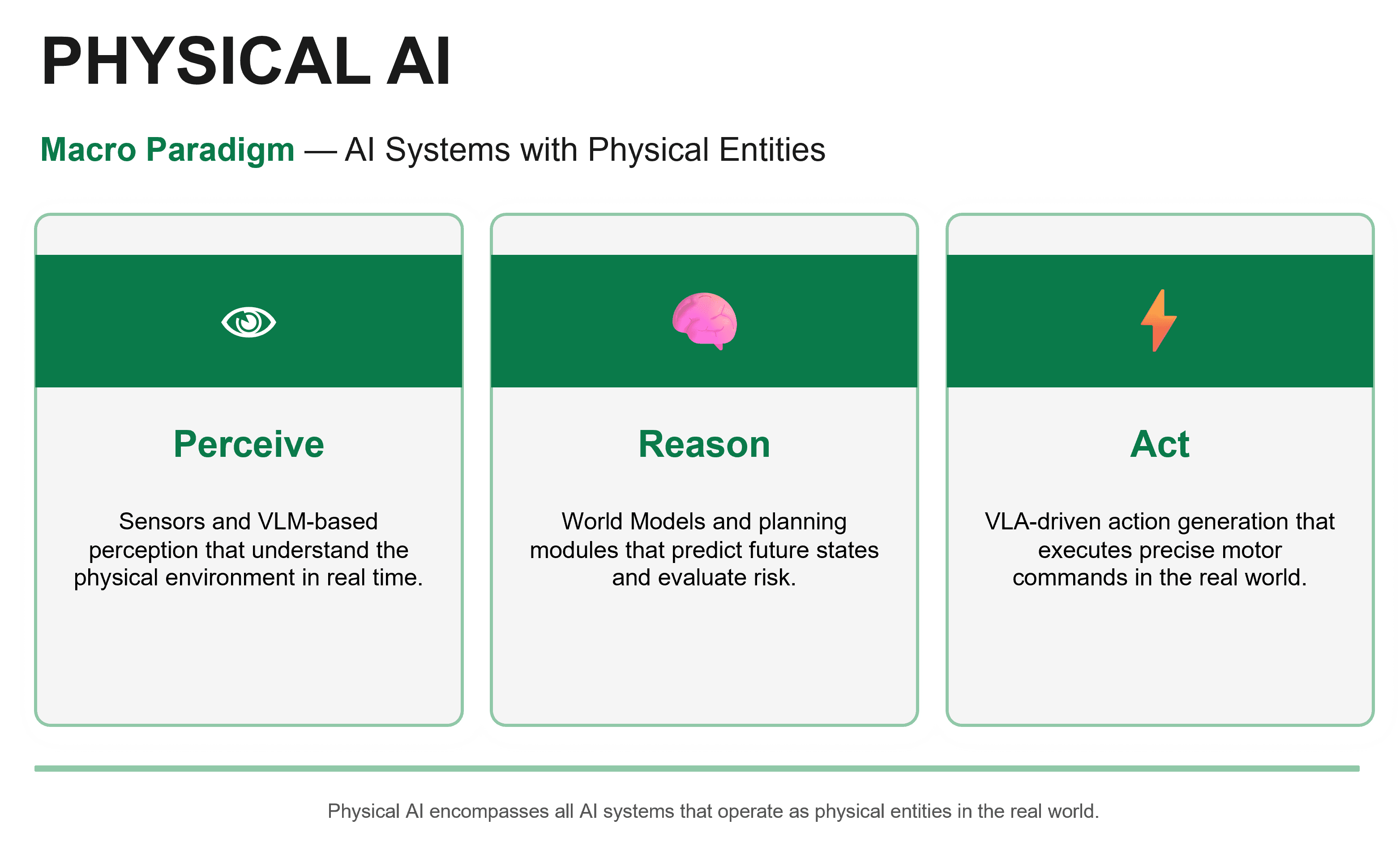
Physical AI refers to AI systems equipped with physical entities or capable of direct interaction with the real physical world. These systems perceive real environments through sensors, engage in reasoning and decision-making, and produce real physical effects through actuators. Unlike Generative AI, Physical AI must contend with four core constraints:
Real-time Requirements: Decision latency measured in milliseconds — cannot tolerate extended processing time
Irreversibility: Erroneous actions may cause equipment damage or human casualties
Physical Law Constraints: Gravity, friction, inertia, and material physics cannot be hallucinated
Sensor Noise: Cameras, LiDAR, IMUs, and other sensors all have noise and occlusion issues
1.2 Jensen Huang's Three-Stage Framework
Jensen Huang first systematically proposed the Physical AI concept in July 2025, then promoted it globally at CES 2025 with a 90-minute keynote, framing AI evolution in three stages:
Stage | Type | Representative Technologies | Period |
|---|---|---|---|
Stage 1 | Perception AI | AlexNet, Computer Vision | 2012–2017 |
Stage 2 | Generative AI | GPT, DALL·E, Sora | 2017–2024 |
Stage 3 | Physical AI | Robotics, Autonomous Driving, Embodied AI | 2025– |
1.3 Key Participating Companies
NVIDIA: Isaac GR00T N1, Cosmos World Foundation Model (1→3), Omniverse, Newton physics engine, Cosmos Reason inference VLM
Tesla: Optimus humanoid robot, large-scale simulation training + Sim-to-Real transfer, factory-first internal deployment
Figure AI: Helix VLA dual-system architecture, targeting commercial humanoid robot deployment
Boston Dynamics: Spot/Atlas series expanding into unstructured environments
XPeng: IRON humanoid robot, partnering with NVIDIA
2. Embodied AI: Core Methodology
2.1 Definition
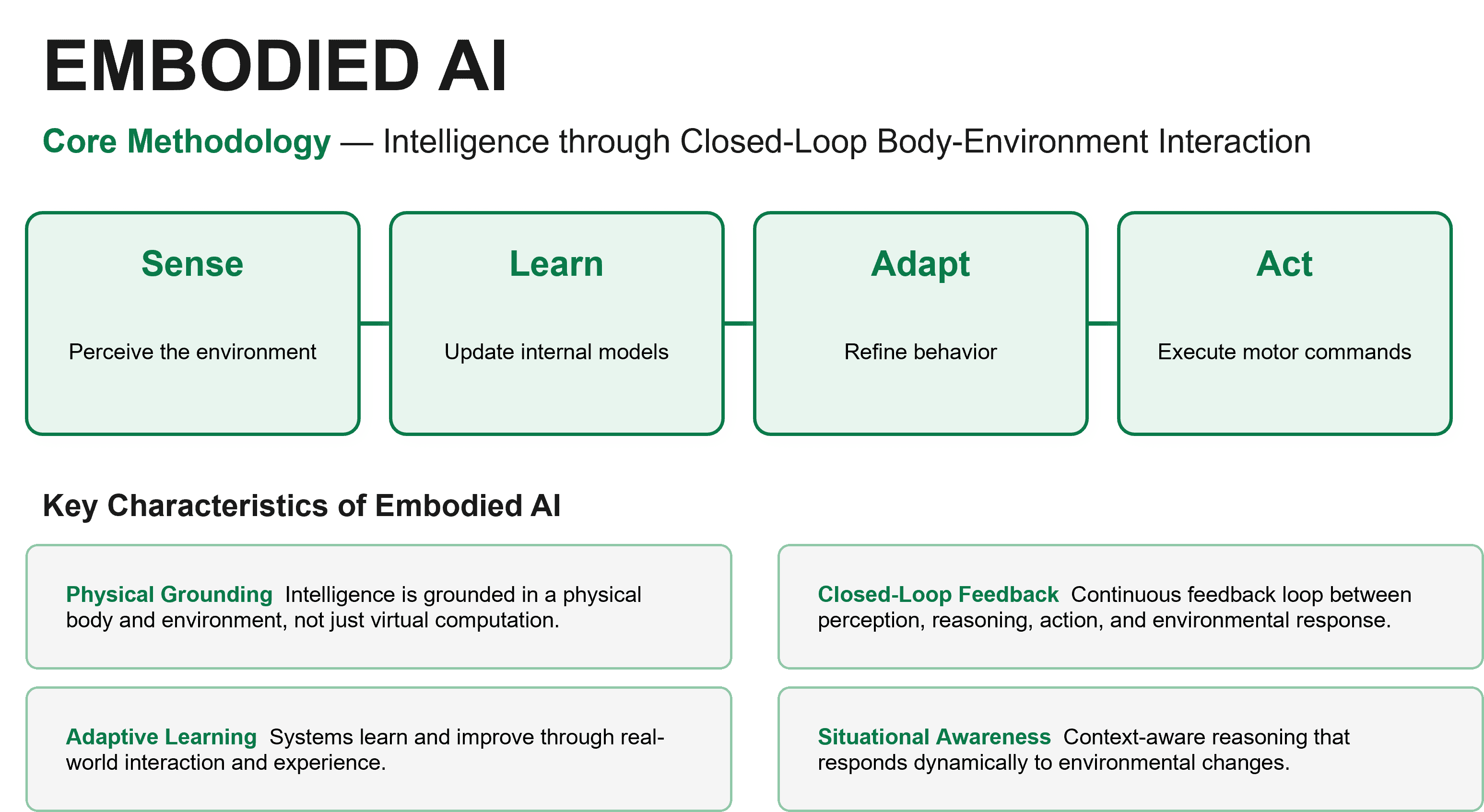
Embodied AI refers to AI systems embedded in physical bodies that achieve continuous learning, emergent intelligence, and adaptive capability through closed-loop interactions between sensors, environment, and actuators. The core theory derives from the cognitive science concept of Embodied Cognition — intelligence cannot exist independently of bodily and environmental interaction.
Physical Grounding: Cognition is anchored in concrete physical form, not pure symbolic computation
Closed-Loop Feedback: Continuous cycle of perception → reasoning → action → environmental response → re-perception
Adaptive Learning: Continuous improvement through real-world interaction, not hard-coded programs
Situational Awareness: Real-time perception of dynamic scene changes with context-appropriate responses
3. Field AI vs Factory / Indoor AI
3.1 Scene Differentiation Logic
When Embodied AI systems are deployed, environmental complexity determines the branching of technical paths. Both major application branches share the same underlying AI pipeline (VLM ⇄ World Model → VLA), but differ fundamentally in infrastructure, control architecture, and AI implementation routes.
3.2 Field AI (Outdoor / Field AI)
Definition: Embodied AI systems deployed in unstructured, dynamic, high-uncertainty outdoor and field environments. Core challenges: GPS-denied, no pre-built maps, weather changes, complex terrain, sensor degradation, multi-robot coordination.
Representative Company — FieldAI: Founded in 2023 (former NASA JPL/DeepMind team), raised $314M in Series C funding in August 2025, valued at approximately $2B. Core technologies: Field Foundation Models (FFMs), Belief World Model (BWM), EDGE edge system (latency <100ms). Commercially deployed across three continents in construction, energy, and mining.

3.3 Factory / Indoor AI — Critical Technical Route Clarification
⚠️ Technical Route Clarification There are two fundamentally different AI implementation routes in factory environments that must be clearly distinguished, or serious misrepresentation will result.
Route A: Traditional Industrial Giants (Fanuc / ABB / Yaskawa / KUKA) — Determinism-First Route
Core Logic: Strong Determinism + High Repeatability & Precision. Traditional industrial automation giants hold values diametrically opposed to general-purpose VLA — factory production lines cannot tolerate any randomness or sporadic physical hallucination in robot actions.
Actual AI Implementation Routes:
Industrial Edge Data Platform: Fanuc's FIELD system (Fanuc Intelligent Edge Link and Drive) as the representative — core value is edge data connectivity and real-time factory data collection
ZDT (Zero Downtime): Sensor-data-based predictive maintenance — using AI to predict failure timing of critical components like spindles and servo motors to avoid unplanned downtime
Localized Embodied Skills: Such as AI Bin Picking — robots using visual AI to identify and precisely grasp randomly stacked parts in bins. This is a localized perception skill, not an end-to-end general VLA brain
💡 Key Distinction The current AI route for traditional giants like Fanuc is: localized perception skills + predictive maintenance + edge data platform — NOT replacing entire robot motion control with a general VLA brain like Figure Helix. The former pursues determinism; the latter pursues generalization. These are fundamentally opposed engineering philosophies.
Route B: Next-Generation General Robot Companies (Figure AI / 1X / Agility) — VLA Generalization Route
Core Logic: Generalization-First. Using humanoid robots as the carrier, VLA brain-driven, trading some determinism for cross-task generalization capability. The goal is to start from structured factory scenarios and gradually extend to semi-structured environments.
Figure AI (Helix VLA): Dual-system architecture, trained on ~500 hours of high-quality data, piloted at BMW factories
Agility Robotics (Digit): Amazon warehouse material handling, relatively structured factory scenarios suitable for VLA generalization
Tesla Optimus: Internal factory deployment first, gradually replacing fixed programs with VLA + imitation learning
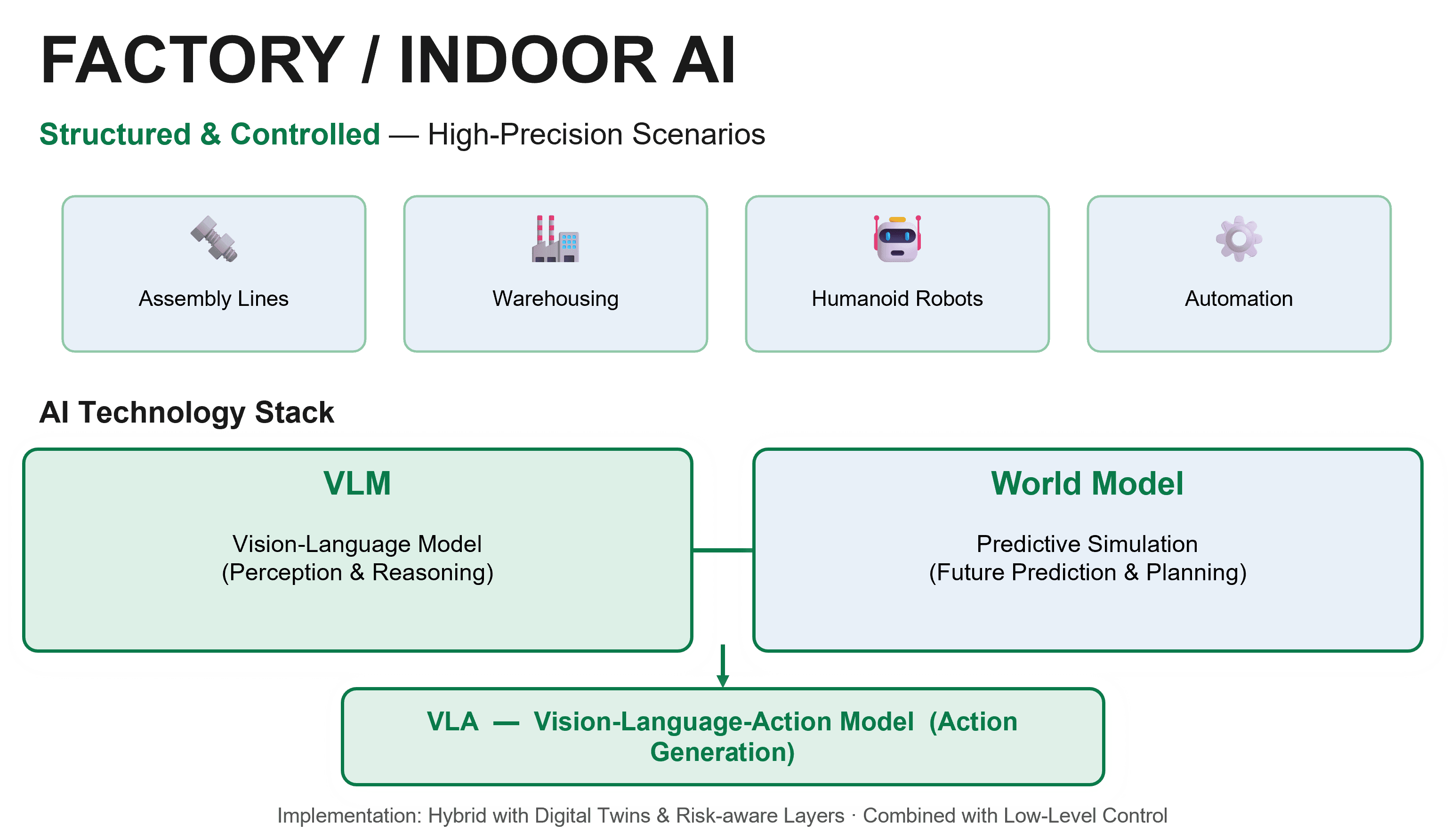
Figure 5 | Factory / Indoor AI — Application Scenarios and Technology Stack (Route B: VLA Generalization Route)
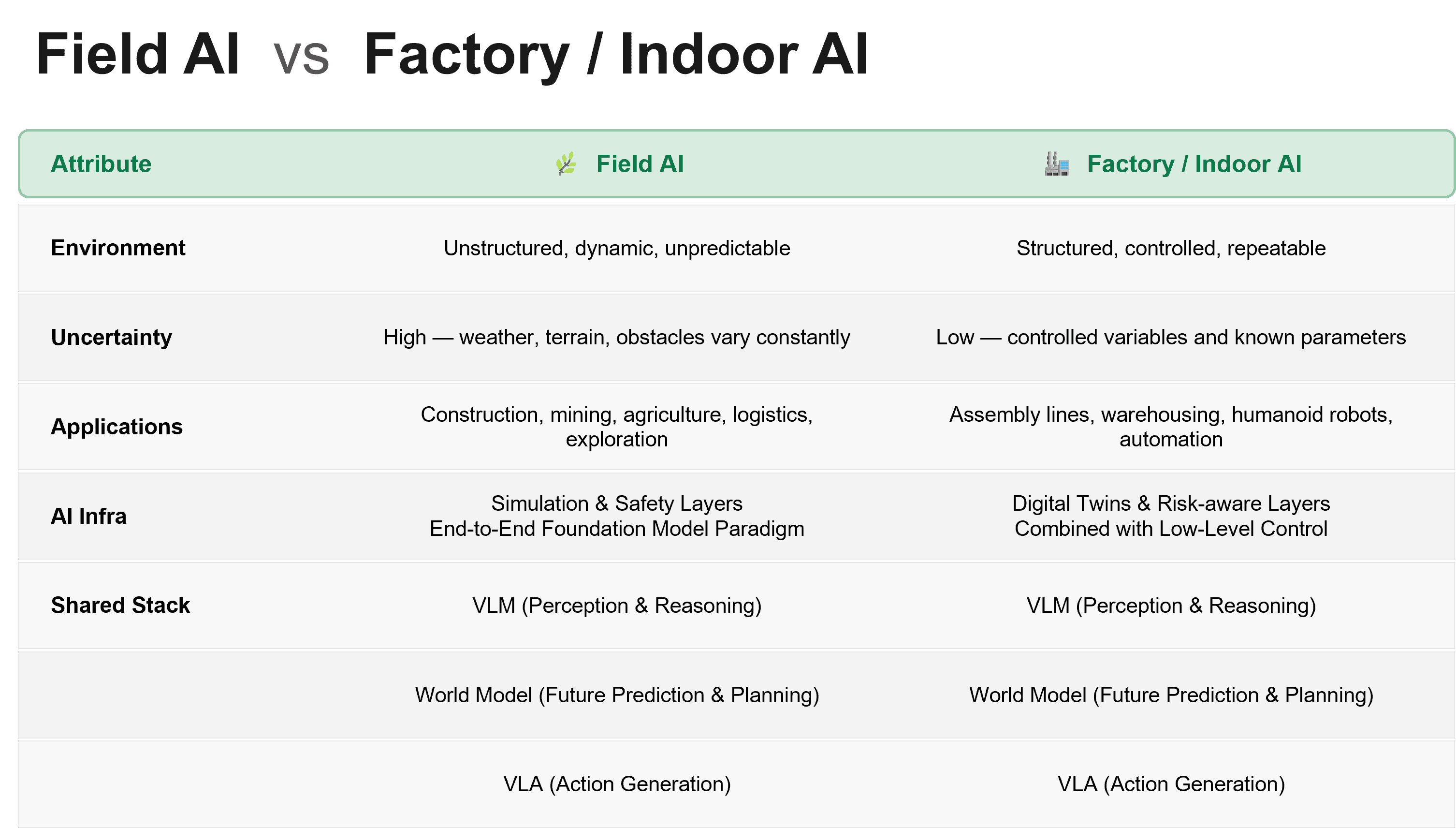
3.4 Comparison of the Two Scenarios
Dimension | Field AI | Factory AI (Traditional) | Factory AI (New-Gen) |
|---|---|---|---|
Key Companies | FieldAI / Boston Dynamics | Fanuc / ABB / KUKA | Figure AI / Agility / Tesla |
Core AI Route | FFMs + Belief World Model | FIELD System + ZDT + AI Bin Picking | VLA brain + dual-system architecture |
Engineering Philosophy | Robustness + Risk-aware | Strong determinism + Zero randomness | Generalization + Acceptable error |
VLA Stance | High-level planning + traditional control mix | Not using end-to-end VLA currently | Core driving intelligence |
Shared AI Pipeline | VLM ⇄ World Model → VLA | Local VLM (vision) + classical control | VLM ⇄ World Model → VLA |
4. AI Technology Pipeline: VLM · World Model · VLA
4.1 VLM (Vision-Language Model) — Eyes and Brain
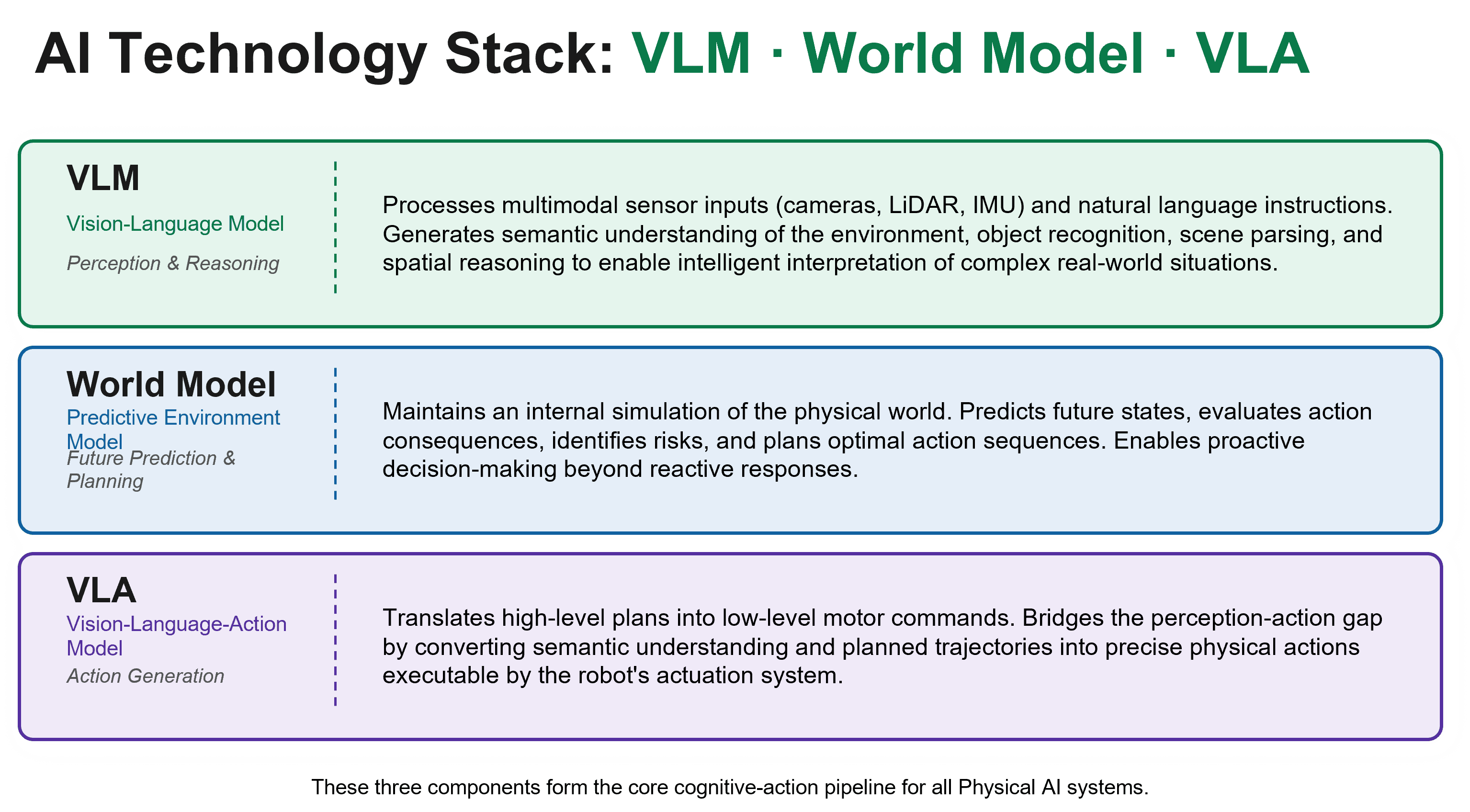
Vision-Language Model (VLM) — A multimodal foundation model pre-trained on massive image-text paired data, providing open-world perception, scene understanding, language instruction grounding, and spatial reasoning capabilities. In Embodied AI, it plays the role of "eyes + semantic brain" — understanding the current moment.
Representative Models: SigLIP (Google), LLaVA series, PaliGemma (Google), InternVL, NVIDIA Cosmos Reason (7B, specialized for physical reasoning, #1 on HuggingFace physical reasoning leaderboard).
4.2 World Model — Experience and Anticipation
World Model — A predictive model that maintains an internal simulation of the physical world. It does not merely perceive the current state, but predicts future state sequences, evaluates action consequences, identifies risks, and plans optimal paths.
🔑 Core Insight of This Report: VLM and World Model are Bidirectionally Coupled, Not Unidirectionally Serial In plain language: The VLM is like your eyes, telling you 'there's a mud pit ahead right now.' The World Model is like experience, predicting 'if you step in it, the car will skid.' The World Model's prediction then feeds back to remind the eyes: 'look carefully at the stones beside the mud pit.' This back-and-forth interweaving of eyes and brain is true Embodied Intelligence.
This bidirectional coupling (VLM ⇄ World Model) distinguishes the current architecture from the simple unidirectional serial flow 'VLM → World Model → VLA' previously described in media coverage. VLM handles understanding 'now'; World Model handles predicting 'the future.' Both drive VLA action decisions through continuous information exchange.
Representative Systems:
NVIDIA Cosmos Series (2025–2026): Cosmos 1→3, physics-aware video world foundation models, latest version supports World Action Models (WAMs)
Google DeepMind Genie 3 (2025): Interactive basic world model
Meta V-JEPA 2 (2025): Self-supervised video prediction, transferable with minimal robot data
FieldAI Belief World Model (BWM): Designed for unstructured field environments, uncertainty-aware prediction engine, cloud-independent
⚠️ 2026 New Development: World Action Models (WAMs) — NVIDIA technical blog (June 2026) proposed WAMs: using world model backbones directly for robot policies, rather than VLMs with added action heads. This represents a deeper fusion of world models and action generation beyond traditional VLA.
4.3 VLA (Vision-Language-Action Model) — Intent into Action
Vision-Language-Action Model (VLA) — Built on top of VLMs with added action output heads (action decoders), achieving end-to-end mapping from visual + language instructions to robot physical actions. Core insight: treating robot actions as a language, tokenizing motor commands to reuse Transformer architecture and transfer web-scale knowledge.
Year | Model | Institution | Milestone Significance |
|---|---|---|---|
2022 | RT-1 / SayCan | Early large-model-driven robot control exploration | |
2023 | RT-2 | Google DeepMind | First large-scale VLA, transferring web knowledge to robots |
2024 | OpenVLA | Stanford + 21 institutions | Open-source 7B VLA, Open X-Embodiment dataset |
2024 | pi0 (pi-zero) | Physical Intelligence | Flow-matching VLA, high-frequency 50Hz smooth trajectories |
2025 | Helix | Figure AI | Dual-system VLA, whole-body humanoid robot control |
2025 | GR00T N1 | NVIDIA | Dual-system Physical AI humanoid robot foundation model |
2025 | SmolVLA | Hugging Face | Lightweight VLA, deployable on low-cost hardware |
2026 | Gemini Robotics | Google DeepMind | Gemini 2.0 VLM backbone, high-dexterity manipulation |
4.4 Dual-System Architecture and the Engineering Reality of Control Frequency
⚠️ Important Technical Clarification: VLA Output ≠ Joint Current Commands This is one of the most common misconceptions in current industry coverage and must be clearly stated.
Common Misconception: VLA (System 1) directly outputs high-frequency joint current commands to drive robot motion.
Engineering Reality: Even the fastest current VLA models (e.g., pi0 at ~50Hz) are far from meeting the demands of low-level joint control — quadruped robots preventing skidding and bipedal robots maintaining balance on outdoor terrain require 200Hz–1000Hz ultra-high-frequency response. There is an indispensable control layer between them.
The Real Four-Layer Engineering Chain:
Layer | Component | Output | Typical Frequency |
|---|---|---|---|
Layer 1 | VLM + World Model (System 2) | Task semantic understanding / sub-task planning | 1–5 Hz (slow thinking) |
Layer 2 | VLA action head (System 1) | Trajectory / position / torque targets | 10–50 Hz (fast planning) |
Layer 3 | MPC / RL Cerebellum (motion controller) | Joint angle / velocity commands | 100–500 Hz (real-time control) |
Layer 4 | Servo driver / motor controller | Joint current / torque commands | 500–1000 Hz (low-level execution) |
💡 Analogy VLA's System 1 is like a coach shouting 'run left, fast!' (trajectory target). The MPC cerebellum is like the athlete's cerebellum and spinal cord, coordinating dozens of muscles (joints) within milliseconds to produce balanced, high-frequency movement. Neither can do without the other — without the coach, the athlete doesn't know where to go; without the cerebellum, the athlete falls immediately. In Field AI outdoor scenarios, the robustness of this low-level cerebellum is especially critical.
Actual Engineering Implementation: Both NVIDIA GR00T N1 and Figure Helix employ this layered architecture — VLA outputs trajectory/position/torque targets, which interface with MPC or specially trained end-to-end RL cerebellum controllers at the lower level, ultimately converting to hundreds-of-Hz real joint current commands. Without this layer, the robot would lose stability and fall within one second on complex outdoor terrain.
4.5 Precise Logical Relationship of VLM · World Model · VLA
VLM (Perceive Now) ⇄ World Model (Predict Future) ──▶ VLA (Trajectory Targets) ──▶ MPC/RL Cerebellum ──▶ Physical World
⇄ represents the bidirectional coupling between VLM and World Model (forward perception + reverse predictive feedback); the MPC/RL Cerebellum is an indispensable control layer connecting VLA output to physical joints.
5. Comprehensive Company Landscape
5.1 Infrastructure & Platform Layer
NVIDIA: Isaac GR00T N1, Cosmos 1→3 (WAMs support), Omniverse simulation, Newton physics engine, Cosmos Reason (physical reasoning VLM)
5.2 VLA Research & General Robotics Layer
Google DeepMind: RT-1/RT-2/RT-X, Gemini Robotics, Genie 3 world model
Physical Intelligence (pi): pi0, pi0fast — general robot flow-matching policy
Figure AI: Helix dual-system VLA, humanoid robot BMW factory pilot
Hugging Face + Academic Alliance: OpenVLA (open-source), SmolVLA (lightweight), LeRobot platform
1X Technologies: Neo humanoid robot, VLA-driven
Agility Robotics: Digit biped robot, Amazon warehouse deployment
5.3 Field AI Focused Layer
FieldAI: FFMs + BWM + EDGE, deployed across three continents in construction/energy/mining, $400M funding, $2B valuation
Boston Dynamics: Spot/Atlas series, partnering with FieldAI to advance FFM integration
5.4 Traditional Industrial Automation Layer (Determinism Route)
Route Distinction [object Object]
Fanuc: FIELD system (edge data connectivity), ZDT (zero downtime predictive maintenance), AI Bin Picking, visual inspection in machining
ABB: ABB Ability platform, machine vision systems, collaborative robot YuMi series, localized AI skill integration
Yaskawa: Cockpit digital factory platform, sensor fusion and predictive maintenance
KUKA: KUKA.AI series, process parameter optimization and vision-guided positioning
5.5 Simulation & Data Infrastructure
NVIDIA Isaac Sim / Omniverse: Leading physics simulation environment
Genesis: Next-generation differentiable physics simulation, ultra-high fidelity
Open X-Embodiment: 21-institution collaboration, 1M+ robot manipulation data, 22 embodiment types
LeRobot (Hugging Face): Open-source robot learning platform and dataset
6. Industry Consensus and Core Debates
6.1 Established Industry Consensus
VLM is the starting point for VLA: Almost all advanced VLAs use a strong pre-trained VLM as their backbone
Dual-system architecture dominates: Slow semantic reasoning (VLM/System 2) + fast trajectory planning (System 1) + low-level MPC/RL cerebellum, three-level division of labor
Data is the biggest bottleneck: Combining internet pre-training + large-scale simulation + real physical interaction data is the industry-recognized path
Field and Factory share the upper pipeline: VLM ⇄ World Model → VLA is identical; differences lie in deployment infrastructure and lower-level control architecture
World Model is the future direction: Academic and industry consensus in 2025–2026 is that world models are the critical next step beyond pure VLA
Traditional industrial AI and new-generation embodied AI are two distinct routes: The former pursues strong determinism, the latter seeks generalization — not to be confused
6.2 Core Debates and Disagreements
【Epic Showdown】VLA Route vs WAM Route — The Highest-Intensity Architecture Debate of 2026
This is the most cutting-edge and fiercely debated route competition in the Physical AI field, representing two fundamentally different philosophical answers to the question 'How should the robot brain come into being':
🧠 Traditional VLA Camp Google DeepMind / Figure AI / Physical Intelligence First use language and vision models to 'think' thoroughly in the digital world, then 'translate' the results into robot actions. The robot is 'a linguist who learned to manipulate a body' — rich linguistic knowledge, but must bridge the semantic-to-physical gap. Advantages: Internet-scale knowledge transfer, strong zero-shot generalization. Weaknesses: Domain gap (semantic to physical), VLM hallucinations are extremely risky in the physical world. | ⚡ Native WAM Camp NVIDIA Cosmos 3 (June 2026) From birth, the brain watches physical world videos, learns the evolution rules of the physical world, and directly generates actions using world model physical predictions. The robot is 'an intuitive beast that innately understands physical laws' — no translation from language to physics needed; physical intuition itself is its language of thought. Advantages: Native physical understanding, no domain gap. Weaknesses: Requires massive high-quality physical video data, newer engineering path, awaiting large-scale validation. |
The outcome of this debate will determine: will the future robot brain be 'a linguist who learned to manipulate a body (VLA),' or 'an intuitive beast that innately understands physical laws (WAM)'? No conclusion yet — engineering validation results in 2026–2027 will be decisive.
Debate 2: Can the Sim-to-Real Gap Be Fully Bridged
Simulation proponents (NVIDIA/Tesla): Addressable through higher simulation fidelity (physical/optical/dynamic) and domain randomization. Skeptics: SAE 2026 noted that models trained at 1080p simulation fail when deployed to 800×600 real cameras; friction, collisions, and liquid behavior are difficult to fully model.
Debate 3: Data Scale vs Data Quality
Scale camp: Internet-scale pre-training volume is the decisive factor, Scaling Laws apply. Quality camp: Figure Helix paper indicates ~500 hours of high-quality multi-robot data can train a commercial-grade VLA — data quality and diversity matter more than pure scale.
Debate 4: End-to-End vs Modular / Layered Architecture
End-to-end camp (Google RT-2 route): Joint training of the whole system, no information loss. Modular/layered camp: Each module can be independently verified, replaced, and debugged; easier to meet safety certifications (SAE J3329 etc.), suitable for industrial production environments.
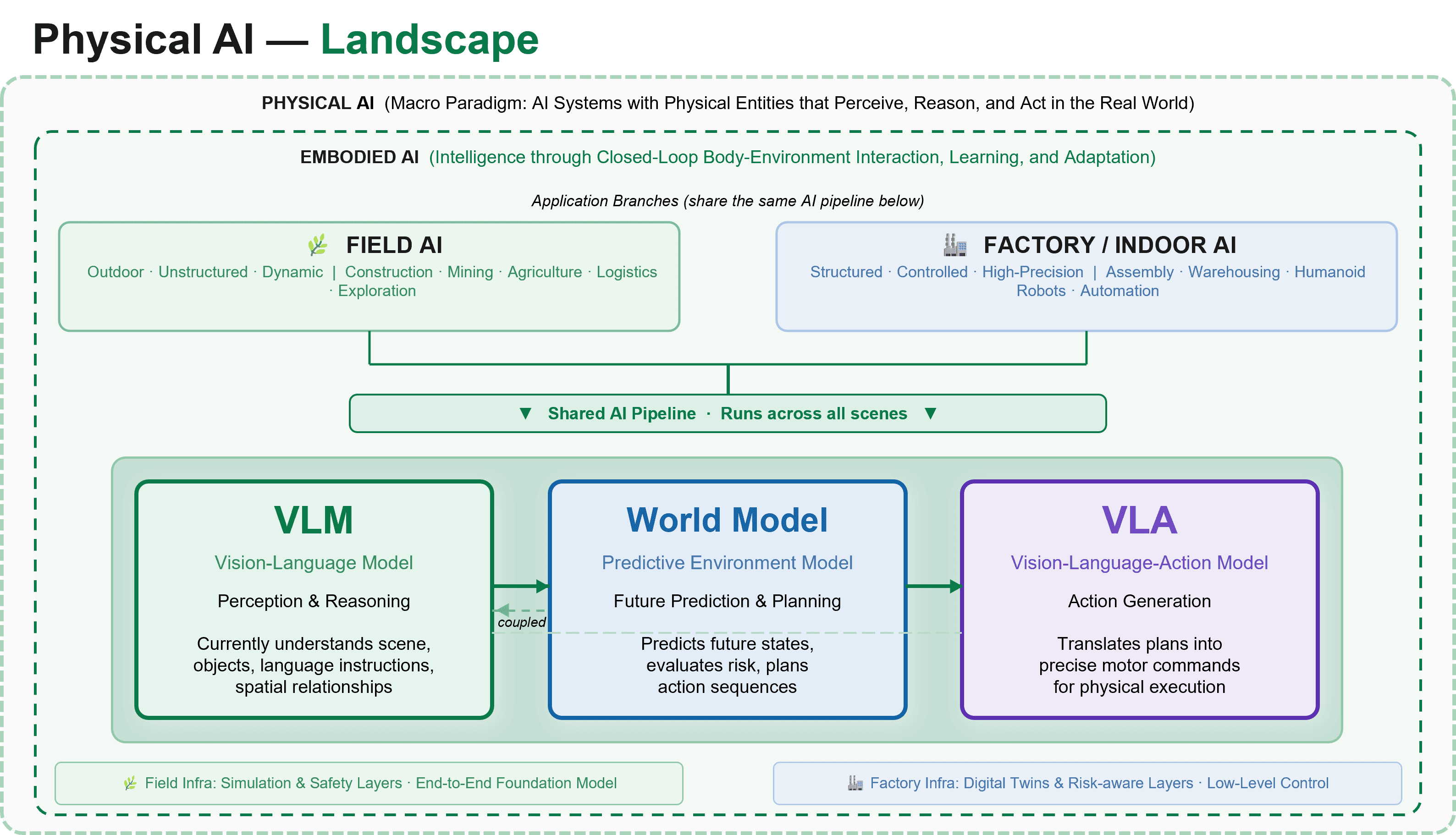
7. Comprehensive Architecture Diagram (Landscape) Explained
7.1 Diagram Naming
Physical AI Landscape · Designed by RobotToday Research Team
Full title: The Physical AI Embodied Intelligence Hierarchical Paradigm — A Closed-Loop Architecture from Digital Intelligence to the Real Physical World, Driven by VLM–World Model–VLA | Designed by RobotToday Research Team
7.2 Five-Layer Structure
Layer 1 (Outermost): Physical AI macro paradigm — outermost dashed box, defining AI systems that must have physical entities or interaction capability
Layer 2: Embodied AI methodology — inner dashed box, embodied closed-loop is the core mechanism
Layer 3: Application branches — Field AI (green box) and Factory AI (blue box) compactly side by side, explicitly labeled 'sharing the AI pipeline below'
Layer 4 (Greatest Visual Weight): Shared AI Pipeline — VLM ⇄ World Model (bidirectional coupled) → VLA, three equal-height equal-width boxes; pipeline layer carries greater visual weight than scene layer
Layer 5 (Bottom Annotations): Infrastructure differences — Field (Simulation + Safety Layers) vs Factory (Digital Twins + Low-Level Control)
7.3 Originality of the Diagram
Based on our search, no publicly published visualization framework identical to this architecture diagram exists in academia or industry. This diagram is an original comprehensive synthesis based on the latest 2025–2026 industry developments. Its core original value lies in: (1) clear layering of application branches and technology pipeline; (2) explicit expression of VLM ⇄ World Model bidirectional coupling; (3) correction of the visual hierarchy to reflect the logical importance of the technology pipeline over application scenarios.
8. 2025–2026 Hot Topics and Trends
World Action Models (WAMs): Proposed by NVIDIA in June 2026 — world model backbones directly driving action generation, potentially the next paradigm beyond VLA (see Section 6 epic showdown)
Scaling Laws for Robotics: Does the robot data scaling law match NLP? Academia is actively validating
Cross-Embodiment Generalization: Same model driving wheeled/legged/biped/drone robots — Open X-Embodiment direction
Control Layer Fusion: Deep integration of VLA trajectory output with MPC/RL cerebellum to reduce inter-layer switching overhead
Safety & Regulation: How SAE J3329, ISO 13849, and other standards adapt to VLA-driven robots; impact of EU AI Act on Physical AI
Data Flywheel: Real deployment → data collection → federated learning → model optimization → re-deployment; FieldAI has achieved the full chain
Low-Cost Democratization: SmolVLA (Hugging Face), pi0, and other lightweight models dramatically lower barriers to entry for startups
9. References and Further Reading
Academic Papers
[1] Brohan et al. (2022). RT-1: Robotics Transformer for Real-World Control at Scale. arXiv:2212.06817
[2] Brohan et al. (2023). RT-2: Vision-Language-Action Models Transfer Web Knowledge to Robotic Control. Google DeepMind.
[3] Kim et al. (2024). OpenVLA: An Open-Source Vision-Language-Action Model. Stanford et al.
[4] Black et al. (2024). pi0: A Vision-Language-Action Flow Model for General Robot Control. Physical Intelligence.
[5] Figure AI (2025). Helix: A System 1 & System 2 VLA for Whole-Body Humanoid Control.
[6] Ma et al. (2025). A Survey on Vision-Language-Action Models for Embodied AI. arXiv:2405.14093
[7] arXiv:2505.04769 (2026). Vision-Language-Action Models: Concepts, Progress, Applications and Challenges.
[8] arXiv:2507.10672 (2025). Vision-Language-Action Models in Robotic Manipulation: A Systematic Review.
[9] NVIDIA (2025). Cosmos World Foundation Model Platform for Physical AI. arXiv:2501.03575
[10] NVIDIA Research (2026). Cosmos 3: Omnimodal World Models for Physical AI. Technical Report.
[11] Assran et al. (2025). V-JEPA 2: Self-Supervised Video Models. Meta AI.
[12] arXiv:2510.16732 (2025). A Comprehensive Survey on World Models for Embodied AI.
[13] arXiv:2605.10653 (2026). Embodied AI in Action: SAE World Congress 2026 White Paper.
[14] arXiv:2505.01458 (2025). Robotics Navigation and Manipulation with Physics Simulators in Embodied AI.
[15] arXiv:2604.26509 (2026). 3D Generation for Embodied AI and Robotic Simulation.
[16] Wikipedia (2025). Vision-Language-Action Model.
Industry Reports & Media
[17] NVIDIA Blog (2025). CES 2025 Jensen Huang Keynote.
[18] NVIDIA Developer Blog (2026). Pretrained to Imagine, Fine-Tuned to Act: The Rise of World-Action Models.
[19] NVIDIA Newsroom (2025). Cosmos Physical AI Models Announcement.
[20] Contrary Research (2026). FieldAI Business Breakdown & Founding Story.
[21] The Robot Report (2025). FieldAI raises $405M.
[22] Sacra (2026). FieldAI: Valuation, Funding & News.
[23] Fanuc Corporation. FIELD System Technical Documentation. www.fanuc.com
[24] Pebblous (2026). World Models Explained: Why VLM and VLA Are Not Enough for Physical AI.
[25] Stackademic (2026). VLA Models: The AI Brain Behind the Next Generation of Robots.
[26] LearnOpenCV (2025). Vision Language Action Models & Policies for Robots.
[27] LDV Capital (2026). Physical AI Can't Exist Without Eyes.
[28] Superb-AI (2026). Physical AI Series 1: What Is It?
Further Reading Recommendations
Beginners: Superb-AI Physical AI Series → NVIDIA CES 2025 Keynote → Wikipedia VLA entry
Engineers: OpenVLA paper → LeRobot GitHub → NVIDIA GR00T N1 technical report → Open X-Embodiment dataset
Researchers: arXiv:2505.04769 survey → NVIDIA Cosmos 3 technical report → arXiv:2510.16732 world model survey
Strategic Decision Makers: Contrary Research FieldAI report → Fanuc FIELD System documentation → SAE 2026 white paper → Sacra valuation analysis






Leave a comment