


And What Suppliers Gain From Passing Them
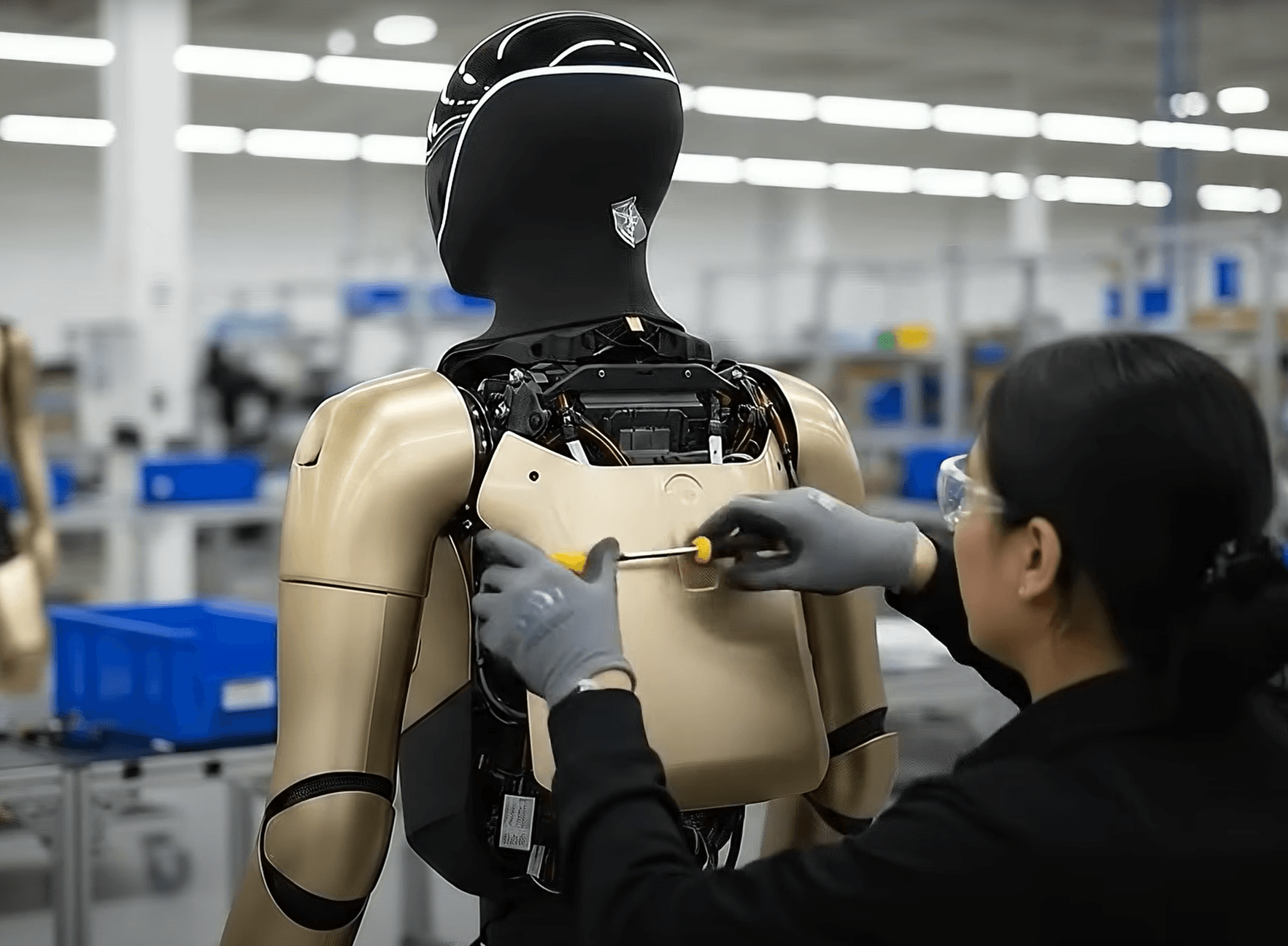
Tesla’s supplier audits for the Optimus humanoid robot are often described as demanding—sometimes even extreme. Yet framing these audits purely as a compliance hurdle misses the larger picture. In reality, Tesla’s audit standards are redefining how humanoid robots are manufactured at scale, while simultaneously reshaping the strategic position of suppliers capable of passing them.
At their core, Tesla’s audit standards enforce what can be understood as an Optimus Manufacturing Readiness Stack—a layered framework spanning hardware design, manufacturing systems, quality control, cost discipline, supply chain governance, and ESG compliance. Together, these gates determine whether a humanoid robot can move from prototype demonstrations to true mass production.
While Tesla does not publicly label such a framework, its supplier audits already function as one.
Manufacturing, Not Intelligence, Is the Real Bottleneck
Public discussion around humanoid robots and AI robotics remains dominated by intelligence—perception models, motion planning, reinforcement learning, or dexterous manipulation demos. Tesla’s audit regime points decisively in a different direction.
Optimus is being evaluated not by how impressive it looks in controlled lab environments, but by whether it can withstand automotive-grade manufacturing discipline: yield stability, cost ceilings, global scalability, regulatory compliance, and supply chain resilience.
This shift becomes clear when Tesla’s audits are examined through the lens of manufacturing readiness rather than AI capability.
The Optimus Manufacturing Readiness Stack
Level 1 — Product & Technology Readiness
(Hardware Designed for Scale)
At the foundation of the stack lies hardware architecture optimized for mass production. Tesla emphasizes integrated joint modules that combine motors, reducers, controllers, and encoders into standardized units. Precision components—such as planetary roller screws, high-resolution encoders, and force-torque sensors—are assessed not only for performance, but for dimensional consistency, reliability, and modular assembly compatibility.
The signal is explicit: Optimus hardware is engineered for throughput and repeatability first, not experimental flexibility.
Level 2 — Manufacturing System Validation
(Factory Reality Check)
Tesla applies process audits rooted in VDA 6.3 and Formel Q, standards traditionally associated with high-volume automotive production. These audits scrutinize workstation stability, automation levels, line balancing, bottlenecks, and failure containment. Target benchmarks reported by industry sources—such as cycle times approaching eight minutes per unit—underscore that Optimus is being validated as a production system, not a low-volume robotics build.
Level 3 — Quality & Process Capability
(Statistical Control Over Inspection)
Yield discipline forms the next gate. Suppliers are expected to achieve yield rates above 95%, supported by statistical process control rather than post-assembly sorting. For critical characteristics, Tesla requires Ppk data during pilot runs and Cpk data after SOP, embedding statistical stability directly into supplier qualification. Safety-critical processes trigger formal corrective action plans within defined timelines. This layer reflects a core Tesla philosophy: quality must be engineered into the process, not inspected at the end.
Level 5 — Supply Chain Governance
(Ecosystem-Level Control)
Tesla’s audit scope extends beyond Tier-1 suppliers. Sub-supplier management, traceability from raw material to shipment, and serial- or batch-level tracking are enforced. Tesla conducts on-site evaluations of critical downstream vendors, treating the supply chain as a single integrated system. For humanoid startups accustomed to loosely coupled supplier networks, this layer represents one of the most underestimated barriers to scale.
Level 6 — ESG & Compliance Readiness
(Enterprise Integration)
At the top of the stack sits enterprise governance. Suppliers are expected to operate formal environmental management systems and demonstrate compliance with labor, human rights, and employee welfare standards. This aligns Optimus with Tesla’s broader ESG framework and signals that humanoid robots are being absorbed into Tesla’s mainstream industrial footprint, not treated as experimental projects.
Why These Audit Standards Redefine the Industry
Viewed collectively, these layers explain why Tesla’s audit standards matter far beyond Optimus itself.
Many humanoid programs today can pass Level 1 and occasionally Level 2. Very few survive Levels 3 and 4, where yield discipline collides with aggressive cost ceilings. Almost none are structurally prepared for Levels 5 and 6, where supply chain governance and enterprise compliance become gating factors. Tesla’s audits do more than screen suppliers—they codify industrial reality.
What Suppliers Gain From Passing Tesla’s Audit Gates
For suppliers, Tesla’s audits are undeniably demanding. Yet for those that pass, the benefits extend well beyond a single program.
-
First, supplier designation is a long-cycle asset. Qualification typically leads to multi-year framework agreements rather than short-term purchase orders. This provides volume visibility and justifies investment in automation, tooling, and overseas manufacturing capacity.
-
Second, Tesla’s audits function as a capability accelerator. Compliance with ISO 9001, IATF 16949, VDA 6.3, and SPC requirements forces suppliers to upgrade internal systems—from quality governance to process engineering. Once established, these capabilities are transferable across automotive, robotics, and advanced industrial customers.
-
Third, passing Tesla’s audits delivers a powerful market signaling effect. Recognition as a Tesla-qualified supplier—even informally—enhances credibility with other OEMs, system integrators, and institutional investors. In capital-intensive segments such as actuators, precision components, and robotics subsystems, this validation can materially lower financing friction.
-
Fourth, Tesla’s cost-down discipline pushes suppliers to internalize manufacturing economics earlier. Rather than relying on volume alone to defend margins, suppliers are incentivized to redesign products and processes for automation compatibility, yield stability, and global replication—shifting their role from contract manufacturers toward scalable industrial platform providers.
-
Fifth, Tesla’s global governance requirements create pathways to internationalization. Suppliers capable of meeting overseas manufacturing, traceability, and ESG standards are structurally prepared to support multinational OEMs beyond Tesla itself.
-
Finally, within the humanoid ecosystem, Tesla’s audits act as a form of early certification. As humanoid robots move toward mass production, OEMs will increasingly favor suppliers already proven under automotive-grade scrutiny. For qualified suppliers, Tesla’s audit becomes a first-mover advantage in a market where formal standards have yet to emerge.
A Quiet but Decisive Shift
Tesla does not need to publicly name a Manufacturing Readiness Stack. Its supplier audits already enforce one.
And in doing so, Tesla is quietly redefining humanoid robotics—not as an AI showcase, but as a manufacturing problem governed by yield, cost, compliance, and supply-chain discipline.
For suppliers, the message is equally clear: Tesla’s audits are painful in the short term, but transformative in the long term. Humanoid leadership will not be decided by who has the most compelling demo, but by who can climb—and sustain—the full Manufacturing Readiness Stack
Continue exploring Optimus coverage for updates on mass production timelines:
- Tesla Launches Final Audits of Potential Suppliers for Optimus (Mass Production I)
- Why Tesla's Audit Standards Redefine Humanoid Manufacturing (Mass Production II)
- China VS TESLA Two Paths to Humanoid Robot (Mass Production III)
Tesla’s Humanoid Robot Supply Chain coverage articles:
Why the Tesla Supply Chain for Optimus is Consolidating in Chinese Yangtze River Delta
Explains the geographic and industrial reasons behind the heavy concentration of Optimus suppliers in China's Yangtze River Delta region.




Leave a comment