


Executive Summary
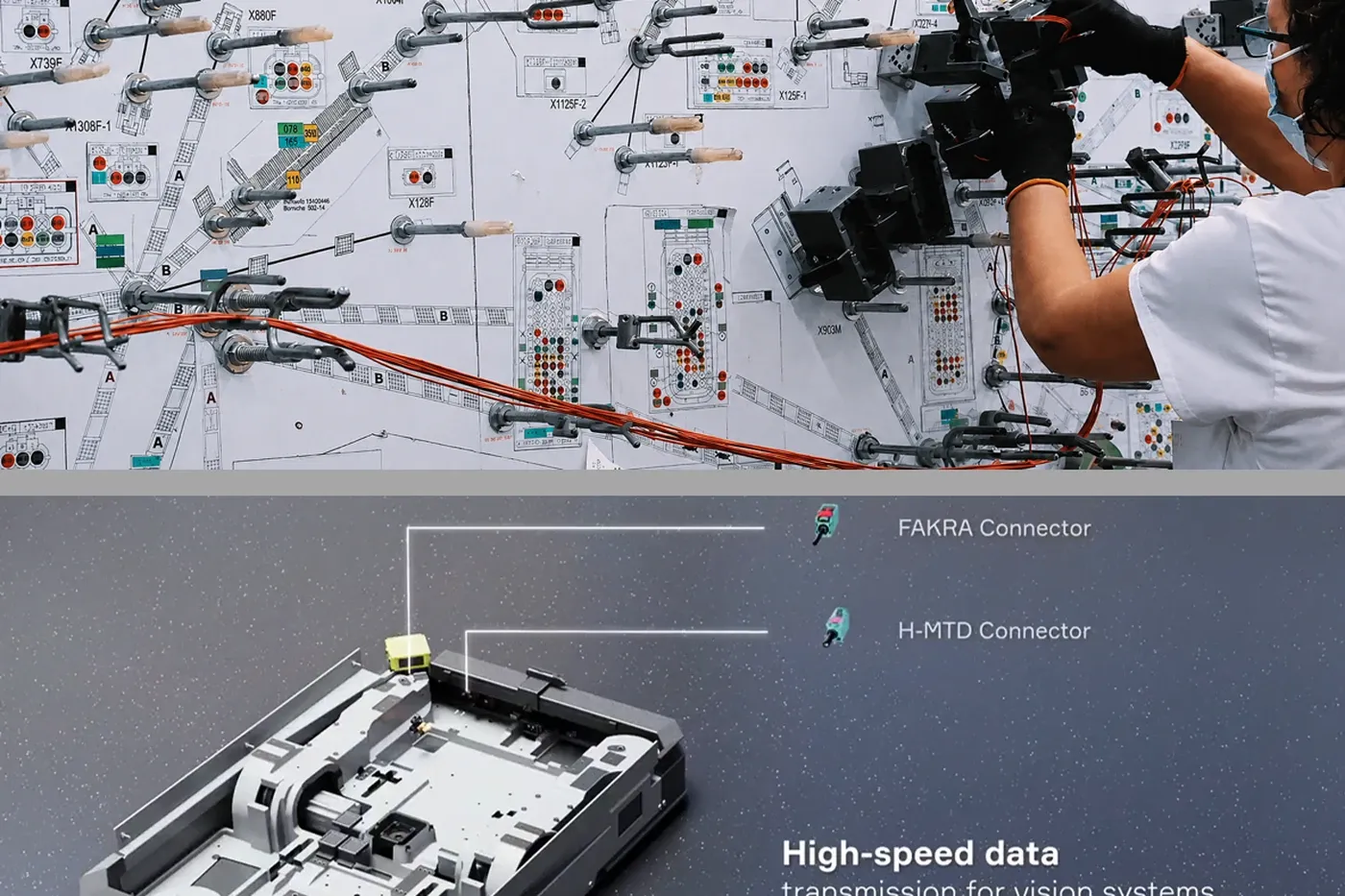
Driven by advances in AI and embodied intelligence, the global humanoid robot market is moving from engineering prototypes toward commercial deployment. Industry attention remains focused on foundation models and dexterous hands, but the wire harness has emerged as a system-level constraint that governs reliability, serviceability, and the ability to scale production.
Humanoid platforms overturn conventional wiring assumptions. A typical robot packs 28 to 40 actuated joints and more than 100 connectors into a compact frame, while the harness is expected to remain a small fraction of the hardware bill of materials. It must survive high-velocity internal routing—joint angular velocities on the order of 720°/s—inside bend radii as tight as three times the cable outer diameter, across millions of three-dimensional torsion cycles. At the same time, the data backbone is scaling toward 10 Gbps to 100 Gbps aggregate rates to serve hundreds of sensors alongside noisy, high-voltage motor lines.
This deep dive examines the engineering requirements, manufacturing and quality demands, cost and supply-chain evolution, and the global standards reshaping next-generation humanoid electrical architectures.
Industry Context
Electrical interconnection has long been treated as a mature discipline. Automotive manufacturers routinely manage vehicle harnesses exceeding 3–5 km in total cable length, commercial aircraft rely on wiring systems qualified for demanding environmental conditions, and industrial robots have adopted flexible cables that survive millions of repetitive bending cycles.
Humanoid robots combine the most demanding characteristics of all three. Unlike automobiles, whose wiring remains largely stationary after assembly, humanoids operate under continuous motion. Unlike aircraft, whose moving electrical systems are confined to specific mechanisms, humanoids distribute dynamic interconnections throughout the entire body. Unlike industrial arms, where cables are commonly routed externally through dress packs or drag chains, humanoids increasingly route wiring internally through compact joints with limited installation space and restricted bend radii.
A typical humanoid integrates 28 to 40 actuated joints, more than 100 connectors, multiple cameras, force sensors, inertial measurement units, microphones, distributed motor controllers, and high-performance computing modules. Each subsystem requires reliable power delivery and deterministic data communication while sharing mechanical space with motors, reducers, bearings, and structural components. As a result, wire harnesses are no longer independent electrical assemblies; they are integral elements of the robot's mechanical architecture.
Engineering Comparison Across Industries
| Engineering Factor | Industrial Robot | Automotive | Aerospace | Humanoid Robot |
|---|---|---|---|---|
| Dynamic motion | Medium | Low | Medium | Very High |
| Multi-axis torsion | Low | Low | Medium | Very High |
| Internal cable routing | Limited | Moderate | High | Extensive |
| Packaging density | Medium | Medium | High | Very High |
| Weight sensitivity | Medium | High | Very High | Very High |
| High-speed data integration | Medium | High | High | Very High |
| Production volume | High | Very High | Low | Emerging |
Humanoids do not simply inherit wiring practice from adjacent industries; they combine multiple constraints into a single platform, creating a new class of electrical architecture.
Technology
Designing a humanoid harness requires balancing four competing objectives: mechanical durability, electrical performance, manufacturing efficiency, and lifecycle reliability. Optimizing one often compromises another. Adding shielding improves electromagnetic compatibility but adds weight. Reducing cable diameter saves space but can increase voltage drop and shorten fatigue life. Adding connectors improves serviceability while introducing additional failure points. Successful design therefore depends on system-level optimization rather than component-level selection.
Hollow-Shaft Routing and 3D Dynamic Fatigue
Dynamic fatigue is a defining challenge. Industrial cables are qualified for repetitive bending within predictable motion paths; high-flex robotic cables may survive 5 to 20 million drag-chain cycles depending on bend radius, speed, and operating conditions. Humanoid joints face a more chaotic environment: a shoulder, hip, or ankle can simultaneously undergo bending, torsion, axial compression, extension, and vibration while walking, lifting, climbing stairs, or recovering from a disturbance.
To maximize range of motion and protect wires from snagging, the industry has shifted toward hollow-shaft internal routing. Passing a dense bundle through the center of a hollow-shaft motor or harmonic drive can constrain the minimum bend radius to roughly three times the cable outer diameter. Under angular velocities up to about 720°/s, these three-dimensional loading conditions accelerate conductor fatigue and, more critically, introduce fretting wear between adjacent insulation layers inside the bundle.
Engineers are moving away from standard PVC and standard industrial polyurethane insulation and adopting:
Ultra-fine stranded conductors using oxygen-free copper or silver-plated copper alloys, at wire diameters around 0.05 mm or thinner.
Modified fluoroplastics (PTFE/ETFE) and expanded PTFE (ePTFE), which offer a very low coefficient of friction to reduce internal fretting while allowing thinner insulation walls.
Optimized strand lay lengths and counter-directional twisting, which neutralize internal mechanical stress during multi-axis torsion.
High-Bandwidth Signal Integrity and EMI Shielding
With edge AI compute, HD depth cameras, and high-density tactile arrays in dexterous hands, the data backbone demands substantial bandwidth—often scaling toward 10 Gbps to 100 Gbps aggregate rates with sub-10 ms latency thresholds. The primary bottleneck is routing high-frequency differential pairs within millimeters of high-voltage, high-current motor lines—commonly a 48 V to 100 V+ DC bus—undergoing high-frequency PWM switching. This proximity produces severe electromagnetic interference. Traditional heavy braided shielding is effective but adds weight and stiffness that degrade joint flexibility.
Advanced architectures address this with micro-coaxial cables and dual-layer aluminum foil combined with ultra-thin, high-density tin-plated copper braids exceeding 90% coverage. Bulky RJ45 or M12 connectors are replaced with micro-miniature, 360-degree fully shielded differential connectors—such as the ix Industrial interface jointly developed by Hirose and Harting and standardized under IEC 61076-3-124, which supports 10 Gbps over Category 6A in roughly 75% less space than RJ45—maintaining continuous shield grounding across the structural frame.
Engineering Analysis: Manufacturing, Quality, and Functional Safety
Manufacturing and Quality Assurance
Manufacturing quality matters as much as component selection. Critical processes include cutting, stripping, crimping, crimp-force monitoring, pull-force testing, continuity testing, high-potential (Hi-Pot) testing, and automated optical inspection. IPC/WHMA-A-620—updated to Revision F in 2025—provides the principal workmanship standard for cable and wire harness assemblies. Given the high-vibration, safety-critical nature of walking platforms, assembly lines should enforce Class 3 (high-reliability) acceptance criteria, which require gas-tight crimp geometry, zero severed conductor strands, and full process traceability.
Hardware-Level Functional Safety Redundancy
Robots operating alongside people are expected to satisfy Performance Level d (PLd), Category 3 functional safety under ISO 13849-1. In a Category 3 architecture, a single fault must not cause loss of the safety function. This directly shapes harness design in two ways.
Dual-channel physical isolation. Safety-critical paths such as joint-encoder feedback and emergency-stop loops can no longer share a cable jacket or multi-pin connector insert with high-power motor phases. They must be separated by defined air and creepage distances or routed in independent grounded conduits.
Anti-failure redundancy. Critical data paths incorporate redundant, interleaved cores positioned on diagonally opposite connector pins, so that a localized pin failure—from micro-fretting or partial fluid ingress—cannot disable both safety channels at once.
Commercial Progress: Cost Structure and the Shift to Flexible Printed Circuits
The harness is a small share of total robot cost yet has an outsized effect on reliability, factory first-pass yield, and warranty lifecycle costs. Estimates of its share vary with scope: the bare harness assembly is often placed at roughly 1.5% to 2.5% of the hardware budget, while broader "wiring and connector" categories that include distributed interconnect are estimated considerably higher. Within the harness assembly itself, cost concentrates as follows:
Connectors and terminal interfaces — 45% to 55%. The largest single cost driver.
Specialized high-flex cable and materials — 25% to 30%.
Advanced assembly, potting, and testing — 20% to 25%.
To approach the long-term mass-market cost targets that leading developers have signaled—Tesla's Elon Musk has repeatedly cited a $20,000 to $30,000 per-unit target for Optimus at full scale, well below current build costs—the interconnect architecture must move away from low-volume aerospace and specialized industrial supply chains.
Rigid-Flex and the FPC Alternative
To reduce cost and weight, design teams are adopting flexible printed circuits (FPC) and flexible flat cables (FFC) to replace round wire bundles in semi-static sections such as the torso, forearm, and thigh cavities. FPCs can be produced on automated equipment at a fraction of the cost of manually bundled wires, driving assembly labor toward near zero.
The trade-off is motion capability. FPCs excel in tight spaces and simple linear bending, such as hinge joints, but cannot handle the complex multi-axis twisting of 3-DoF shoulder or hip joints. The emerging architecture for mass-commercial humanoids is therefore a rigid-flex hybrid: highly automated FPC sub-assemblies for static routing, coupled to ultra-reliable high-flex round harnesses only at the most dynamic joint interfaces.
The supply base is shifting accordingly—from heavy-industry component makers toward automotive-grade automated harness suppliers such as Aptiv and Kunshan Huguang, and precision consumer-electronics manufacturers such as Luxshare Precision. Having mastered ultra-dense, low-cost micro-connections for premium smartphones, these firms are positioned to commoditize the micro-miniature connectors and high-density crimping that dexterous hands and compact actuators require.
Case in Point: The Specialty-Interconnect Tier and Its Cost Gap
The class of parts that keeps an early humanoid running is visible in commercially available specialty interconnect. Amphenol's FloatCombo floating board-to-board connectors, for example, use a 0.5 mm-pitch mezzanine format that tolerates board-to-board misalignment while carrying up to 5 A per power pin and 10 to 16 Gbps of data, absorbing the micron-scale shifts that rigid connectors cannot survive. Paired with ix Industrial-class 360-degree shielded interfaces (IEC 61076-3-124, roughly 75% smaller than RJ45), this is the toolkit that keeps a walking robot's data link intact beside PWM motor noise.
The trade-off is cost. These aerospace- and automotive-grade parts can run tens of dollars each. Agility Robotics' Digit, deployed with Amazon, GXO, Schaeffler, and Toyota and carrying more than $300 million in forward orders ahead of a 2026 SPAC listing with Churchill Capital Corp XI, shows the approach works commercially on a machine priced around $150,000 to $250,000. But a per-robot interconnect bill of roughly $2,000 to $3,000 is about ten times what a $20,000 Optimus target allows.
The cost pressure concentrates in connectors. Industry estimates place connectors at roughly 30% of harness raw-material cost, while domestic localization of the micro-miniature, high-bandwidth joint connectors remains near 10%, the single largest opening for cost reduction. Back-calculating from an approximately $11,000 Optimus bill of materials, the entire harness-and-connector budget must be held near $220 to $330 per robot, against roughly $350 to $500 for a conventional EV harness that is heavier but far less connector-dense. Closing that gap points back to automated crimping and connector localization rather than premium specialty sourcing.
Market Perspective: Global Standards and Compliance
As humanoids move beyond pilot deployments into the major markets of China, the United States, and Europe, compliance with recognized engineering standards becomes a market-access requirement rather than an option. The table below summarizes the standards with the most direct impact on harness design.
| Standard / Directive | Domain / Scope | Impact on Humanoid Wire Harnesses |
|---|---|---|
| IPC/WHMA-A-620 Class 3 (Rev F, 2025) | Workmanship & inspection | Mandates gas-tight crimp geometry, zero severed strands, non-wicking solder joints, and full traceability for high-vibration environments. |
| ISO 13849-1 (PLd / Cat. 3) | Functional safety | Requires physical isolation of safety-related signals (E-stop, sensor buses) from motor power lines so no single fault disables the safety function. |
| EU Machinery Regulation 2023/1230 | European market access (from 20 Jan 2027) | Replaces Directive 2006/42/EC; adds assessment of autonomous and software-driven risks, pushing hardware-level safety redundancy into the harness. |
| UL 746C / VW-1 / FT1 | North American safety | Requires flame-retardant ratings for plastics, jackets, and connectors to mitigate thermal-runaway risk from high-capacity batteries. |
| CE-EMC (2014/30/EU) | Electromagnetic compatibility | Enforces radiated-emission limits; penalizes inadequate shielding or improper grounding architectures. |
| RoHS 3 / REACH | Environmental compliance | Restricts hazardous substances (lead, phthalates) in insulation and solder; mandatory for EU market entry. |
| CR Certification (China, voluntary) | Chinese market access | China Robot Certification is currently voluntary; compulsory CCC certification applies to in-scope electrical products. Type testing checks module endurance and multi-axis cable life. |
Standards references verified against ISO, IPC/WHMA, EU EUR-Lex, and CNCA / China Robot Certification sources, July 2026.
Challenges
Several obstacles stand between current prototypes and reliable mass production. Fretting wear inside tightly packed hollow-shaft bundles remains difficult to predict and to test accelerated-life against real 3D motion profiles. Shielding that is light enough to preserve joint flexibility yet effective against PWM noise is an active area of trade-off. Connector miniaturization increases assembly-precision requirements and raises the stakes on crimp quality. Finally, standards for humanoid-specific electrical safety are still consolidating, which complicates simultaneous certification across China, the United States, and Europe.
RobotToday Analysis
Technical significance
Humanoid robots integrate electrical, mechanical, thermal, and software systems into a compact, continuously moving platform. Decisions about routing, connector placement, shielding, and serviceability affect several engineering disciplines at once. Wire harnesses are best understood as system-level assets that help define the mechanical envelope, not as procurement line items.
Commercial significance
Manufacturing scale and yield stability, more than isolated engineering breakthroughs, have historically separated durable products from perpetual prototypes in automotive and consumer electronics. Firms that can produce consistent, automated electrical assemblies with low defect rates and design-for-manufacturing routing are positioned to gain cost and volume advantages as production scales.
Remaining challenges
Electrical interconnect failure is among the most common root causes of intermittent faults in mobile machinery. A single broken wire in a hip joint or an oxidized micro-pin in a finger can halt an automated line. Designing for dynamic reliability and field-serviceable modularity is a practical indicator of product maturity.
Industry outlook
As humanoid robotics enters large-scale commercialization, advances in intelligence will attract public attention. Behind them, the ability to engineer robust, maintainable, and scalable harness systems will help determine which platforms succeed. Tomorrow's commercial robots will be judged less by demonstration videos and more by operational metrics—uptime, availability, mean time between failures, and mean time to repair.
References
[1] ISO 10218-1:2025 — Robotics — Safety requirements, Part 1: Industrial robots. https://www.iso.org/standard/73933.html
[2] ISO 13849-1 — Safety of machinery, safety-related parts of control systems (PL / Category). https://www.pilz.com/en-US/support/law-standards-norms/functional-safety/en-iso-13849-1
[3] IPC/WHMA-A-620F (2025) — Requirements and Acceptance for Cable and Wire Harness Assemblies. https://blog.ansi.org/ansi/ipc-whma-a-620f-2025-cable-wire-harness-assembly/
[4] EU Machinery Regulation (EU) 2023/1230 — applies from 20 January 2027. https://eur-lex.europa.eu/EN/legal-content/summary/machinery-safety-requirements.html
[5] IEC 61076-3-124 — ix Industrial interface (Hirose / Harting). https://www.hirose.com/en/product/en/pr/ix_industrial/
[6] Churchill Capital Corp XI — Form 8-K (SEC, 2026). https://www.sec.gov/Archives/edgar/data/0002074973/000121390026071287/ea029548401ex99-1.htm
[7] China Robot (CR) Certification — scope and voluntary status. https://www.baclcorp.com.cn/show.asp?para=en_2_49_2431
[8] Tesla Optimus — price target and production status. https://standardbots.com/blog/tesla-robot









Leave a comment