


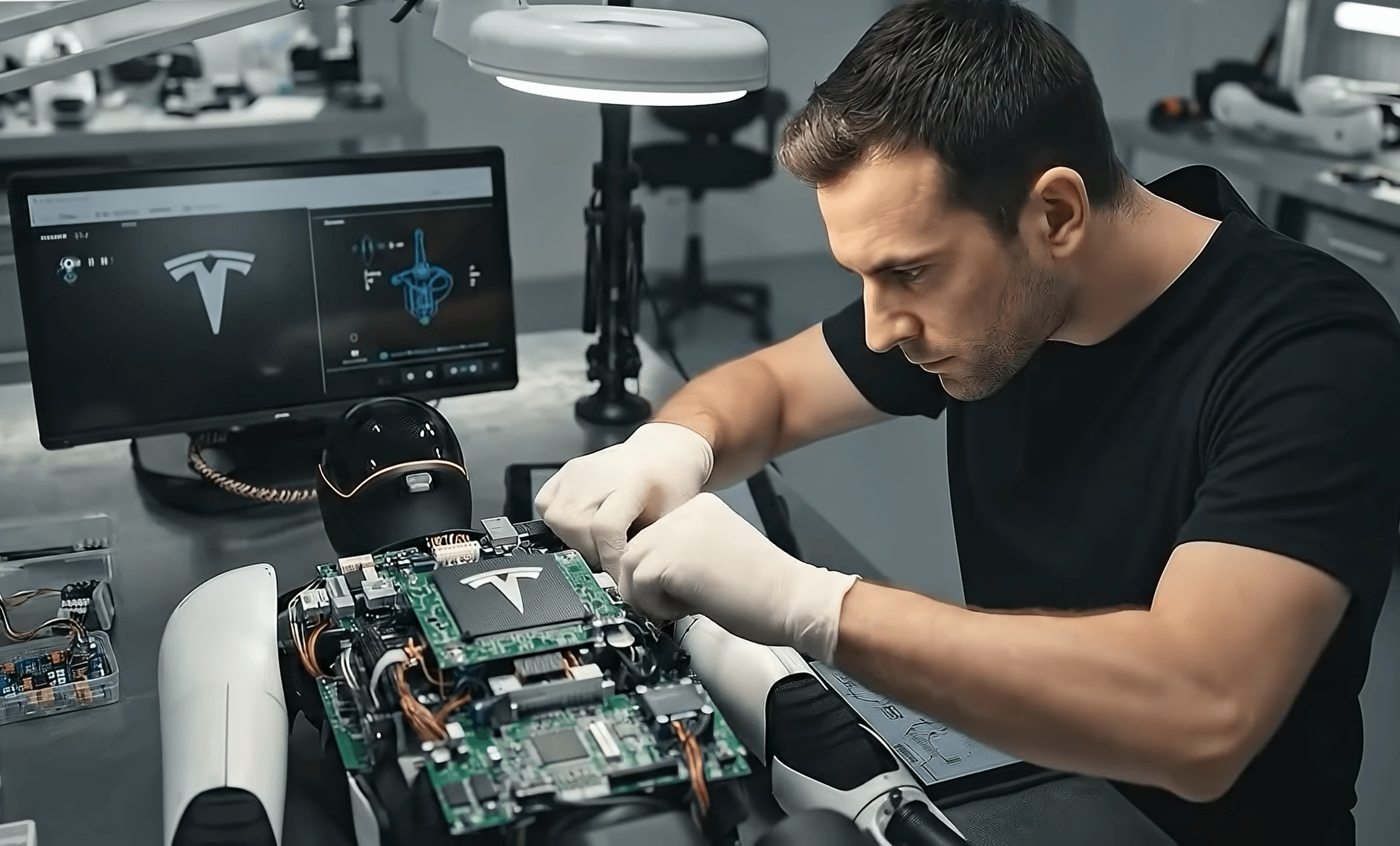
From Prototype Development to Manufacturing Readiness
Tesla has initiated a final round of supplier audits for its Optimus humanoid robot, marking a clear transition from prototype development to manufacturing readiness validation ahead of planned mass production.
According to industry sources, Tesla began structured Optimus supplier audits as early as mid-2025, with a concentrated final validation window conducted in early December. These audits are widely viewed as a prerequisite for official supplier designation, framework agreements, and production ramp approval for the first mass-manufactured generation of Optimus.
What Tesla Is Auditing: Three Manufacturing Priorities
The audit scope centers on three critical manufacturing domains: integrated joint modules, core precision components, and final assembly consistency.
Integrated joints—widely regarded as the most cost- and performance-critical subsystem in humanoid robot manufacturing—are being evaluated for highly integrated designs combining motors, reducers, controllers, and encoders, enabling modular assembly and high-throughput production.
Precision Components and Assembly Capability Under Review
In parallel, Tesla is reviewing suppliers of precision mechanical components such as planetary roller screws, as well as advanced sensor systems used in dexterous hands, joint feedback loops, and force-torque sensing.
Precision machining capability, multi-axis CNC capacity, and final robot assembly readiness form a central part of the assessment—reinforcing Tesla’s emphasis on manufacturing repeatability over prototype performance.
Automotive-Grade Benchmarks Define the Audit Bar
Industry participants indicate that Tesla’s audit criteria are tightly defined and automotive-grade.
Key benchmarks reportedly include production cycle times approaching eight minutes per unit, yield rates exceeding 95%, and strict cost control aligned with a long-term target of approximately USD 20,000 per robot. Suppliers are also expected to demonstrate overseas manufacturing capability, global supply scalability, and Tier-2 supplier governance.
Suppliers Widely Linked to the Optimus Supply Chain
Several Chinese industrial suppliers are widely reported by industry sources to be involved across key Optimus subsystems, including actuators, joint modules, motors, structural components, bearings, and precision machining, reflecting Tesla’s reliance on mature automotive-grade manufacturing ecosystems in East Asia.
Actuators, Motors, and Precision Mechanics
Among actuator and integrated joint module suppliers, companies frequently linked to the Optimus supply chain include Sanhua Intelligent Controls, Top Group, and Lingyi iTech, all of which have extensive experience in high-volume automotive and electromechanical manufacturing.
In motors and drive systems, Wolong Electric is often cited due to its global manufacturing footprint and long-standing presence in industrial motor supply. For precision bearings and mechanical components, Wuzhou Xinchun is widely referenced for its expertise in high-precision bearing systems relevant to humanoid joint assemblies.
Structural Parts, Machining, and Assembly Expertise
Structural components and precision machining capabilities are commonly associated with suppliers such as Changying Precision, known for advanced pin-shaft processes and multi-axis CNC capacity.
In enclosure and high-precision assembly segments, Lens Technology has been reported as participating in Optimus-related manufacturing through its experience in complex structural and glass components.
Why This Audit Phase Matters
While Tesla has not publicly confirmed its final supplier list, industry consensus suggests that this audit phase will directly shape the first wave of designated Optimus suppliers in 2026, laying the manufacturing foundation for large-scale humanoid robot production.
The audit milestone underscores a broader shift in the humanoid robotics industry: Optimus is no longer evaluated as a robotics demonstration platform, but as an automotive-grade manufactured product—where yield discipline, cost ceilings, and global supply chain readiness now define competitiveness.
Editor’s Note
Company references are based on industry reporting and supply-chain analysis. Tesla has not formally disclosed its Optimus supplier list.
Continue exploring Optimus coverage for updates on mass production timelines:
- Tesla Launches Final Audits of Potential Suppliers for Optimus (Mass Production I)
- Why Tesla's Audit Standards Redefine Humanoid Manufacturing (Mass Production II)
- China VS TESLA Two Paths to Humanoid Robot (Mass Production III)
Tesla’s Humanoid Robot Supply Chain coverage articles:
Why the Tesla Supply Chain for Optimus is Consolidating in Chinese Yangtze River Delta
Explains the geographic and industrial reasons behind the heavy concentration of Optimus suppliers in China's Yangtze River Delta region.
For more real-time updates on robotics and AI, visit our Industry Briefing section.




Leave a comment