


AGRICULTURAL ROBOTICS | Weeding & Crop Management Robots: The $34B Market Disruption Hiding in Plain Sight
Weeds cost agriculture $150B+ annually. Four robot platforms are disrupting a $34–42B herbicide market that chemical innovation has failed to solve. Deep-dive on Carbon Robotics, Ecorobotix, Verdant, and FarmWise.
INTRODUCTION
Weeds cost global agriculture more than $150 billion annually in lost yields.
They compete with crops for water, nutrients, and sunlight. They harbor disease vectors. They drive the $34–42 billion annual global herbicide spend — one of farming’s largest variable costs.
Despite decades of chemical innovation, the problem is accelerating. Herbicide-resistant superweeds now affect 500+ species across 92 countries. The USDA reported in 2022 that resistant weeds cause roughly 30% annual crop losses in the Americas.
Three forces now converge: labor cost pressure, herbicide resistance, and tightening pesticide regulation. No other robotics segment carries all three simultaneously.
The EU Farm to Fork Strategy mandates 50% pesticide reduction by 2030. The organic market — chemical-free by definition — has grown to $130+ billion globally. And the pipeline of new herbicide modes of action is functionally empty for the next decade.
Four technology platforms are now commercially deployed and scaling. This is the deep-dive analysis of that opportunity.
Scope of This Analysis
This analysis covers the Western commercial market only — the $48–56B tracked segment spanning the US, Europe, and Australia. All companies, market figures, and 2030 projections refer exclusively to this segment.
China operates a separate $80–150B state-directed ecosystem. Its manufacturers, procurement channels, and subsidy structures are structurally distinct. Mixing the two markets in a single analysis obscures both.
China vs. Rest of World will be covered as a dedicated comparative series.
MARKET OPPORTUNITY: MAPPING THE $34B TARGET
The opportunity is best understood by mapping it against the existing spend it targets — not by starting with current robotics market size, which remains small relative to the underlying problem.
| Market Segment | 2024 Value | 2030 Projection | CAGR |
Global herbicide market | $34–42B | $52–61B | ~6% |
Global weed control (all methods) | ~$33B | ~$69B | ~5.9% |
Laser weed control robots | $0.33B | $1.09B | ~27% |
Robotic weeding machines (hardware + software) | $0.31B | $0.85B+ | ~19% |
Precision spraying robots (UHP segment) | Emerging | $2–4B est. | 35–50% |
Sources: IMARC Group, ResearchNester, Coherent Market Research, Grand View Research (2024–2025). UHP spraying projection is author estimate.
The critical insight: there is a 100:1 gap between the problem ($34B+ herbicide spend) and the current robotic solution (~$330M). That gap is the measure of a disruption just beginning.
Carbon Robotics estimates its TAM at $41 billion based on specialty crop acreage alone. Its 2025 row crop expansion into corn and soybeans roughly triples that base.
100:1 gap between the $34B+ herbicide problem and the $330M robotic solution · disruption just beginning
THE FOUR TECHNOLOGY PLATFORMS
The segment has consolidated around four commercial platforms. Each targets different crops, farm sizes, and weed control philosophies.
| Platform | Mechanism | Weed Reduction | Primary Crops | Price Range |
Laser Weeding | CO₂ laser destroys weed meristem | 99% weed mortality; no herbicide | Specialty crops, leafy greens, row crops | $600K–1.2M+ |
UHP Precision Spraying | AI plant-by-plant targeting; 6×6cm spray footprint | 70–95% herbicide reduction | Sugar beet, lettuce, carrots, broadacre | ~$250–350K |
Multi-Function Precision Sprayer | Computer vision + micro-turret nozzles; 270 shots/sec | Up to 99% input reduction; weed + fertilize + thin | Specialty row crops, horticulture, corn, soy | ~$500K |
Mechanical Robotic Cultivator | AI-guided physical cultivation; in-row and between-row | Herbicide-free mechanical removal | Vegetables, specialty crops, organic | $150–400K |
Sources: Carbon Robotics, Ecorobotix, Verdant Robotics, FarmWise company data (2024–2025).
KEY PLAYERS: DEEP PROFILES
1. Carbon Robotics — The Laser Pioneer
Founded: 2018 | HQ: Seattle, WA | Funding: $97M+ | Backers: NVIDIA Ventures, Sozo Ventures, Anthos Capital
Carbon Robotics proved laser weeding was commercially viable — not just a lab concept.
Its LaserWeeder G2 has now eliminated 10 billion+ weeds across three continents. That milestone took just 24 months of commercial deployment.
The core AI is the Large Plant Model (LPM). It was trained on 150 million+ labeled plant images. It targets weeds at the meristem with sub-millimeter accuracy. Verified weed mortality rate: 99%.
The economics are documented. Braga Fresh (California) replaced three 25-person weeding crews with two LaserWeeders. Cost dropped from $900/acre to $268/acre — a 70% reduction. Triangle Farms reported a 50% crop yield increase after one year of use.
The G2 range now spans 8-foot units for small specialty farms to 40-foot units for organic corn and soy. Machine payback: 1–3 years. Machine lifespan: 7–10 years.
NVIDIA’s investment through NVentures signals that the AI compute behind Carbon’s platform has value well beyond the farm.
$268/acre Carbon Robotics deployment cost vs $900/acre hand weeding · 70% cost reduction · 1–3 year payback
2. Ecorobotix — The Precision Spraying Champion
Founded: 2011 | HQ: Yverdon-les-Bains, Switzerland | Funding: $150M (Series C: $45M 2024 + Series D: $105M 2025) | Lead: Highland Europe
Ecorobotix is the most heavily funded pure-play in the segment. Its approach differs sharply from Carbon’s. Rather than eliminating herbicides, it applies them with precision so extreme that chemical and regulatory concerns largely disappear.
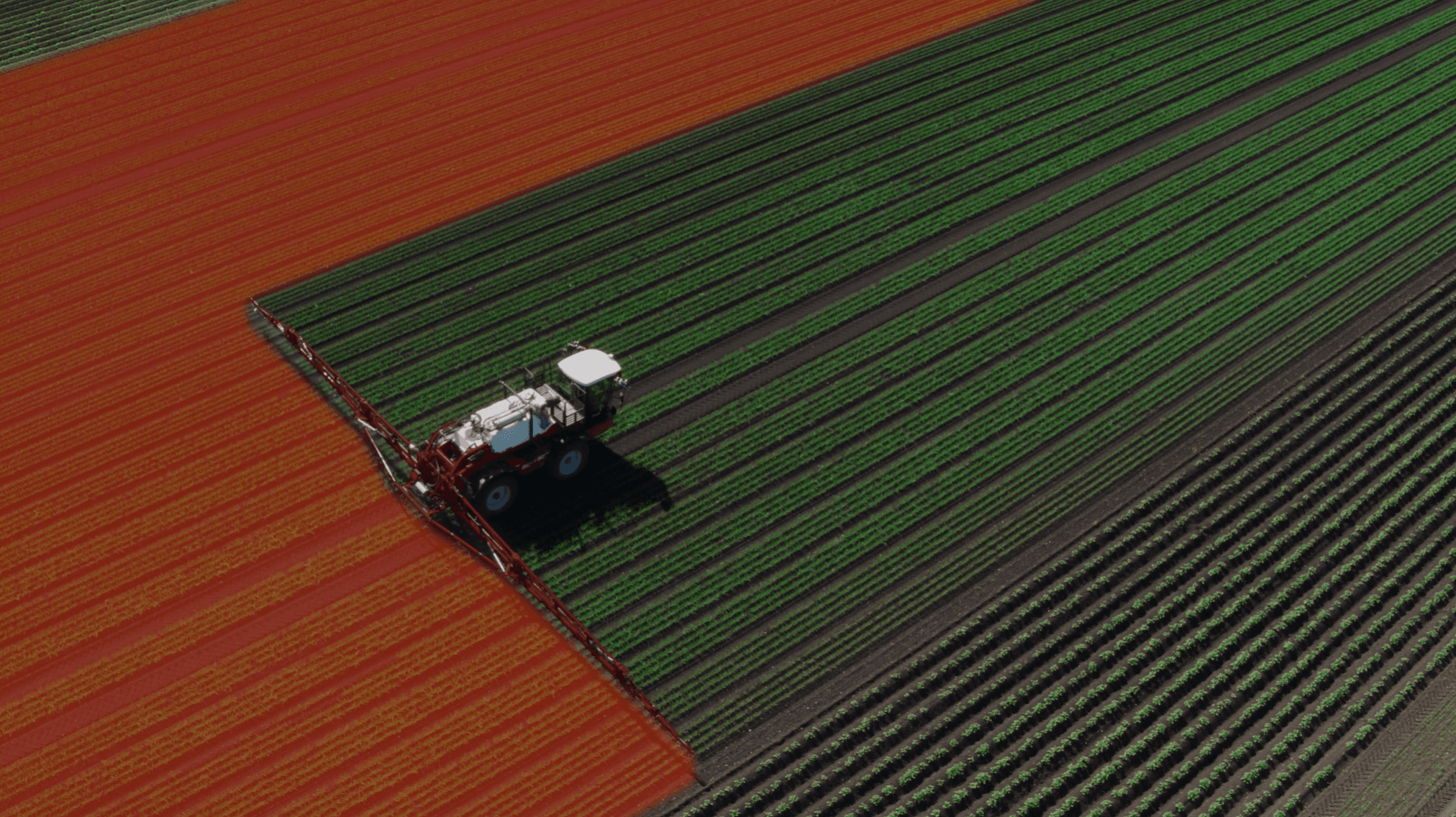
The ARA UHP sprayer’s Plant-by-Plant™ system scans a field in under 250 milliseconds. It delivers herbicide in a 2.4×2.4-inch footprint per target. The result: 70–95% herbicide reduction with equivalent weed control.
Regulatory certification is a unique commercial driver. Germany’s Julius Kühn Institute certified ARA for 95% spray drift reduction. The Netherlands awarded Dutch DRT-list status.
For European farmers facing the EU Farm to Fork mandate, ARA is not just a cost tool — it is a compliance tool. That changes the investment calculus entirely.
ARA also handles liquid fertilizers, fungicides, insecticides, and biologicals. It generates ROI across the full season — not just during peak weed pressure. With 25 crop algorithms deployed and more in development, its software moat deepens with each unit sold.
$150M total funding raised · Series D 2025 · 13 countries deployed · 95% spray drift certified
3. Verdant Robotics — The Multi-Function Disruptor
Founded: 2018 | HQ: Stockton, CA | Product: SharpShooter | Status: Commercially deployed, US
Verdant’s SharpShooter operates at 270 targeted applications per second. It scans approximately 700,000 plants per hour. At 1,800 pounds, it is light enough for wet or damp fields.
It does more than weed. In a single pass, it weeds, fertilizes, thins crops, and collects field data. Growers report ROI in 6–18 months. Input savings reach up to 99% in some applications.
In organic specialty crops — where hand weeding costs $900+ per acre — the SharpShooter is the first economically viable mechanized alternative.
The platform runs across 35+ crops: organic carrots, broccolini, corn, and soy. Verdant is now collaborating with SwarmFarm Robotics. The goal: bring SharpShooter precision to autonomous Midwest row crop operations.
270/sec targeted applications per second · 700K plants/hour scanned · 6–18 month payback
4. FarmWise — The Mechanical Cultivator
Founded: 2016 | HQ: San Francisco, CA | Product: Titan FT-35 | Focus: Organic and conventional vegetable operations
FarmWise takes the mechanical approach. No chemicals. No lasers. The Titan FT-35 uses AI vision to distinguish crops from weeds, then removes weeds physically.
The 2024 upgrade added real-time crop analytics. The robot now collects actionable agronomic data while weeding. A single-function machine became a field intelligence platform.
FarmWise is strongest in the organic segment. No herbicide cost means mechanical cultivation economics are particularly compelling. Its AI-guided system targets individual weeds within centimeters of crop plants — previously only achievable by skilled hand crews.
EMERGING TECHNOLOGIES
A second wave is advancing from field trial to early commercialization. These platforms expand the toolbox — and in several cases, redefine what “crop management” means.
| Emerging Platform | Technology | Stage | Key Differentiator | Market Focus |
John Deere See & Spray Ultimate | AI vision; 20 images/sec; 80–90% herbicide reduction | Commercial, scaling | Commodity scale (corn, soy, cotton) | US row crops |
Solix Ag Robotics (Solinftec) | Autonomous AI scouting + pest/weed detection | Commercial | 98% herbicide reduction in monitoring ops | Large-scale row crops |
Ecorobotix ALBA | Plant-by-Plant™ AI extended to turf + non-ag markets | Commercial 2025 | Same AI platform; entirely new TAM | Golf, parks, municipal |
SwarmFarm + Verdant (integrated) | Autonomous swarm platform + SharpShooter precision | Pilot / early commercial | High-precision weeding at low per-acre cost | Midwest row crops |
Dahlia Robotics | AI thinning + weeding combined in one pass | Commercial | Crop thinning + weed removal simultaneously | Lettuce, specialty vegetables |
Sources: Company disclosures, AgFunder News, SkyQuest market analysis (2024–2025).
THE THREE FORCES ACCELERATING ADOPTION
Force 1: Herbicide Resistance Has Created a Crisis Without a Chemical Solution
Resistance is now structural — not cyclical. More than 500 weed species resist at least one active ingredient. Waterhemp and Palmer amaranth resist 7+ herbicide sites of action simultaneously.
New herbicide modes of action take 10–15 years and hundreds of millions to develop. The pipeline is functionally empty for the next decade.
Carbon’s laser destroys weeds regardless of resistance status. Verdant’s SharpShooter applies organic herbicides — which resistance populations have never encountered — with precision impossible by hand. Resistance is, perversely, one of the segment’s strongest tailwinds.
Force 2: Regulatory Pressure Is Creating a Compliance Market
The EU Farm to Fork Strategy mandates 50% pesticide reduction by 2030. Enforcement is already in force. For European farmers, broadcast herbicide at current volumes is increasingly non-compliant.
Ecorobotix’s ARA is certified for 95% drift reduction in Germany and the Netherlands. Farmers adopting ARA are not just cutting costs — they are becoming certifiably compliant. A capital expense becomes compliance infrastructure. The risk calculus changes.
Force 3: The Organic Premium Is Creating a Capital Accumulation Runway
Global organic food sales exceeded $130 billion in 2023. Growth runs at 8–12% annually. Organic farming prohibits synthetic herbicides entirely.
Every organic acre is a potential customer. Most organic weed control still relies on expensive hand labor — the very labor disappearing fastest (see Part 1). Organic farmers are not adopting robots because they are good options. They are adopting them because alternatives have become unworkable.
$130B+ global organic food market · 8–12% annual growth · synthetic herbicides prohibited
COMPETITIVE LANDSCAPE & STRATEGIC POSITIONING
This segment differs structurally from other agricultural robotics markets. Unlike autonomous tractors (OEM-dominated) or dairy systems (Lely, DeLaval), weeding robotics was built by venture-backed startups. This rewards technical differentiation over distribution scale — for now.
| Company | Technology Edge | Stage | Scale (2025) | Regulatory Fit | OEM Risk |
Carbon Robotics | Laser meristem targeting; 150M+ plant dataset | Commercial | 100+ growers; 3 continents | ✓ Herbicide-free | Medium |
Ecorobotix | Plant-by-Plant™ AI; EU-certified 95% drift reduction | Commercial, 13 countries | $150M raised; US scaling | ✓ EU certified | Low |
Verdant Robotics | 270 shots/sec; multi-function platform | Commercial, US | Dozens of farms; expanding | ✓ Organic-compatible | Low–Med |
FarmWise | Mechanical in-row cultivation; zero inputs | Commercial, US | Vegetable farms; CA focus | ✓ Organic-certified | Low |
John Deere See & Spray | 80–90% herbicide reduction at commercial sprayer scale | Commercial, scaling | Thousands of US row crop units | Moderate — still uses herbicides | None (is the OEM) |
OEM Risk = risk of acquisition or displacement by major agricultural OEM. Source: Company disclosures, AgFunder News, Coherent Market Research (2024–2025).
John Deere’s See & Spray is the only platform operating at true commodity scale. For the venture-backed startups, Deere is simultaneously a market validation and a structural ceiling.
The strategic question: can Carbon, Ecorobotix, and Verdant build data moats large enough to remain independent? Or do they become acquisition targets? Both outcomes generate strong investor returns. The segment wins either way.
FARM ECONOMICS: THE ROI FRAMEWORK
Commercial viability depends on farm-level economics. The following uses verified deployment data from operating farms.
| Platform | Machine Cost | Cost/Acre | vs. Conventional | Payback Period | ROI |
Carbon LaserWeeder G2 | $600K–1.2M | ~$268/acre (large ops) | vs. $900/acre hand weeding | 1–3 years | ✓✓✓ |
Ecorobotix ARA | ~$250–350K | 5–30% of broadcast herbicide cost | vs. $200–400/acre chem + labor | 1–2 years | ✓✓✓ |
Verdant SharpShooter | ~$500K | Up to 99% input reduction | vs. $150–900/acre by crop type | 6–18 months | ✓✓✓ |
FarmWise Titan | $150–400K | Near-zero input cost per acre | vs. $400–800/acre organic hand weeding | 2–4 years | ✓✓ |
Sources: Western Growers case study (Braga Fresh), Verdant Robotics grower data, Carbon Robotics field data (2024–2025). Results vary by crop density, weed pressure, and acreage.
Payback periods here are short relative to most agricultural capital investments. A $300K tractor returns value over 10–15 years.
A $1.2M LaserWeeder G2, running 18 hours per day on high-value organic crops, achieves payback in 1–3 years. It then generates $630+ per acre in annual savings for 7–10 years of machine life.
The yield enhancement dimension multiplies the return. Triangle Farms reported a 50% yield increase. Weeding robots are not just cost reducers — they are yield enhancers that monetize through the premium prices quality organic crops command.
2030 OUTLOOK: THE MARKET TRAJECTORY
This is a market in early exponential growth — not steady linear expansion. The technology is proven. The economics are favorable. The regulatory tailwinds are structural. The primary constraint now is manufacturing capacity and farm-by-farm adoption cycles.
| Market Segment | 2024 Size | 2030 Projection | Key Driver |
Laser weeding systems (global) | $330M | $1.1B+ | Row crop expansion |
UHP precision spraying | <$200M | $2–4B | EU regulation + herbicide resistance |
Mechanical robotic cultivators | $100–150M | $500M+ | Organic market growth |
Multi-function crop management robots | Emerging | $1–2B | Data + multi-function ROI |
Total weeding robotics (Western markets) | ~$650–800M | $5–8B | Technology + regulatory convergence |
Source: Author projections based on Coherent Market Research, IMARC Group, company funding data (2024–2025). Western markets only; excludes China domestic market.
Three inflection points drive the 2030 numbers. First: row crop expansion is underway now. Carbon’s G2 1800, Verdant’s SwarmFarm collaboration, and Deere’s See & Spray scaling convert this from specialty-crop niche to commodity category.
Second: EU Farm to Fork enforcement will accelerate European precision spraying adoption between 2025 and 2027 as penalty regimes activate.
Third: the software platforms being built by Carbon, Ecorobotix, and Verdant will generate recurring subscription revenue. This transforms the business model from one-time hardware sales to durable software-driven enterprises — the architecture that commands premium valuations.
$5–8B Western weeding robotics market by 2030 · from ~$650–800M today · 10× growth trajectory
CONCLUSION: THE CHEMICAL CEILING AND THE ROBOTIC FLOOR
Weeding robotics occupies a unique position in agricultural technology. It solves a problem that the previous solution — chemical herbicides — has demonstrably failed to solve.
Resistance is accelerating. Regulation is tightening. Organic demand is growing. Manual labor is disappearing. These forces reinforce each other. They do not reverse.
The companies profiled here are not competing for a fixed share of existing herbicide spend. They are redefining what weed control means. That creates a value proposition rare in agtech: cost reduction, yield enhancement, regulatory compliance, and environmental benefit — all in one deployment decision.
The $650–800M weeding robotics market of 2024 will look very different in 2030. The companies that navigate the transition from specialty crops to commodity row crops will define the sector’s ceiling. The chemical ceiling is real. The robotic floor is being built now.
SOURCES & REFERENCES
Carbon Robotics: LaserWeeder G2 specifications and commercial deployment data (2025)
Ecorobotix: ARA product documentation; Series C ($45M) and Series D ($105M) announcements (2024–2025)
Verdant Robotics: SharpShooter specifications and grower case studies (2024–2025)
Western Growers Center for Innovation: LaserWeeder Case Study — Braga Fresh & Triangle Farms (March 2024)
IMARC Group: Global Herbicides Market — $34.16B in 2024 (2024)
ResearchNester: Weed Control Market Analysis — $32.83B in 2024 (2025)
Coherent Market Research: Robotic Weeding Machines Market — 19% CAGR projected (2024)
Grand View Research: Laser Weed Control Market — $330M in 2024 → $1.09B by 2029 at 27% CAGR
NC State Extension: AI-Enabled Robotic Weeders in Precision Agriculture (October 2024)
Cambridge University Press: Key Technologies of Intelligent Weeding Robots, Weed Science (2024)
USDA: Herbicide-Resistant Weeds Cause ~30% Annual Crop Losses in Americas (2022)
European Commission: Farm to Fork Strategy — pesticide reduction targets (2020–2030)
AGRICULTURAL ROBOTICS SERIES NAVIGATION
Part 1: Labor Crisis: How Robots Will Fill the Global Agricultural Workforce Gap
Part 2: Market Leaders, Regional Analysis & Top Countries
Part 3: Weeding & Crop Management — Deep Dive Market Opportunity (this document)
Part 4 (upcoming): Harvest Automation — The Last Frontier of Agricultural Labor Replacement
Agricultural Robotics Research Series:
Part 1: Labour Crisis — How Robots Will Fill the Global Agricultural Workforce Gap
Part 2: Agricultural Robotics | Market Leaders, Regional Analysis & Top Countries
Part 3: Agricultural Robotics | $34B Weeding Robot Market
Part 4: Agricultural Robotics | Harvesting Robots: $6.9B Market
Part 5: Agricultural Robotics | Precision Planting & Seeding
Part 6: Agricultural Robotics: Crop Monitoring and Aerial Scouting
Part 7: Dairy & Livestock Automation
Part 8: Autonomous Tractors & Field Machines
Part 9: Post-Harvest Automation — Sorting, Grading & Cold Chain
Part 10: Future Trends 2025–2030









Leave a comment