


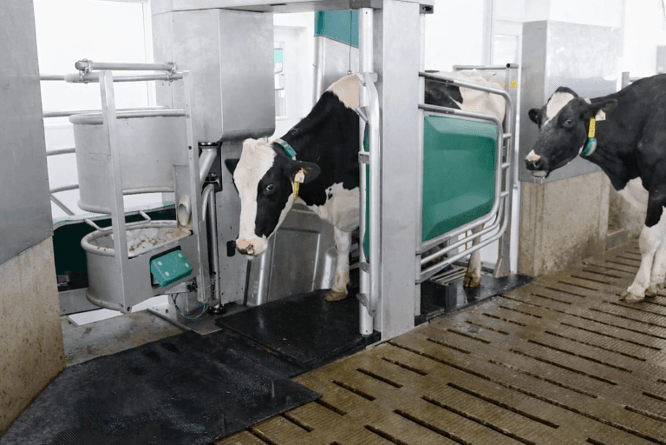
Dairy robots hold a 37% share of the entire agricultural robotics market. Only 5% of US dairy farms have adopted them. The gap between market dominance and actual penetration is where the next decade of growth lives. Deep-dive on market sizing, Lely, DeLaval, GEA, Afimilk, and the emerging tech closing the distance.
Scope of This Analysis
This analysis covers EU, North America, Japan, and Israel — the commercially advanced dairy and livestock robotics markets. China operates a separate state-directed ecosystem with distinct manufacturers, procurement channels, and subsidy structures. Mixing both markets obscures both. China vs. Rest of World will be covered as a dedicated comparative analysis.
INTRODUCTION
Dairy and livestock robots are not a niche. They dominate the entire agricultural robotics sector. The dairy robots segment held 37–38% of global agricultural robots market revenue in 2024. The milking application alone accounted for nearly 30% of total agri-robot revenue that year.
The driver is simple and irreversible. One robotic milking unit operates 24 hours a day. It handles 50–70 cows per unit without a human operator. The International Dairy Federation reports robotic milking systems increase milk production by 15–20% per cow. Labor cost savings are immediate and compounding year on year.
Three forces converge to make this sector structurally different from other agri-robotics segments: labour scarcity, fixed-cost economics, and precision data value. No other robotics segment carries all three simultaneously with this depth of commercial proof.
37–38% of the entire global agricultural robots market in 2024 was dairy robots · milking application alone: ~30% of revenue
MARKET OPPORTUNITY: THE NUMBERS
The opportunity is best understood by mapping the total addressable market against current robotics penetration — not by starting with current market size, which remains small relative to the underlying opportunity.
| Market Segment | 2024 Value | 2030 Projection | CAGR | Region |
|---|---|---|---|---|
| Global milking robots market | $3.2B | $5.3B | 10.8% | Global |
| Precision livestock farming | $7.94B | $12.12B | 8.8% | Global |
| Livestock monitoring market | $4.56B | $14.55B | 12.3% | Global |
| Dairy robots share of agri-robots | 37–38% | — | — | Global |
| Dairy & livestock RaaS model | Emerging | Expanding | — | EU / NA |
Sources: MarketsandMarkets (2024), ResearchNester (2025), Grand View Research, Roots Analysis. Market size estimates vary across sources due to differing scope definitions. Figures should be treated as directional.
The critical insight is a penetration gap. Globally, an estimated 34,000 robotic milking systems were in use as of 2024. Annual robot dairy sales are projected to exceed 12,000 units in 2025. Only about 5% of US dairy operations currently use robotic milking — roughly 1,000 farms concentrated in the Midwest and Northeast.
That low penetration figure is not a market failure. It is the measure of a disruption still in early innings.
5% · US dairy operations currently using robotic milking · ~34,000 systems installed globally · 12,000+ new units projected for 2025
REGIONAL ANALYSIS: FOUR DISTINCT MARKETS
EU, North America, Japan, and Israel each operate under fundamentally different economics, regulatory environments, and farm structures. The technology is the same. The adoption dynamics are not.
| Region | Adoption Stage | Robot Penetration | Key Driver | Key Players |
|---|---|---|---|---|
| EU | Most Advanced | ~48% dairy farms | Labor regs + welfare rules | Lely, DeLaval, GEA, Dairymaster |
| North America | Underpenetrated | ~5% dairy operations | Labor cost + immigration pressure | GEA, DeLaval, BouMatic, Merck Animal Health |
| Japan | Gov.-backed push | ~40% farms (any tech) | Aging farmers; avg. age 67+ | Kubota, Yanmar + imported EU systems |
| Israel | Tech exporter | Domestic market small | Data/sensor innovation culture | Afimilk, ENGS Systems, miRobot (seed) |
Sources: MarketsandMarkets, Willagri Japan Agriculture Report (Nov 2024), Tracxn Israel Livestock Tech (Oct 2025), AgDaily (Jun 2025), Smart Agriculture Devices Market Report (2025).
European Union: Most Advanced, Most Contested
Europe leads the global milking robots market. Milking robots now operate in approximately 48% of European dairy farms. The EU's labour regulations and rising wages make automation economically mandatory for medium and large farms.
The Netherlands, Germany, Denmark, and Sweden are core adopters. DeLaval, Lely, Fullwood JOZ, Dairymaster, Hokofarm, and Connecterra are all EU-headquartered. Competitive density is highest here. EU farms managing herds above 1,000 cows are particularly advanced adopters.
EU animal welfare regulations also accelerate adoption. Robotic milking demonstrably reduces physical stress on cattle. Regulators increasingly reward farms showing measurable welfare outcomes. This alignment between commercial and regulatory incentive is uniquely strong in the EU.
The constraint: a 100-cow farm transitioning to robotic milking faces €400,000–€680,000 in total capital outlay including barn modifications. EU agricultural subsidies partially offset this. The gap remains for farms under 80 cows.
North America: Underpenetrated, Highest Growth Potential
North America held approximately 36–38% of the global agricultural robots market in 2024. Yet robotic milking penetration is ~5% of US dairy operations. Only 13% of US dairy farms use any computerised milking system at all.
The forces closing that gap are structural. High labour costs, immigration-driven farm labour shortages, and tightening overtime wage requirements in states like New York all accelerate farmer interest in fixed-cost automation. A robot's cost-to-operate is identical in year one and year ten. Labour is not.
Canada leads the US on adoption. Smart feeding systems grew 33% in Canada and the US combined. Canadian mid-size dairy farms were early adopters of robotic milking in the 2010s. The US is tracking approximately five years behind.
Japan: Government-Backed, Urgency-Driven
Japan faces perhaps the most acute version of the global farm labour crisis. The average age of Japanese farmers in 2024 exceeded 67 years. Approximately 40% of Japanese farms already use some form of robotic or automated technology — a high baseline driven by necessity.
In 2024, Hokkaido Prefecture launched the AgriTech Innovators project, a government-backed programme deploying automated milking robots on smallholder dairy farms. The programme reportedly increased productivity by more than 25% — per programme reporting, not independently audited. The Japanese government allocated approximately 100 billion yen ($700M) to agricultural robotisation research in 2024 alone.
Kubota and Yanmar are Japan's dominant domestic AgTech hardware companies. Japan's approach favours integration of robotics into existing small-farm structures rather than scaling farm size — a structurally different model from Europe and North America.
Israel: Small Country, Outsised Global Influence
Israel punches well above its weight in livestock technology. Afimilk, founded in 1977 at Kibbutz Afikim, manages over 10 million cows in 52 countries — per Afimilk's own disclosure, not independently audited by a third party. Products are distributed through over 250 marketers worldwide.
Afimilk's core products include neck-collar sensors monitoring individual cow activity, health, and reproductive status. The AfiFarm software suite processes sensor data into herd management decisions. The system detects mastitis and ketosis early, improving intervention timing. It claims to identify estrus events in approximately 50,000 cows daily using sensor data — per company claims.
Israel's differentiation is software intelligence and sensor miniaturisation, not mechanical hardware. Its agtech innovation culture — combining military-grade sensor technology with precision analytics — produces dairy technology that competes directly with European hardware leaders. Israeli companies export almost exclusively, forcing them to design for global market conditions from day one.
KEY PLAYERS: COMPETITIVE LANDSCAPE
The market has two structural layers: European hardware leaders that own the installed base, and data/monitoring specialists — led by Israel — that control the intelligence layer. The companies building across both layers will define the sector's ceiling.
| Company | HQ | Core Product | Scale / Reach | 2024–25 Key Move |
|---|---|---|---|---|
| Lely | Netherlands | Astronaut A5 milking robot; Juno feed pusher | 45+ countries; 13,000+ Juno units* | Next-gen Juno; Horizon farm mgmt platform |
| DeLaval | Sweden | VMS robotic milking; OptiWagon feeder | 100+ markets | VMS Batch Milking (Jan 2024); Milk Sustainability Center with John Deere (Oct 2024) |
| GEA Group | Germany | Full-range milking robots; CattleEye AI | 150+ countries | Acquired CattleEye AI (Mar 2024); acquired Southwest Dairy Farmers UK (Apr 2025) |
| Afimilk | Israel | AfiFarm herd mgmt; neck-collar sensors | 52 countries; 10M+ cows* | Continuous sensor + ML expansion; 17 patents filed |
| BouMatic | US/Netherlands | Robotic milking systems | EU + North America | Expanding dealer network; RaaS model focus |
| Merck Animal Health | USA | SENSEHUB wearables | Global | SENSEHUB Cow Calf (Oct 2024); SENSEHUB Youngstock (Apr 2024) |
| Nedap | Netherlands | CowControl monitoring | Global incl. Pakistan (2024) | FrieslandCampina partnership; 5 farms in Pakistan |
* Lely unit count and Afimilk cow coverage figures are based on company disclosures and have not been independently verified by a third party. All 2024–25 moves sourced from company announcements, MarketsandMarkets, and AgDaily.
FARM ECONOMICS: THE ROI FRAMEWORK
Commercial viability depends on farm-level economics. The data below is drawn from publicly available deployment figures and market research — not internal company projections.
| Cost Element | Detail | Comparator | Saving / Impact | Payback |
|---|---|---|---|---|
| Milking robot (per unit) | $150K–$230K | Manual labor + parlor | 15–20% milk production gain (IDF) | 5–10 yr lifespan |
| Full 100-cow installation | $430K–$740K | 2-robot setup + barn mods | Labor cost fixed vs. rising wages | ~5–8 yrs |
| US farm labor (livestock) | $17.45/hr avg (2024) | Overtime laws tightening | Robots: zero overtime cost | Fixed cost certainty |
| Wearable collar (per animal) | $200–$500 | Vet check costs | Early mastitis/ketosis detection | ROI within 1–2 yrs |
| Annual sales (2025 est.) | 12,000+ units globally | vs. ~34,000 total installed base | Low penetration = high upside | NA |
Sources: CCFBank dairy robotics analysis (Aug 2025), AgDaily dealer survey (Jun 2025), International Dairy Federation, MarketsandMarkets milking robots report (2024). Results vary by herd size, barn layout, and geography.
Payback periods here are short relative to most agricultural capital investments. A $300,000 tractor returns value over 10–15 years. A robotic milking installation, running continuously on a 200-cow dairy operation, achieves payback in 5–8 years and then generates compounding labour savings for its remaining lifespan.
The yield-enhancement dimension multiplies the return beyond labour cost alone. A 15–20% milk production increase per cow — documented by the International Dairy Federation across multiple deployment studies — means the robot pays back faster on high-producing herds than simple cost modelling suggests.
Fixed cost certainty · A robot's operating cost is identical in year 1 and year 10 · Farm labour cost has risen every year for 15 consecutive years
EMERGING TECHNOLOGIES: THE NEXT ADOPTION WAVE
Robotic milking is the first adoption wave. Four additional technology categories are now scaling commercially — each addressing a different part of the livestock operation cost structure.
| Technology | Stage | Key Player(s) | Significance |
|---|---|---|---|
| AI vision health scoring | Commercial (2024) | GEA (CattleEye), DeLaval BCS | Passive monitoring; no wearables required |
| Automated feeding robots | Scaling | DeLaval (OptiWagon, Optimat), Lely | Feed = #1 milk yield driver; data-driven ration mgmt |
| Robot-as-a-Service (RaaS) | Early commercial | Multiple EU dealers | Removes $200K+ capex barrier; unlocks small farms |
| Virtual fencing / AI collars | Commercial | Afimilk, Halter (NZ) | Guides herds sans physical fencing; $200–500/head |
| Barn hygiene robots | Growing | Various EU manufacturers | Automated slurry + cleaning; completes automation loop |
Sources: MarketsandMarkets livestock monitoring report, DeLaval product announcements, GEA CattleEye acquisition (Mar 2024), Halter company data, Afimilk company disclosures (2024–2025).
KEY CHALLENGES
Capital Cost Barrier
A two-robot dairy installation for 100 cows costs $430,000–$740,000 all-in — including barn modifications, electrical upgrades, plumbing, and ventilation. Banks in most markets lack standardised underwriting models for AgTech assets. Smaller farms cannot access this without subsidy or structured financing.
Data Fragmentation
Multiple robot platforms generate incompatible data formats. DeLaval's Lely Horizon, GEA's monitoring dashboards, and Afimilk's AfiFarm operate in separate ecosystems. True whole-farm intelligence requires costly integration work. This is a known problem that no single vendor wants to solve — interoperability threatens lock-in revenue.
Retrofit Complexity
Older barn layouts were not designed for voluntary cow traffic systems. Structural modifications add 20–40% to installation costs. New farm builds are far easier to automate than legacy operations. Most farms in Europe and North America are legacy operations. This constraint slows adoption speed more than any other single factor.
Labour Transition Gap
Robots shift labour demand — they do not eliminate it. Farms need technicians who can maintain robotic equipment and interpret analytics data. Rural areas lack these workers. Dealer service networks remain thin outside Western Europe and North America. A failed milking robot at 3am on a 200-cow farm is a critical operational crisis without local technical support.
Connectivity and Cybersecurity
Dairy robots depend on cloud-connected farm management systems. Outages or rural broadband gaps disrupt operations. Cybersecurity vulnerabilities in connected livestock systems are underappreciated in current market analysis. As farms integrate more cloud-dependent systems, this risk profile grows.
2030 OUTLOOK: MARKET TRAJECTORY
This is a market in early exponential growth — not steady linear expansion. The technology is proven. The economics are favourable. The regulatory tailwinds are structural. The primary constraint now is manufacturing capacity and farm-by-farm adoption cycles.
The next five years will see North American penetration rise from 5% toward 15–20% of dairy operations. EU adoption will push past 60% of qualifying farm sizes. Japan will deploy government-subsidised systems at scale on smaller farms. Israel will continue generating software intelligence that runs on hardware made in the Netherlands, Germany, and Sweden.
Three companies are best positioned to compound their advantages: Lely, DeLaval, and GEA — because they own both the hardware relationship and the long-term data layer. Afimilk holds a formidable 47-year data and distribution moat that new entrants will struggle to replicate.
2030 target: North America dairy robot penetration 15–20% · EU 60%+ · Japan government-funded smallholder deployment at scale
CONCLUSION: THE LABOUR CEILING AND THE DATA FLOOR
Dairy and livestock robotics occupies a structurally privileged position in agricultural technology. It solves a problem that no previous solution — manual labour, traditional parlour systems, or basic automation — has solved at scale with positive unit economics.
Labour scarcity is structural and not reversing. Milk demand is growing globally. Animal welfare regulation is tightening. These forces reinforce each other. They do not reverse.
The companies profiled here are not competing for a fixed share of existing farm spend. They are building the infrastructure of a fundamentally different way to run a dairy operation. The 5% US penetration figure of 2025 will look very different in 2030. The labour ceiling is real. The data floor is being built now.
SOURCES & REFERENCES
MarketsandMarkets: Milking Robots Market — $3.2B in 2024, $5.3B by 2029 at 10.8% CAGR (2024)
MarketsandMarkets: Precision Livestock Farming Market — $7.94B in 2025, $12.12B by 2030 at 8.8% CAGR (2025)
MarketsandMarkets: Livestock Monitoring Market — $4.56B in 2024, $14.55B by 2034 at 12.3% CAGR (2025)
Grand View Research: Agricultural Robots Market — dairy robots 38.1% share of type segment in 2024 (2024)
AgDaily: Dealers See Robots Become Bigger Part of Dairy Solution — 34,000 global systems; 5% US penetration (Jun 2025)
CCFBank: The Future of Dairy Farming — Financial & Technical Components of Robotic Milking Systems (Aug 2025)
Willagri: Robotization of Agriculture in Japan — AgriTech Innovators project; 100B yen government allocation (Nov 2024)
Israel Agri Hub: Afimilk — 10M+ cows in 52 countries; AfiFarm platform; sensor technology overview (2025)
GEA Group: CattleEye Acquisition announcement (Mar 2024); Southwest Dairy Farmers UK acquisition (Apr 2025)
DeLaval: VMS Batch Milking launch (Jan 2024); Milk Sustainability Center with John Deere partnership (Oct 2024)
MarketsandMarkets: Livestock Monitoring companies — Merck SENSEHUB Cow Calf (Oct 2024); SENSEHUB Youngstock (Apr 2024)
International Dairy Federation: Robotic milking systems increase milk production by 15–20% (referenced in Straits Research 2024)
ResearchNester: Agriculture Robots Market — dairy & livestock segment highest growth CAGR (May 2025)
Agricultural Robotics Research Series:
Part 1: Labour Crisis — How Robots Will Fill the Global Agricultural Workforce Gap
Part 2: Agricultural Robotics | Market Leaders, Regional Analysis & Top Countries
Part 3: Agricultural Robotics | $34B Weeding Robot Market
Part 4: Agricultural Robotics | Harvesting Robots: $6.9B Market
Part 5: Agricultural Robotics | Precision Planting & Seeding
Part 6: Agricultural Robotics: Crop Monitoring and Aerial Scouting
Part 7: Dairy & Livestock Automation
Part 8: Autonomous Tractors & Field Machines
Part 9: Post-Harvest Automation — Sorting, Grading & Cold Chain
Part 10: Future Trends 2025–2030









Leave a comment