


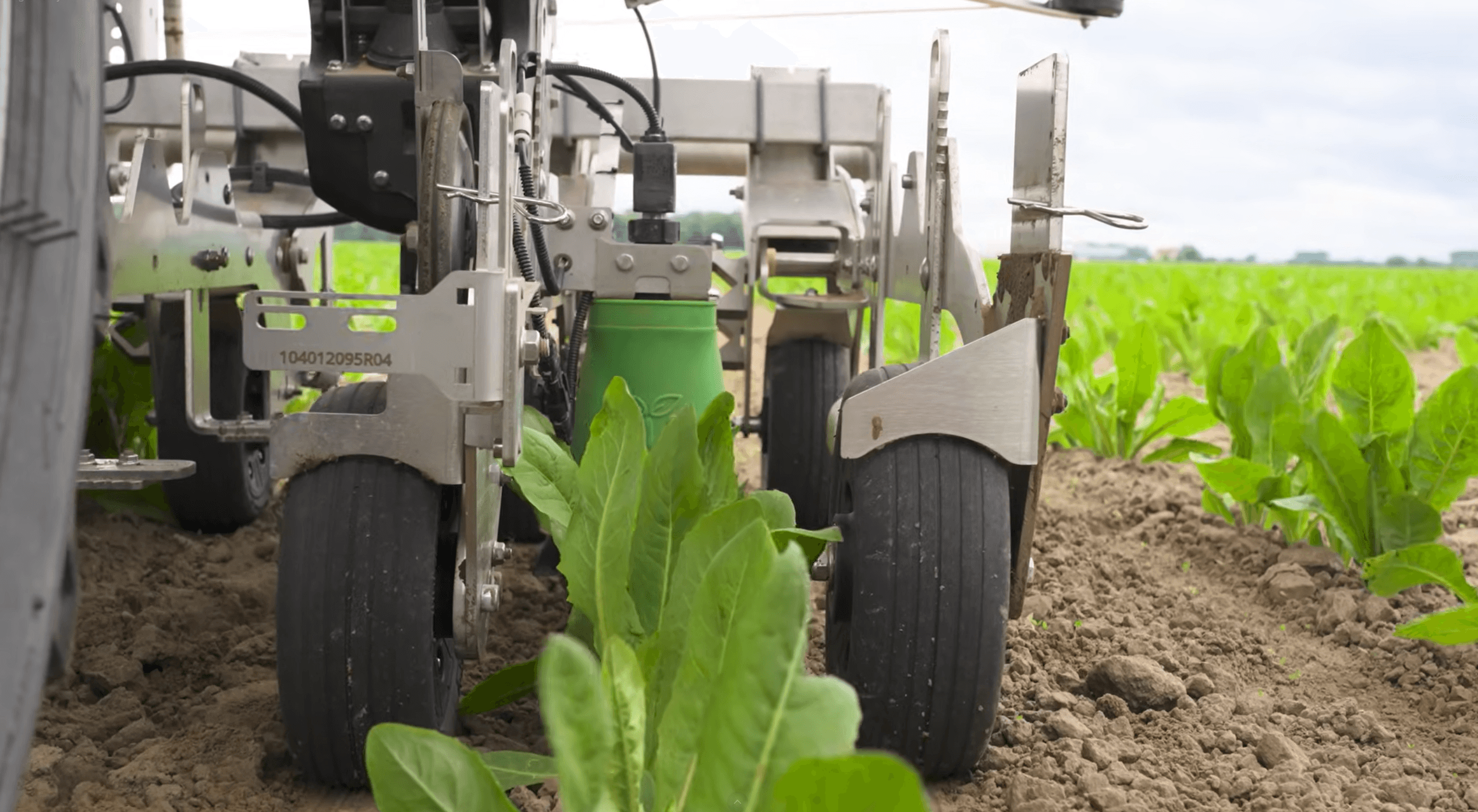
Market Opportunity, Key Players, and Emerging Technologies Across EU, North America, Japan, and Israel
Why Planting Is the Highest-ROI Moment in Farming
Every crop starts with a seed. Get planting wrong and nothing else matters. Yield losses from poor seed placement run 15–30%, according to agronomic studies. That is the entire profit margin on most row crops.
Precision planting technology addresses this risk directly. RTK-GPS guidance, individual-row depth control, and variable-rate seeding have moved from novelty to baseline expectation on large commercial farms across North America and Europe.
The market is real and growing. Third-party researchers put the global seeding and planting robots market at $2.83–2.85 billion in 2023, with projected CAGR of 21–25% through 2032. These figures vary by definition and methodology.
⚠ Market size estimates diverge sharply across research firms due to differing scope definitions. Some reports include all GPS-guided planters; others count only autonomous field robots. The $2.85B figure (Global Market Insights, 2024) is the most conservative credible estimate for pure seeding/planting robots and is used here.
The Global Market Outside China
North America holds the largest share of the addressable precision planting market. The US alone covers roughly 92 million hectares of row crops. John Deere, AGCO (Precision Planting), and CNH Industrial dominate installed base, with adoption rates of 40–60% on farms over 1,000 acres for basic precision technology.
Europe presents a different profile. Average farm sizes are smaller, but regulatory pressure on pesticide reduction under the Farm to Fork strategy has accelerated demand for precision seeding. EU adoption of precision planting technology sits around 20–35% of commercial arable farms, with stronger penetration in Germany, France, Netherlands, and Denmark.
Japan is the outlier. Its aging farming population — average farmer age exceeded 67 in 2024 — has created extreme urgency around automation. The government allocated roughly 100 billion yen (approximately €700 million) to agricultural robotics in 2024. But Japan's market is structurally distinct: small paddy fields, not large row-crop operations. Automation here means autonomous rice transplanters, not 36-row corn planters.
Israel is a technology exporter, not primarily a technology consumer for planting. Its agricultural sector is small but innovation-dense. Israeli precision agriculture technology — particularly AI-driven crop monitoring — routes through global deployment rather than domestic field adoption.
| Region | Market Maturity | Primary Driver | Key Gap |
|---|---|---|---|
| North America | High — 40–60% large farm adoption | Labor cost, yield maximization | Small farm access |
| European Union | Medium — 20–35% commercial farms | Regulatory compliance, input reduction | Farm fragmentation |
| Japan | Medium-High — 40% robotic/automated use* | Aging workforce, labor crisis | Paddy-specific solutions |
| Israel | Low domestic, high export | Innovation ecosystem, R&D | Limited arable scale |
⚠ Japan figure (40%) includes all robotic/automated technology on farms per Willagri 2024 report, not precision planting specifically.
Core Technology: What Actually Works
RTK-GPS Guided Planters
RTK-GPS gives planters centimeter-level accuracy — typically ±2cm. This enables repeatable passes, row-to-row consistency, and prescription map execution. It is now standard on all major commercial planters in North America and EU.
The limiting factor is not the GPS technology. It is the downstream execution: depth control, singulation accuracy, and seed-to-soil contact. These determine actual yield outcomes.
Variable-Rate Seeding
Variable-rate technology (VRT) adjusts seed populations across field zones using prescription maps. Corn populations typically vary 28,000–38,000 seeds per acre based on soil productivity zones. Soybeans range from 120,000–180,000 seeds per acre.
Independent research by Precision Planting (an AGCO subsidiary) documents 5–12% yield improvements from optimized populations, alongside 10–20% seed cost reductions. These claims are based on internal company trial data and have not been independently verified by third parties at scale.
⚠ Yield improvement claims from Precision Planting (AGCO) and John Deere are based on company-sponsored trials and customer data. Independent peer-reviewed verification at commercial scale is limited. Results will vary by soil type, crop, and year.
Individual Row Control and Depth Management
Individual electric row drives — such as John Deere's ExactEmerge and AGCO's vDrive system — allow each planter row to operate independently. Speed, population, and depth adjust by row without mechanical linkage constraints.
Active downforce systems (Precision Planting's DeltaForce) adjust pressure on each row unit in real time. Soil hardness varies within a single field pass. Constant pressure adjustment improves stand establishment to 90–95% versus 75–85% with passive systems. These figures are from Precision Planting company documentation.
⚠ Stand establishment improvement figures (90–95% vs. 75–85%) are sourced from Precision Planting marketing materials. Independent agronomic trial confirmation is advisable before financial modeling.
North America: The Established Market
John Deere owns the largest installed base. Its ExactEmerge system operates at 10+ mph while maintaining 99%+ singulation accuracy. The system documents 3–5 bushels per acre yield improvement in John Deere's own customer data. ExactEmerge integrates directly with the John Deere Operations Center cloud platform.
Precision Planting (acquired by AGCO in 2017) built its business on aftermarket retrofits — making existing planters more precise without full replacement. The vSet meter, DeltaForce downforce system, and SmartFirmer in-furrow soil sensor can be added to planters from multiple brands. This approach unlocked medium-farm adoption where full equipment replacement economics are challenging.
Kinze Manufacturing's Blue Drive electric row units represent the independent engineering alternative. Kinze has a strong customer base in the US Corn Belt, particularly among farmers who want performance without John Deere's data ecosystem.
The US market is also where cost-benefit math works most clearly. A 2,000-acre corn operation generating $36 per acre in yield improvement captures $72,000 annually. A $75,000 precision retrofit pays back in under one year. No other segment of agricultural robotics achieves this ROI speed.
| Company | Key Product | Core Advantage | Data Note |
|---|---|---|---|
| John Deere (US) | ExactEmerge | Integrated ecosystem, highest market share | 3–5 bu/ac yield data: company-disclosed |
| Precision Planting / AGCO (US) | vDrive, DeltaForce, SmartFirmer | Retrofit flexibility, multi-brand compatibility | 5–12% yield improvement: company-disclosed |
| Kinze (US) | Blue Drive | Independence from major OEM ecosystems | Performance data: company-disclosed |
| CNH Industrial (US/EU) | Case IH / New Holland planters | Global distribution, multi-market presence | Limited public performance data |
Europe: Regulation-Driven Innovation
FarmDroid — Denmark
FarmDroid is the most commercially significant European precision seeding startup. Its FD20 robot uses 8mm RTK-GPS accuracy to mark crop positions at seeding, then returns to perform mechanical inter-row and intra-row weeding. It runs on solar power, with four panels producing up to 20 kWh per day — enough for 24-hour continuous operation.
FarmDroid raised €10.5 million in October 2024 in a Series A led by Convent Capital, with participation from EIFO and Navus Ventures. As of late 2024, over 500 units operate across more than 20 countries. The company's next milestone is 1,000 units. Proven primarily on organic farms, FarmDroid has recently added a spot-spraying module targeting conventional farming.
⚠ FD20 performance claims — including up to 40% yield increase and 94% chemical reduction — are sourced from FarmDroid company materials and customer testimonials. Independent third-party validation at commercial scale has not been publicly published.
FarmDroid's model is instructive. It solves an EU-specific problem: organic and low-pesticide farming demands mechanical weed control. The robot's simplicity — no cameras needed for weed detection because it already knows where every crop is — makes it unusually reliable for an autonomous field robot.
AgXeed — Netherlands
AgXeed is building full-size autonomous tractor replacements, not niche robots. Its AgBot operates at up to 13.5 km/h autonomously and handles soil cultivation, seedbed preparation, seeding, weeding, and stubble work. Over 100 AgBots operated worldwide as of 2025.
In November 2025, AgXeed launched the T2 7 SERIES — a 230 hp diesel-electric tracked machine weighing just over 8 tonnes. AgXeed claims 25–35% total cost savings versus conventional tractors and up to 90% labor savings. These figures are from AgXeed company disclosures and have not been independently audited.
⚠ AgXeed cost savings claims (25–35% total cost, 90% labor) are from company marketing materials. Actual savings will depend on farm scale, implement compatibility, and operational context.
CLAAS, the major German farm equipment manufacturer, invested in AgXeed as part of a cooperative development agreement. This signals OEM-level validation of the platform approach.
Small Robot Company — UK
UK-based Small Robot Company developed the Tom-Dick-Harry robot trio. Tom monitors and maps each plant. Dick weeds. Harry plants seeds at precise depths while recording the exact GPS location of each seed. The Wilma AI platform coordinates all three.
Harry's seed-location data enables the system's core insight: future weeding robots know exactly where crops are before they emerge. This eliminates the need for post-emergence weed detection cameras. The system targets 40% cost reduction and up to 95% chemical reduction, based on company estimates.
Small Robot Company operates on a Farming-as-a-Service subscription model, reducing the upfront capital barrier. Commercial deployment has been focused on UK wheat farms. North American expansion plans were announced but have progressed slowly.
Agrointelli Robotti — Denmark
Agrointelli's Robotti platform is a compact autonomous implement carrier designed for inter-row cultivation and precision seeding. It has been adopted on farms in Germany and Denmark. The system has a strong focus on organic farming and minimum-tillage systems.
Japan: A Unique Structural Problem
Japan's precision planting challenge is not technology availability. It is scale and crop type. Most Japanese farms are under 2 hectares. The dominant crop is rice, transplanted from nursery flats rather than direct-seeded. These structural realities shape what automation looks like here.
Kubota's Agri Robo Series addresses this directly. The autonomous rice transplanter and autonomous combine form the core of the lineup. By 2024, approximately 700 Agri Robo machines had shipped in Japan — autonomous rice transplanters, harvesters, and tractors. Kubota uses RTK-GPS to enable precise row alignment and field-coverage optimization, framing 'expert full-field planting' as a skill that autonomous systems can perform better than inexperienced operators.
Yanmar's autonomous rice transplanter (YR8D) uses RTK-GNSS with centimeter-level accuracy for straight-line planting and automated headland turns. One operator can supervise two tractors simultaneously — one tillage, one seeding. This addresses Japan's most pressing constraint: not capital, but working bodies.
The Japanese government's ¥100 billion (~€700 million) agricultural robotics commitment in 2024 is channeled largely through the Ministry of Agriculture, Forestry and Fisheries (MAFF) automation roadmap. Kubota and Yanmar are aligned with this roadmap's three-step progression toward fully uncrewed operation.
Israel: Technology Exporter, Not Consumer
Israel's domestic agriculture operates on roughly 390,000 hectares — a fraction of any major agricultural nation. The country exports $2+ billion in agricultural technology annually, according to Israeli government data, despite limited domestic scale.
Israeli precision agriculture contributions to seeding are primarily in data systems rather than physical robots. Taranis provides AI-powered field analytics that inform prescription planting decisions. Prospera Technologies, acquired by Valmont Industries in May 2021, specializes in computer vision for crop monitoring and yield prediction — inputs that drive precision planting decisions.
CropX has launched its Strato 1 in-field weather station for hyperlocal data capture. Netafim (owned by Orbia) reported 11% year-over-year precision agriculture sales growth to $257 million in Q3 2025. Israel's contribution to precision planting is in the intelligence layer, not the seeding hardware.
⚠ Netafim Q3 2025 revenue figure ($257M, +11% YoY) is from Orbia's publicly disclosed quarterly earnings. It covers the broader Precision Agriculture business, not precision seeding specifically.
Emerging Technology: Swarm Seeding
The swarm approach replaces one large planter with multiple small coordinated robots. Fendt's Xaver concept — 6-8 robots at 50-100 kg each versus a 10,000 kg conventional planter — directly targets soil compaction, the silent killer of long-term yield potential. Soil compaction can reduce yields by up to 20%.
Swarm robots are commercially closest in Europe. AgXeed and Agrointelli have deployment experience. Fendt Xaver remains in commercial pilot phase in Europe with full availability targeted for 2026–2027.
The economic case for swarms is compelling at smaller farm scales where a $400,000 36-row planter makes no sense. Target costs of $15,000–25,000 per robot allow incremental investment. One robot can start the operation; more can be added as economics improve.
| Technology | Maturity | Best Market Fit | Key Risk |
|---|---|---|---|
| RTK-GPS Variable Rate Seeding | Commercial — widely deployed | Large NA/EU farms | Prescription map quality |
| Individual Electric Row Units | Commercial — major OEMs | Large row-crop operations | High capital cost |
| FarmDroid-style solar robots | Commercial — 500+ units deployed | Organic EU farms, small/mid scale | Speed limitations |
| AgXeed autonomous tractor | Commercial — 100+ units deployed | EU/NA medium-large farms | Cost, OEM competition |
| Swarm seeding (Fendt Xaver etc.) | Pilot — pre-commercial | Small/mid EU farms | Reliability, launch timing |
| AI in-furrow sensing (SmartFirmer) | Commercial — AGCO system | Precision data capture | Data quality, calibration |
ROI Reality Check
Precision planting delivers the fastest payback of any agricultural robotics segment. A 2,000-acre US corn operation adding $50 per acre in combined yield and seed savings generates $100,000 annually against a $75,000 retrofit investment. Payback in under twelve months is achievable.
European economics are different. Smaller farms, lower commodity prices, and higher labor costs per unit of output change the math. The ROI case is stronger for integrated systems that combine seeding, weeding, and monitoring — which is exactly why FarmDroid's combined seeding-weeding robot finds purchase in EU organic markets.
Japan's economics hinge on labor replacement, not yield improvement. The value of automation is measured in worker-hours freed, not bushels per acre. An autonomous rice transplanter that allows one person to manage what previously required four is the calculation that matters in Hokkaido.
What the Data Cannot Tell You
Most performance data in this space comes from companies with products to sell. Yield improvements of 5–12%, cost reductions of 25–35%, chemical reductions of 94% — these numbers come from press releases, company trials, and farmer testimonials.
Independent agronomic research at commercial scale is scarce. The International Society of Precision Agriculture reported in 2023 that precision agriculture technologies can increase yields by up to 20%, but this covers the entire precision agriculture category, not precision planting specifically.
The honest position: the directional claims are credible. Seed placement accuracy demonstrably affects yield. Variable populations demonstrably save seed cost. The specific magnitude claims warrant independent verification before capital allocation.
2025–2030 Outlook
North America will see continued consolidation around John Deere and AGCO Precision Planting, with increasing AI integration for real-time field adaptation. Autonomous planters without operators are a near-term commercial reality on large operations.
Europe will be shaped by the Farm to Fork trajectory. Precision placement reduces chemical inputs. Swarm robotics reduce soil compaction. Both align directly with EU policy direction. Expect accelerated public support for precision seeding systems through 2030.
Japan faces a harder path. The structural mismatch between farm scale and technology economics is real. Without farm consolidation, the addressable market for high-cost precision systems remains limited. Government subsidy programs carry the near-term burden.
Israel's role is amplification: its AI and sensing innovations will increasingly route into European and North American planting systems, improving prescription quality and real-time adaptation without Israel needing a large domestic market.
Part 6 of the Agricultural Robotics Deep Dive Series covers Crop Monitoring & Aerial Scouting — the segment with the broadest adoption across farm sizes globally.
Sources & Data Notes
Market sizing: Global Market Insights (2024), SNS Insider (2025), Grand View Research (2025). Figures represent company seeding/planting robot market estimates and vary by definition scope. Company performance data is sourced from respective company disclosures, press releases, and investor materials as noted throughout. Japanese robotics data: Japanese Government (JapanGov 2025), Willagri (2024). Israeli agricultural technology export data: Israeli government trade missions and Orbia quarterly earnings (Q3 2025)
Agricultural Robotics Research Series:
6. AGRICULTURAL ROBOTICS | Crop Monitoring & Aerial Scouting: The Watchful Fields
5. AGRICULTURAL ROBOTICS | Precision Planting & Seeding
2. AGRICULTURAL ROBOTICS | Market Leaders, Regional Analysis & Top Countries
1. AGRICULTURAL ROBOTICS | Labor Crisis: How Robots Will Fill the Global Agricultural Workforce Gap










Leave a comment