

Industry Briefing
A single destination for timely, editor-curated robotics news from around the world.

Zhejiang University Professor Secures Hundreds of Millions for Flying Robot Development
Recently, the flying robotics company Weifen Zhifei announced the completion of hundreds of millions in Series A2 funding. This round was led by PwC Capital, with participation from Honghui Fund, Yangtze River Delta Smart Cultural Fund, and existing investors including Wuyuan Capital and Shenchuang Investment. Founded in July 2024, Weifen Zhifei has completed seven funding rounds totaling over 500 million yuan, focusing on flying embodied intelligence and advanced flight control technologies. The significance of this funding lies in Weifen Zhifei's ambition to develop flying robots capable of operating in complex environments. The company has been recognized as a potential national unicorn and is led by Gao Fei, a professor at Zhejiang University. With over ten years of experience in aerial robotics and numerous publications, Gao has pioneered autonomous flight systems in unstructured environments. The company’s products, including the P300 flying robot, are designed for autonomous operations in challenging settings without GPS. Looking ahead, Weifen Zhifei's products are already being deployed in emergency response, mining, and power sectors, showcasing capabilities in autonomous mapping and safety assessments. However, challenges remain in scaling operations due to regulatory and technical cost barriers. No further timeline was disclosed at the time of publication.
Flying Robots Autonomous Technology Robotics AI Drone Technology
Chinese Robotics Industry Advances with Autonomous Flying Machines
The phrase 'Chinese people can fly' has become a cultural phenomenon this summer, symbolizing a broader trend in China's robotics sector. While the internet buzzes with this slogan, Chinese robots are indeed taking to the skies, transitioning from traditional drones to advanced flying robots capable of autonomous operations. This shift is significant as it reflects China's industrial strength and technological advancements. According to Gao Fei, founder of Micro Differential Intelligence, traditional drones rely on human control, whereas flying robots utilize autonomous navigation and intelligent systems to operate independently in challenging environments. This evolution from tools to intelligent entities is crucial for enhancing operational efficiency in various sectors. Looking ahead, the demand for intelligent flying devices is surging across industries such as agriculture, inspection, rescue, and logistics. The global market for aerial robots is projected to grow significantly, with China's market expected to reach $2.72 billion by 2032. As policies support the development of low-altitude economies and embodied intelligence, the intersection of these two fields is set to accelerate the deployment of flying robots in urban environments.
Flying Robots Embodied Intelligence Aerial Technology Smart Automation
IERA Award 2026 Goes to Flying Warehouse Robots by Verity from Switzerland
Verity, a leading technology company, has been acknowledged for its innovative development and successful market launch of a cutting-edge warehouse intelligence system. This recognition comes as the company aims to enhance operational efficiency and streamline logistics processes within the supply chain sector. The system, which leverages advanced data analytics and artificial intelligence, was officially unveiled in October 2023, positioning Verity at the forefront of warehouse management solutions. The initiative is part of Verity's broader strategy to address the growing demand for smarter, more efficient inventory management in an increasingly competitive market. By integrating real-time data insights, the warehouse intelligence system is designed to optimize inventory tracking, reduce operational costs, and improve overall productivity for businesses.
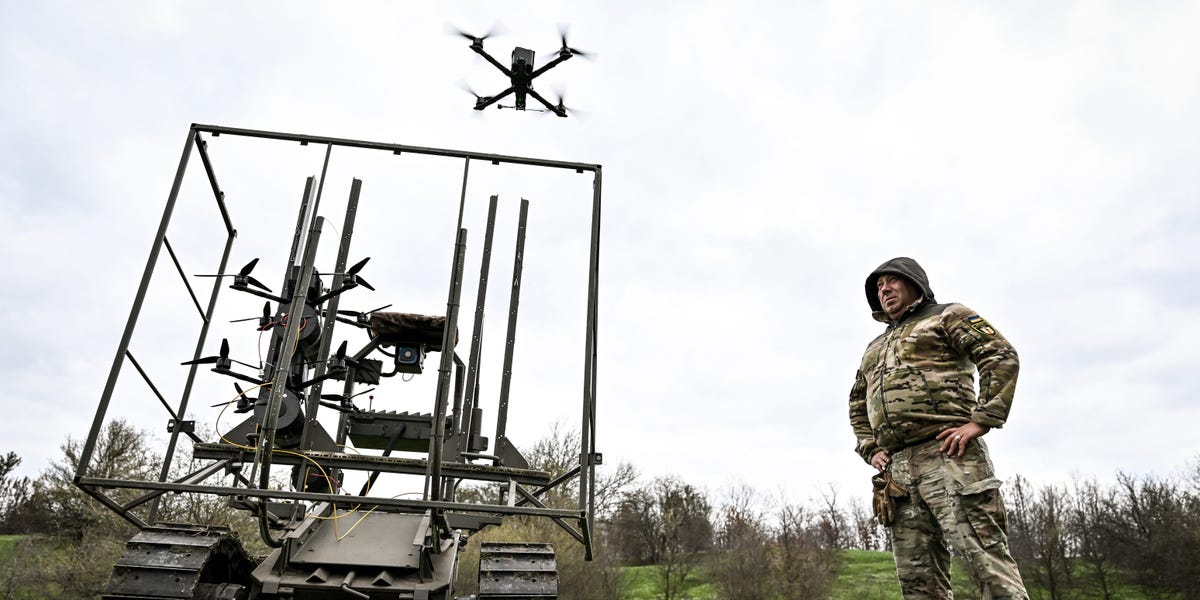
Ukraine is teaming up its war robots with flying drones for maximum effect in battle
Ukraine is enhancing its military capabilities through the integration of a diverse fleet of ground robots and flying drones. This innovative approach, which combines the unique strengths of both technologies, is proving to be a game-changer on the battlefield. As of October 2023, the Ukrainian forces are increasingly leveraging these advanced systems to improve operational efficiency and effectiveness in various combat scenarios. The strategic use of these unmanned vehicles aims to bolster Ukraine's defense efforts amid ongoing conflicts, showcasing the country's commitment to modernizing its military assets and adapting to the evolving nature of warfare.
Military & Defense ukraine ground-robots drones drone-warfareRobotics needs a service framework.
RSF defines a common language for robot service capability, lifecycle operations, certification pathways, and service-provider networks.
Join the RobotToday community on LinkedIn
Daily robotics news, in-depth analysis, conference highlights, and discussions with professionals worldwide.







