

Industry Briefing
A single destination for timely, editor-curated robotics news from around the world.

Innovative Dual-Adaptive Control Enhances Obstacle Avoidance in Hybrid Boom Lifts
The Journal of Field Robotics has published an early view article detailing a dual-adaptive control system designed for hybrid boom lifts. This innovative approach aims to improve the smoothness of obstacle avoidance, enhancing operational safety and efficiency in various environments. The significance of this development lies in its potential to transform how hybrid boom lifts navigate complex work sites. By implementing dual-adaptive control, operators can expect reduced risk of accidents and increased productivity, making these machines more reliable for construction and maintenance tasks. Looking ahead, industry professionals should monitor the adoption of this technology in real-world applications. The effectiveness of dual-adaptive control in enhancing obstacle avoidance will be crucial for its acceptance and integration into existing hybrid boom lift systems. No further timeline was disclosed at the time of publication.
RESEARCH ARTICLE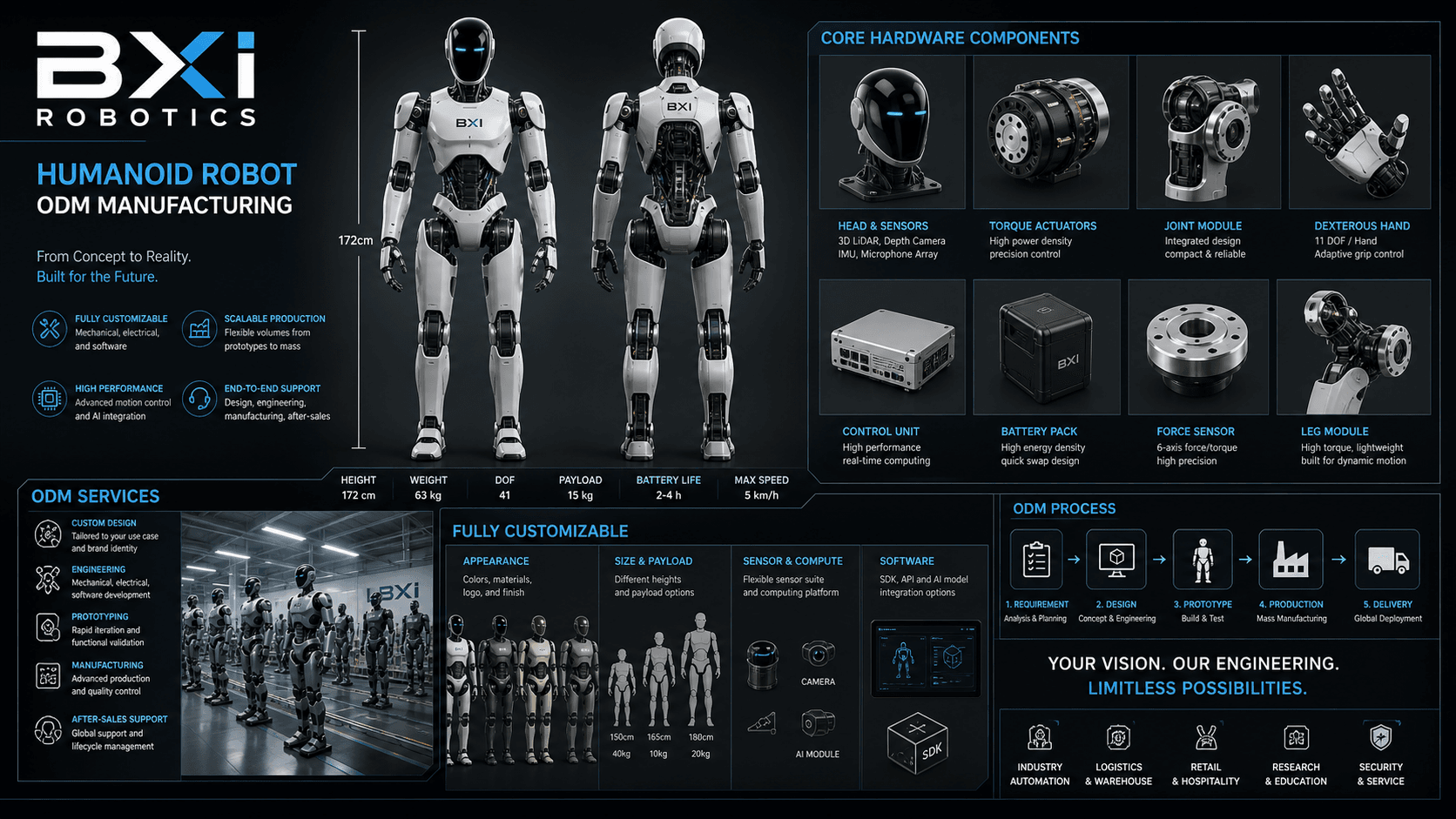
BXI Robotics Secures Funding for Full-Stack Humanoid Robot Solutions
BXI Robotics has successfully raised funding from Suochen Technology, following support from Feirongda. This funding will enhance BXI's capabilities in providing full-stack original design manufacturing (ODM) solutions for humanoid robots, which include self-developed motors, controls, and algorithms that have been verified for marathon-level reliability. The significance of this funding lies in BXI Robotics' commitment to advancing humanoid robotics technology. By securing financial backing, the company can further develop its comprehensive solutions, which are crucial for the growing demand in the robotics sector. The integration of reliable motors and algorithms positions BXI as a competitive player in the market. Looking ahead, industry observers should monitor BXI Robotics' progress in deploying its humanoid robot solutions and any potential partnerships that may arise as a result of this funding. No further timeline was disclosed at the time of publication.
Startups
Efficient and Adaptive Autonomous Guidance and Control of Planetary Rover With Improved Traction Controller and Dynamic Cost Map
In June 2026, the Journal of Field Robotics published a significant study highlighting advancements in robotic technology aimed at enhancing agricultural efficiency. Researchers from various institutions collaborated to develop innovative robotic systems capable of performing tasks such as planting, monitoring crop health, and harvesting. This initiative responds to the growing demand for sustainable farming practices and the need to address labor shortages in the agricultural sector. The study, which spans pages 2848 to 2866 in the journal’s fourth issue, showcases how these robots utilize artificial intelligence and machine learning to adapt to diverse farming environments. By integrating advanced sensors and data analytics, the robotic systems can make real-time decisions, optimizing resource use and minimizing environmental impact. The research team conducted extensive field trials across multiple agricultural settings, demonstrating the robots' effectiveness in improving yield and reducing operational costs. The findings are expected to influence future agricultural policies and practices, promoting the adoption of technology in farming to ensure food security in an increasingly challenging climate. This groundbreaking work not only illustrates the potential of robotics in agriculture but also underscores the importance of interdisciplinary collaboration in addressing global challenges.
FIELD REPORT
A Novel High‐Voltage‐Wire Stripping Robot and Adaptive Fuzzy RBF Neural Network PID Controller Optimized by PSO‐GA Algorithm
In a recent study published in the Journal of Field Robotics, researchers have unveiled significant advancements in robotic navigation systems. This groundbreaking research, conducted by a team of engineers and scientists, was published in the June 2026 issue and highlights innovative algorithms that enhance the ability of robots to navigate complex environments. The study focuses on improving the efficiency and accuracy of robotic systems, which are increasingly utilized in various sectors, including agriculture, manufacturing, and disaster response. By employing advanced machine learning techniques, the researchers demonstrated how robots can better interpret sensory data and make real-time decisions, ultimately leading to safer and more effective operations. The research was conducted in various simulated environments, allowing the team to rigorously test the new navigation algorithms under different conditions. This work is particularly timely as industries are seeking to automate processes and improve operational efficiency in response to growing demands for productivity and safety. The findings are expected to have a profound impact on the future development of autonomous systems, paving the way for more sophisticated robots capable of performing tasks in unpredictable settings. As the field of robotics continues to evolve, this study represents a significant step forward in the quest for smarter, more adaptable machines.
RESEARCH ARTICLE
A Field‐Adaptive Mechanical Weeding System Coupling Oscillating Pneumatic Mechanism With Deep Learning for Intra‐Row Weed Control in Lettuce
The Journal of Field Robotics has published an early view article highlighting recent advancements in autonomous robotic systems. Researchers from leading universities and technology firms presented their findings on October 15, 2023, during a virtual conference focused on robotics innovation. The study emphasizes the growing importance of these systems in various sectors, including agriculture, search and rescue, and environmental monitoring. The motivation behind this research stems from the increasing demand for efficient and reliable robotic solutions capable of operating in complex environments. By integrating advanced artificial intelligence and machine learning algorithms, the researchers demonstrated how these autonomous systems can enhance operational capabilities and decision-making processes. The article details various case studies showcasing successful implementations of robotic technologies, illustrating their potential to revolutionize traditional practices. The findings suggest that as technology continues to evolve, the integration of autonomous robots will become crucial in addressing global challenges, such as food security and disaster response. This publication marks a significant contribution to the field of robotics, providing insights into future trends and encouraging further exploration of autonomous systems' applications. Researchers and industry professionals are urged to collaborate and innovate, ensuring that the benefits of these technologies are realized across multiple domains.
RESEARCH ARTICLE
An Adaptive Double Closed‐Loop Path Tracking Control Method for High‐Precision Autonomous Navigation of Agricultural Machinery
In a recent study published in the Journal of Field Robotics, researchers have unveiled significant advancements in robotic navigation systems, particularly focusing on autonomous vehicles. This groundbreaking research, conducted by a team of engineers and computer scientists, was released in May 2026 and highlights the integration of artificial intelligence with real-time data processing to enhance navigation accuracy. The study took place in various urban environments, where the team tested their innovative algorithms designed to improve obstacle detection and route optimization. The motivation behind this research stems from the increasing demand for safer and more efficient autonomous transportation solutions in densely populated areas. Through a series of simulations and field tests, the researchers demonstrated how their approach allows vehicles to adapt to dynamic conditions, such as changing traffic patterns and unexpected obstacles. This capability not only promises to reduce the likelihood of accidents but also aims to improve overall traffic flow. The findings are expected to have a profound impact on the future of urban mobility, potentially leading to widespread adoption of autonomous vehicles that can navigate complex environments with greater reliability. As cities continue to evolve, the integration of such advanced robotic systems could play a crucial role in shaping the future of transportation.
RESEARCH ARTICLE
Constrained Adaptive Fractional‐Order Sliding‐Mode Controller for Stabilizing the Two‐Degree‐of‐Freedom Gimbal System With Limited Field‐of‐View Sensors: Theoretical and Experimental Discussion
A recent study published in the Journal of Field Robotics highlights advancements in autonomous robotic systems designed for agricultural applications. Conducted by a team of researchers from various universities, the study was released in early October 2023. The research focuses on the integration of artificial intelligence and machine learning technologies to enhance the efficiency and precision of farming practices. The study was carried out in agricultural fields across multiple locations, showcasing the robots' capabilities in tasks such as planting, monitoring crop health, and harvesting. The motivation behind this research stems from the growing need for sustainable farming solutions that can address labor shortages and improve crop yields in the face of climate change. The researchers employed a combination of field trials and simulations to test the robots' performance under various conditions, demonstrating significant improvements in operational efficiency compared to traditional farming methods. This innovative approach not only aims to reduce the environmental impact of agriculture but also seeks to empower farmers with advanced tools for better decision-making. As the agricultural sector continues to evolve, the findings from this study could pave the way for the widespread adoption of autonomous robots, ultimately transforming the future of farming.
RESEARCH ARTICLERobotics needs a service framework.
RSF defines a common language for robot service capability, lifecycle operations, certification pathways, and service-provider networks.
Join the RobotToday community on LinkedIn
Daily robotics news, in-depth analysis, conference highlights, and discussions with professionals worldwide.







