

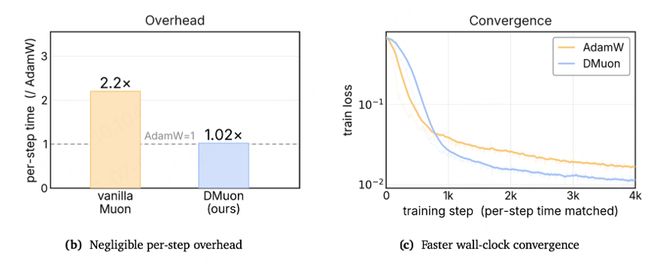
Variable Robotics has introduced the DMuon optimizer, enhancing the distributed Muon model infrastructure's efficiency by approximately 30%. This new optimizer addresses the additional computational and communication costs associated with using Muon in distributed training, which previously resulted in an end-to-end step time 2.2 times longer than AdamW.
The significance of DMuon lies in its ability to maintain the faster convergence benefits of the Muon optimizer while reducing the end-to-end step time to just 1.02 times that of AdamW. This improvement is achieved through fine-grained communication optimization, computation-aware load balancing, and a high-performance kernel system, making DMuon a viable option for embodied model training without requiring changes to parameter update rules or training frameworks.
Looking ahead, DMuon is expected to become a new default choice for embodied model training, as it effectively mitigates the redundant computations and communication overhead that previously hindered Muon's performance in distributed environments. No further timeline was disclosed at the time of publication.
Editor's Note
The introduction of DMuon by Variable Robotics represents a significant advancement in the optimization of large model training infrastructures. By addressing the inherent inefficiencies of distributed computing with the Muon optimizer, DMuon could reshape the competitive landscape for companies relying on high-performance neural network training. The focus on reducing communication overhead and enhancing computational efficiency is crucial for enterprises looking to optimize their AI and machine learning workflows.



























Leave a comment