

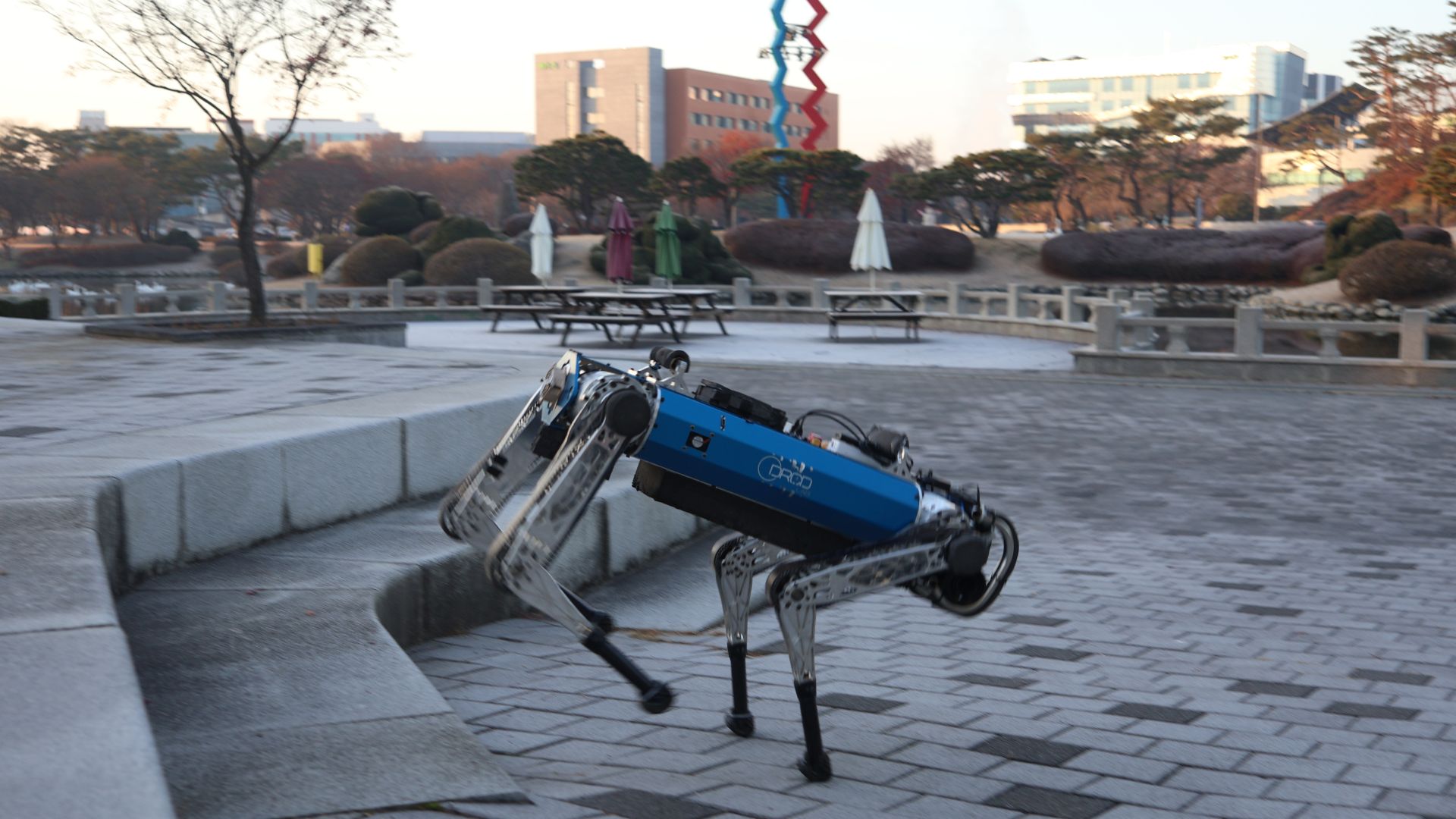
Researchers from Korea have created an AI framework that allows a quadruped robot to autonomously adapt its motor skills while navigating challenging environments. This system enables real-time gait adjustments for traversing forests, climbing stairs, and overcoming obstacles using only onboard sensors and computing capabilities.
The significance of this development lies in its potential applications for autonomous search-and-rescue and exploration missions. The Action Pretrained Transformer-based Reinforcement Learning (APT-RL) framework enhances agility by combining pretrained locomotion skills with adaptive decision-making, demonstrating the robot's ability to handle diverse obstacles effectively.
Future observations will focus on the framework's deployment in real-world scenarios, as it has already shown impressive performance on KAIST’s quadruped robot, HOUND. The robot's ability to switch between different gaits based on terrain and speed, achieving speeds of up to 6 meters per second, highlights the effectiveness of the APT-RL approach in complex environments. No further timeline was disclosed at the time of publication.
Editor's Note
The development of the APT-RL framework represents a significant advancement in robotic locomotion technology. As robots become more capable of navigating unpredictable environments, industries such as search-and-rescue and exploration stand to benefit greatly from these innovations. The ability to adapt in real-time enhances operational efficiency and opens new avenues for autonomous robotic applications.






























Leave a comment