

Hummingbird F100 Revolutionizes Wind Turbine Blade Inspection with Wireless Technology
- Published
- Source
- leaderobot.com
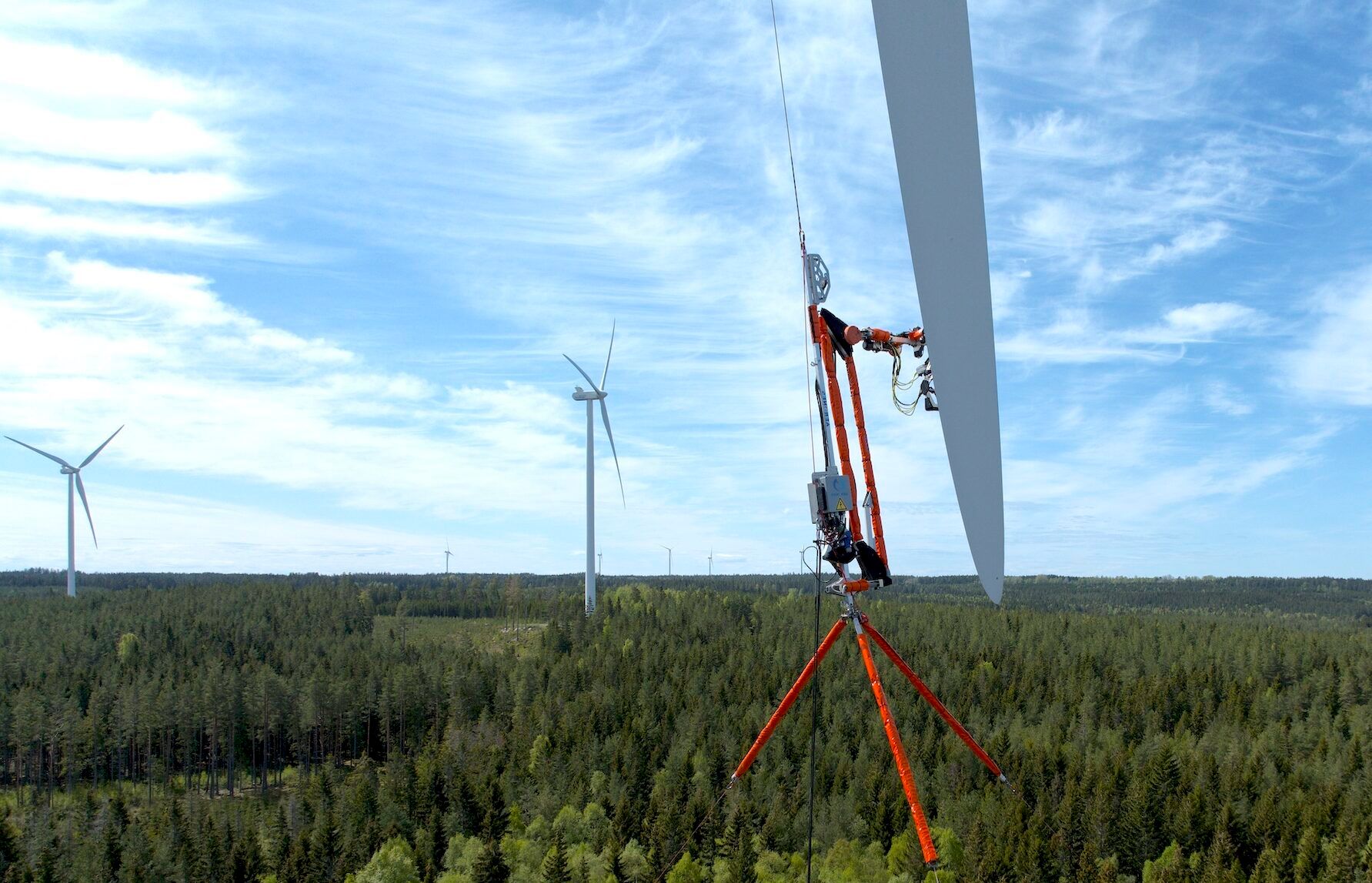
The Hummingbird F100, launched by Schrodinger Industrial Group, marks a significant advancement in wind turbine blade inspection. This device operates wirelessly, enabling stable connections over distances of up to 150 meters, and is designed to navigate complex internal structures of turbine blades, which are typically challenging to inspect due to their confined spaces.
The global market for wind turbine blade inspection services is projected to grow from $7.74 billion in 2025 to $8.48 billion in 2026, with a compound annual growth rate of 9.6%. The Hummingbird F100 addresses the industry's need for more efficient inspection methods by automating data collection and analysis, shifting from reactive maintenance to proactive asset management.
Looking ahead, the integration of AI with inspection robotics will enhance defect detection and reporting capabilities. The transition from wired to wireless operations will not only streamline deployment but also expand operational ranges and reduce on-site risks. The Hummingbird F100's modular design allows for rapid adaptation to various inspection scenarios, positioning it as a key player in the evolving wind energy sector.
Original report
Hummingbird F100: A New Era in Wind Turbine Blade Inspection
leaderobot.com · LeaderobotThis briefing is an independently written summary based on publicly available reporting and is provided for industry information and news discovery. The original report and source publication are credited and linked where applicable. RobotToday does not claim ownership of third-party source material.
Rights concerns? Contact [email protected] with the relevant URL and details. We will review the matter and take appropriate action where warranted.
More related news
-
1
ROBOTTODAY Weekly October 19 – 23, 2026 RobotToday · 7 hours ago
- 2
- 3
- 4
- 5
- 6
- 7
- 8
- 9
- 10
- 11
- 12
Related Suppliers

SROD Industrial 深圳市施罗德工业集团有限公司
China
Shenzhen-based special robot manufacturer founded 2009; 354+ patents, pipeline inspection robots exported to 40+ countries.
Microagi
Germany
Munich embodied-AI company founded September 2025 by five co-founders; closed a $55 million seed round in July 2026 for its Atlas platform.

SkySpecs
United States
Autonomous drone inspection and asset management software for wind turbines, operating in 19+ countries.
Aerones
Latvia
Riga, Latvia wind-turbine robotics company founded 2015; offers robotic blade inspection, cleaning, and repair services; over 240 staff active in 25 countries.

TriVision A/S
Denmark
Odense, Denmark machine vision maker with over two decades in food inspection; detects foreign objects down to 1 square millimeter on packaging lines.

MTL Precision
United States
Lenexa, Kansas and Migdal Tefen, Israel inspection maker founded 1998 as Metroptic; sells non-contact metrology to Pratt & Whitney, GE Aerospace.

Ventcor Systems
Canada
Ventcor Systems is a Canadian manufacturer of industrial spray booths and paint finishing ventilation systems, based in Vaughan, Ontario.

Ulysses (The Ocean Company)
United States
San Francisco startup (est. 2023) building modular AUVs and ASVs for ocean stewardship, defense ISR, and ecological restoration; raised $46M.
Bucket Robotics
United States
AI vision defect detection for manufacturing — trained from CAD and synthetic data, deployed in minutes on existing cameras.
Beijing Aqiu Technology (Aqrose) 北京阿丘科技有限公司
China
Chinese AI machine vision company providing industrial defect detection software, 3D cameras and robot vision systems for quality control in manufacturing.

Doodle Labs
United States
US/Singapore maker of Mesh Rider smart-radio datalinks providing long-range, anti-jam wireless mesh networking for drones and robots.

Hydromea
Switzerland
Swiss underwater robotics company offering optical wireless modems and inspection ROVs for submerged asset monitoring.
Robotics needs a service framework.
RSF defines a common language for robot service capability, lifecycle operations, certification pathways, and service-provider networks.
Join the RobotToday community on LinkedIn
Daily robotics news, in-depth analysis, conference highlights, and discussions with professionals worldwide.


