

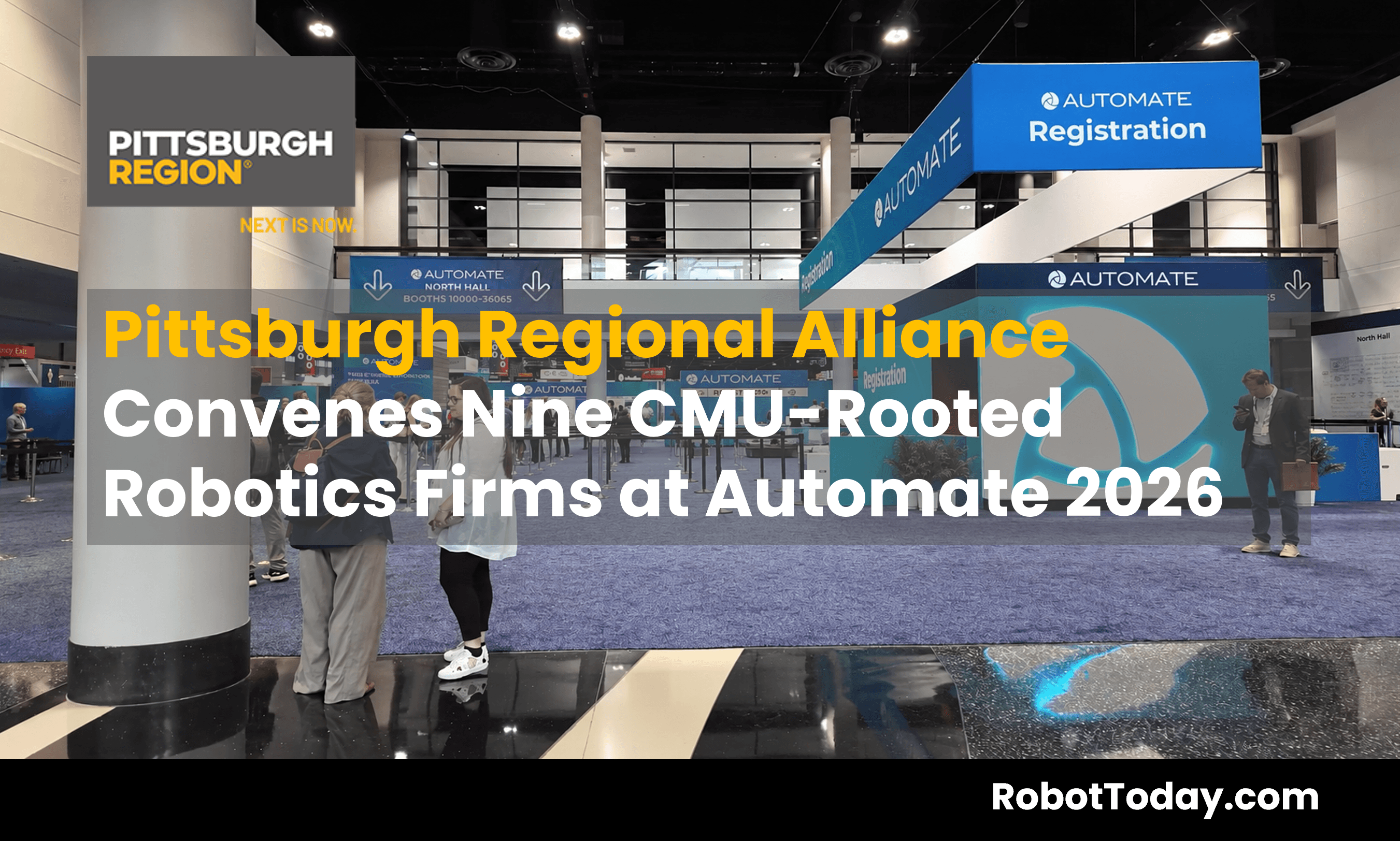
A coordinated regional delegation maps the robotics stack — from polymers to autonomous mobile robots — anchored in Carnegie Mellon research.
Executive Summary
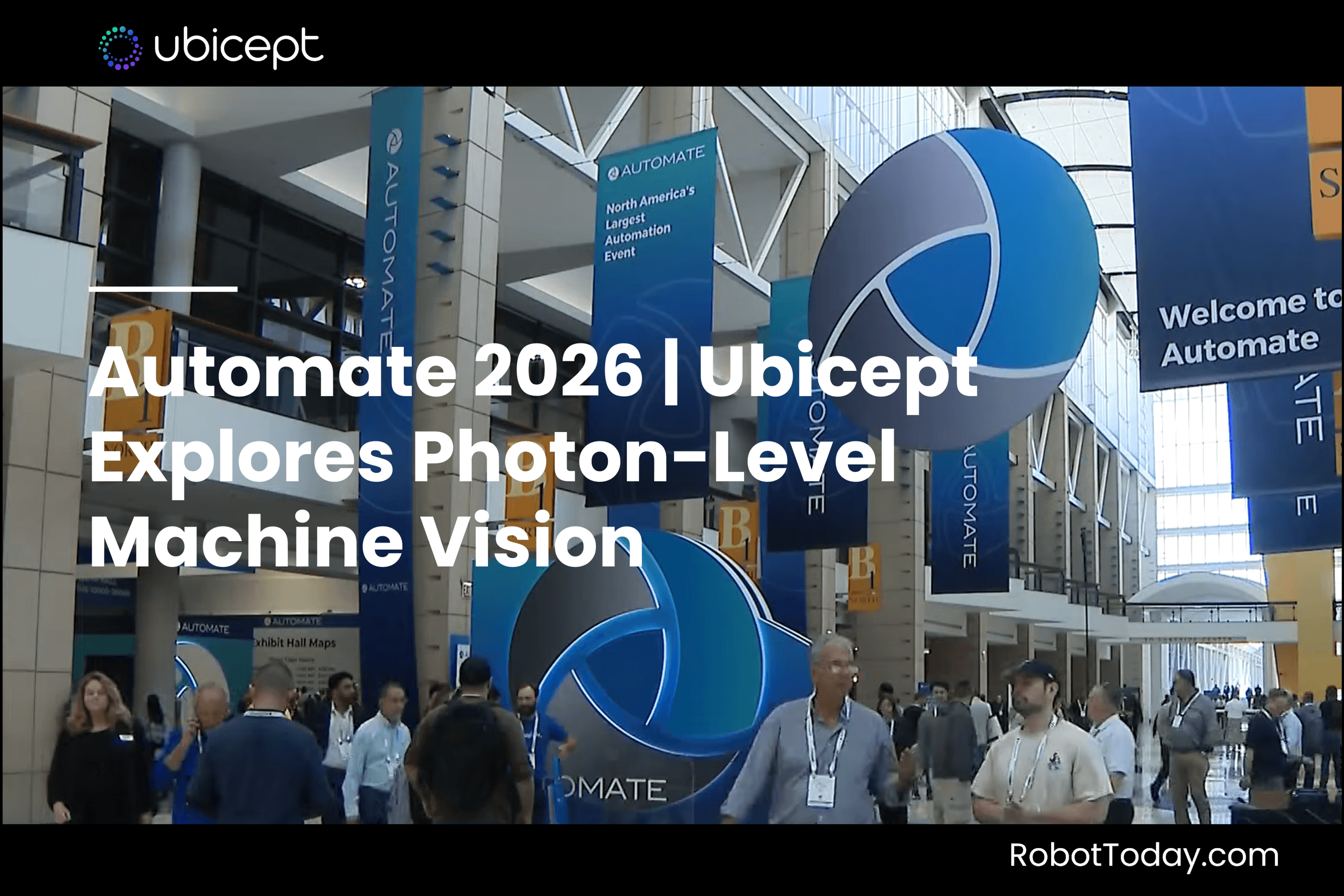
At Automate 2026, held June 22–25 at McCormick Place in Chicago, the Pittsburgh Regional Alliance (PRA) organized a regional delegation of nine companies under a shared "Robotics Row" identity at Booth 3425. The group spans five layers of the robotics value chain: polymer materials, actuation, perception and safety, autonomous mobility, and contract manufacturing.
Seven of the nine companies trace their technology to Carnegie Mellon University (CMU). Five are direct spinouts of specific CMU laboratories; two derive indirectly through the National Robotics Engineering Center (NREC) and its spinout, Carnegie Robotics. The delegation illustrates how a single academic research base supplies an entire regional supply chain rather than isolated startups.
This report examines the cohort's engineering origins and commercialization status, and how close collaboration between research and industry actively and durably supports Pittsburgh's robotics base.
Industry Context
Automate, organized by the Association for Advancing Automation (A3), is the largest automation and robotics exhibition in North America. The 2025 edition in Detroit registered more than 45,000 attendees. The 2026 edition moved to Chicago.
Regional economic-development agencies increasingly coordinate exhibitor delegations to present a supply chain rather than individual vendors. The PRA delegation is a structured example: a passport-style booklet directed attendees to each company and to a private reception, framing the nine firms as one integrated ecosystem.
The convening organization
PRA is the economic-development marketing affiliate of the Allegheny Conference on Community Development (ACCD), founded in 1944 by Richard King Mellon and Carnegie Institute of Technology president Robert Doherty, among others. PRA markets ten southwestern Pennsylvania counties for investment and represents regional government in recruitment.
The distinction matters for interpreting the delegation. The convener is not an industry trade body but a regional investment agency with government backing. The Pittsburgh Robotics Network, a 501(c)(6) trade association, plays the vertical industry role; PRA operates at the level of regional policy and capital attraction.
Technology
The nine companies are best understood by the layer of the stack they address.
Materials and actuation
Covestro, a polymer producer with its North American headquarters in Pittsburgh, supplies polycarbonate and PC/ABS grades used in robot housings, thermally conductive compounds for heat management, and infrared-transmissive materials for sensor covers. ESTAT Actuation, founded in 2019, develops electroadhesive clutches and brakes that replace electromagnetic components with thinner, lower-power devices; the technology originates in CMU's Soft Machines Lab.
Perception and safety
Phlux Technologies, founded in 2020, commercializes a programmable "light curtain" — a software-defined optical safety boundary that detects intrusion into a robot work cell without fixed guarding. The method derives from depth-imaging research in CMU Robotics Institute's Illumination and Imaging Laboratory. Hellbender designs and manufactures edge-AI vision and perception hardware for industrial deployment.
Autonomous mobility
Seegrid, founded in 2003, produces vision-guided autonomous mobile robots (AMRs) — autonomous tow tractors and lift trucks. Thoro.ai, spun out of Carnegie Robotics, develops CoreFlex, a hardware-agnostic autonomy stack supporting 3D visual SLAM, dynamic obstacle avoidance, and fleet management for industrial AMRs.
Integration and manufacturing
HEBI Robotics, founded in 2014, supplies series-elastic modular actuators and arms with motion-control APIs for rapid robot construction. Titan Robotics integrates turnkey robotic systems for high-mix manufacturing processes including grinding, sanding, painting, and sandblasting. Tronix3D provides contract additive manufacturing across polymer and metal processes for prototyping and low-volume production.
Engineering Analysis
The cohort's defining characteristic is a shared research lineage rather than a shared product category. Five companies are direct CMU laboratory spinouts: ESTAT (Soft Machines Lab), HEBI Robotics (Biorobotics Lab, led by Howie Choset), Phlux (Illumination and Imaging Laboratory), Seegrid (Mobile Robot Lab, co-founded by occupancy-grid pioneer Hans Moravec), and Titan Robotics (NREC).
A second tier connects through NREC. Carnegie Robotics was founded in 2010 as an NREC spinout; Thoro.ai later spun out of Carnegie Robotics, and Hellbender's founder previously worked at both NREC and Carnegie Robotics. Tracing these paths, four of the nine companies link back to NREC specifically — the applied-engineering arm of the CMU Robotics Institute.
This concentration produces a technical advantage: founders share methods, toolchains, and validation practices, which lowers integration friction across the layers. It also explains the breadth. The cluster covers materials through systems integration because CMU research spans those domains, not because the companies coordinated product roadmaps.
Cohort by layer, CMU linkage, and founding year
| Company | Layer | CMU linkage | Founded / note |
| Covestro | Materials | None (NA HQ in Pittsburgh) | Public; ex-Bayer (2015) |
| ESTAT Actuation | Actuation | Direct — Soft Machines Lab (ME) | 2019 |
| HEBI Robotics | Actuators / modular | Direct — Biorobotics Lab (RI) | 2014 |
| Phlux | Safety / perception | Direct — ILIM (RI) | 2020 |
| Hellbender | Edge-AI perception | Indirect — via NREC / Carnegie Robotics | 2021 |
| Seegrid | AMR | Direct — Mobile Robot Lab (RI) | 2003 |
| Thoro.ai | Autonomy software | Indirect — via Carnegie Robotics | 2021 |
| Titan Robotics | Systems integration | Direct — NREC (RI) | 2014 |
| Tronix3D | Additive mfg | None (serves CMU ecosystem) | 2017 |
Commercial Progress
Commercial maturity varies widely across the cohort. Seegrid is the most established robotics deployment: the company reports more than 20 million autonomous miles driven and more than 2,500 vehicles across over 200 sites. Covestro is a public materials company and the only non-startup in the group.
The remaining robotics firms are earlier-stage. ESTAT (2019), Phlux (2020), Hellbender (2021), and Thoro.ai (2021) are commercializing first-generation products. HEBI Robotics and Titan Robotics, both founded in 2014, sell into research, industrial, and defense customers. Tronix3D operates as a manufacturing-services provider and was acquired in 2021.
Specific funding, pricing, and certification figures for several private companies were not publicly disclosed at the time of writing and are therefore not reported here.
Market Perspective
For system integrators and OEMs, the delegation functions as a pre-assembled regional supply chain: actuation, perception, safety, mobility, integration, and materials sourced within one metropolitan area. Co-location can shorten development cycles where partners share interfaces and validation environments.
For investors, the cohort represents concentrated exposure to CMU-origin robotics. That concentration is also the central risk variable, addressed below.
Challenges
Concentration is also the cohort's principal strength. A dense research base at CMU and NREC, coordinated by a single regional agency, lets talent, methods, and capital aggregate efficiently. Sustaining the research pipeline and broadening funding sources will help carry that advantage forward over time.
Commercialization risk is significant for the early-stage members. Electroadhesive actuation and programmable optical safety are technically validated but not yet broadly deployed; production readiness, certification, and unit economics remain to be demonstrated at scale.
Competition is external and well-capitalized. In AMRs specifically, Seegrid and Thoro.ai operate against global vendors with larger installed bases. A regional identity does not insulate individual companies from that competition.
RobotToday Analysis
Technical significance: The delegation demonstrates that Pittsburgh's robotics activity is organized around a verifiable research lineage — five direct CMU lab spinouts and a deeper NREC root shared by four companies. This is a genuine engineering asset, not a marketing construct, because it reflects shared methods and talent rather than co-located but unrelated firms.
Commercial significance: The cohort pairs one proven AMR deployment (Seegrid) and one public materials supplier (Covestro) with several early-stage specialists. The mix gives the region credibility at both the component and systems levels, but most robotics revenue in the group remains concentrated in the few mature companies.
Areas to watch: The 2019–2021 companies are moving from validation toward production, and continued research output and regional support are giving them favorable conditions to do so. As more spinouts emerge, the research–industry synergy should further amplify the region's advantage.
Industry outlook: A research-anchored regional supply chain is a credible and resilient model for robotics commercialization. CMU's sustained research output, NREC's applied-engineering depth, and PRA's convening and capital-attraction role are forming a virtuous cycle between research and industry — a synergy that gives Pittsburgh's robotics ecosystem positive, durable support and creates favorable conditions for early-stage companies to reach production.
References
Allegheny Conference on Community Development — About; Pittsburgh Economic Development (pittsburghregion.org) — About Us; Automate 2026 official program (automateshow.com); company technical and corporate pages (Covestro, ESTAT, HEBI Robotics, Phlux, Seegrid, Thoro.ai, Titan Robotics, Tronix3D, Hellbender); CMU Robotics Institute and CMU Mechanical Engineering faculty/lab pages; PR Newswire (Carnegie Robotics / Thoro.ai launch). Founder and lineage details verified against company and university sources; figures not publicly disclosed are omitted.



Leave a comment