

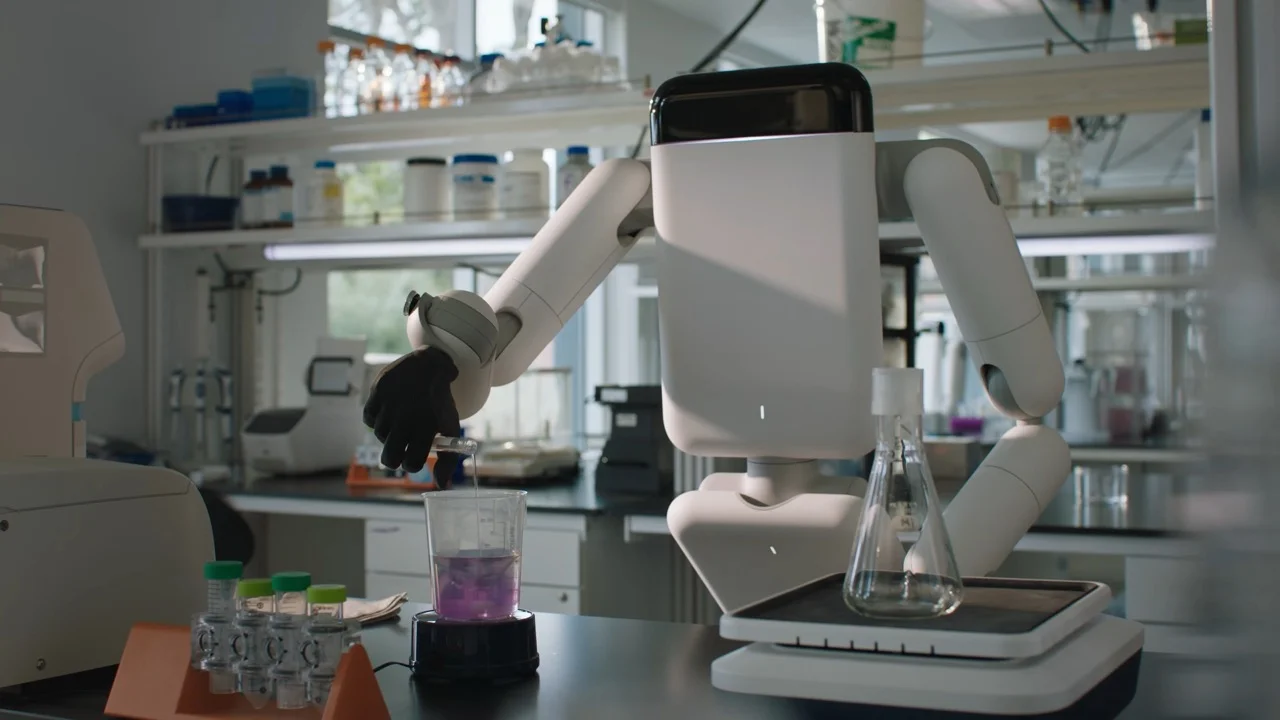
Genesis AI has unveiled its first general-purpose robot, Eno, which diverges from traditional humanoid designs. Instead of mimicking human form, Eno features a minimalist design that enhances human capabilities. CEO Zhou Xian emphasizes that valuable robots require intentional design and integrated systems, resulting in a product that resembles a high-end appliance rather than a humanoid.
Eno's design includes a wheeled base and a central tower of articulated panels, allowing for dynamic height adjustment and compact storage. Unlike typical humanoid robots, Eno lacks a traditional head but offers a chest-mounted cognitive interface that displays its AI's intent and operational state, fostering trust with users. Its arms feature proprietary dexterous hands co-developed with Wuji Tech, boasting 22 degrees of freedom and safety for close human interaction.
Eno operates on GENE, Genesis AI's robotics-native foundation model, enabling it to function as a true physical agent. This system allows Eno to understand high-level objectives, adapt to environments, and manage workflows actively. Genesis AI is enhancing Eno's intelligence through its Genesis World 1.0 simulation platform, which aims to bridge the gap between simulation and real-world application.
Editor's Note
The introduction of Eno by Genesis AI marks a significant shift in the robotics landscape, focusing on minimalist design and enhanced functionality. This approach could influence future robot development, emphasizing utility over humanoid aesthetics. As companies explore automation, Eno's unique capabilities may attract interest from various sectors seeking efficient solutions.


































Leave a comment