Industry Briefing
A single destination for timely, editor-curated robotics news from around the world.
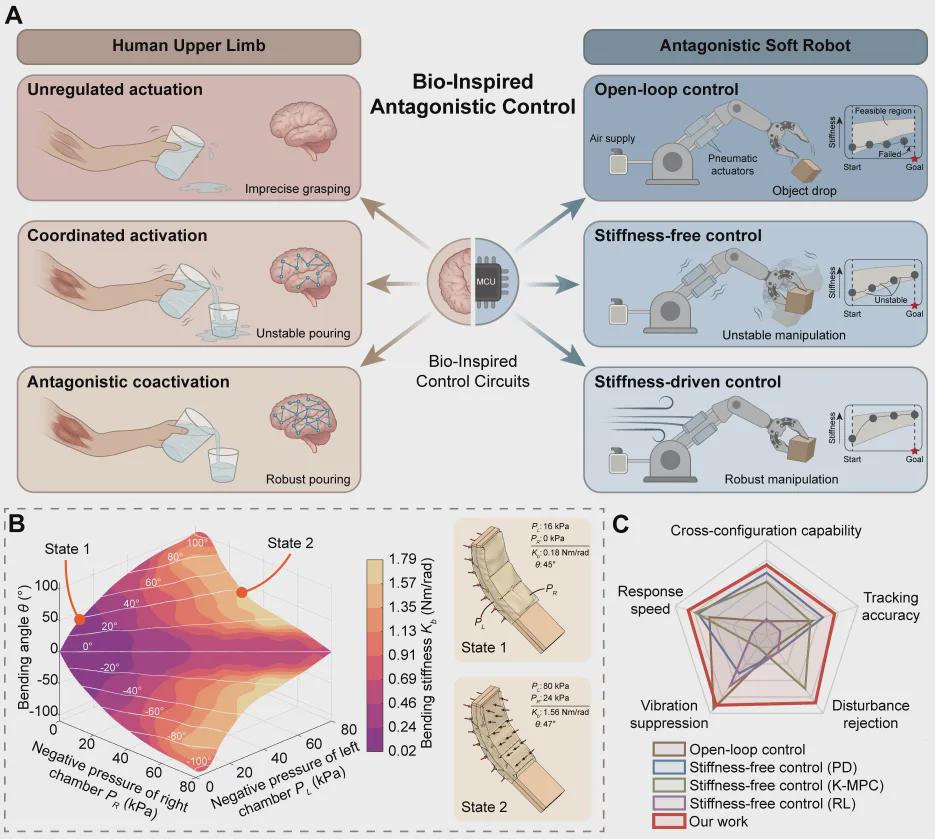
Enhancing Stability and Precision in Antagonistic Soft Robots Through Muscle-Inspired Stiffness Regulation
Researchers from Nanyang Technological University have developed a stiffness-driven control strategy for antagonistic soft robots, inspired by muscle coactivation. This approach improves the robots' stability, precision, and disturbance resistance without relying on complex analytical models or real-time stiffness measurements. The innovation lies in integrating stiffness regulation into motion control, allowing soft robots to maintain similar joint postures while adjusting overall stiffness. The study demonstrated that the bending stiffness of the robot could be increased from approximately 0.02 N·m/rad to 1.79 N·m/rad, an 88-fold enhancement, showcasing the potential for improved performance in various applications. Future developments will focus on refining this control strategy and exploring its applications in real-world scenarios. No further timeline was disclosed at the time of publication.
Soft Robotics Robotic Control Systems Stiffness Regulation Biomechanics Automation TechnologyRobotics needs a service framework.
RSF defines a common language for robot service capability, lifecycle operations, certification pathways, and service-provider networks.
Join the RobotToday community on LinkedIn
Daily robotics news, in-depth analysis, conference highlights, and discussions with professionals worldwide.