Industry Briefing
A single destination for timely, editor-curated robotics news from around the world.
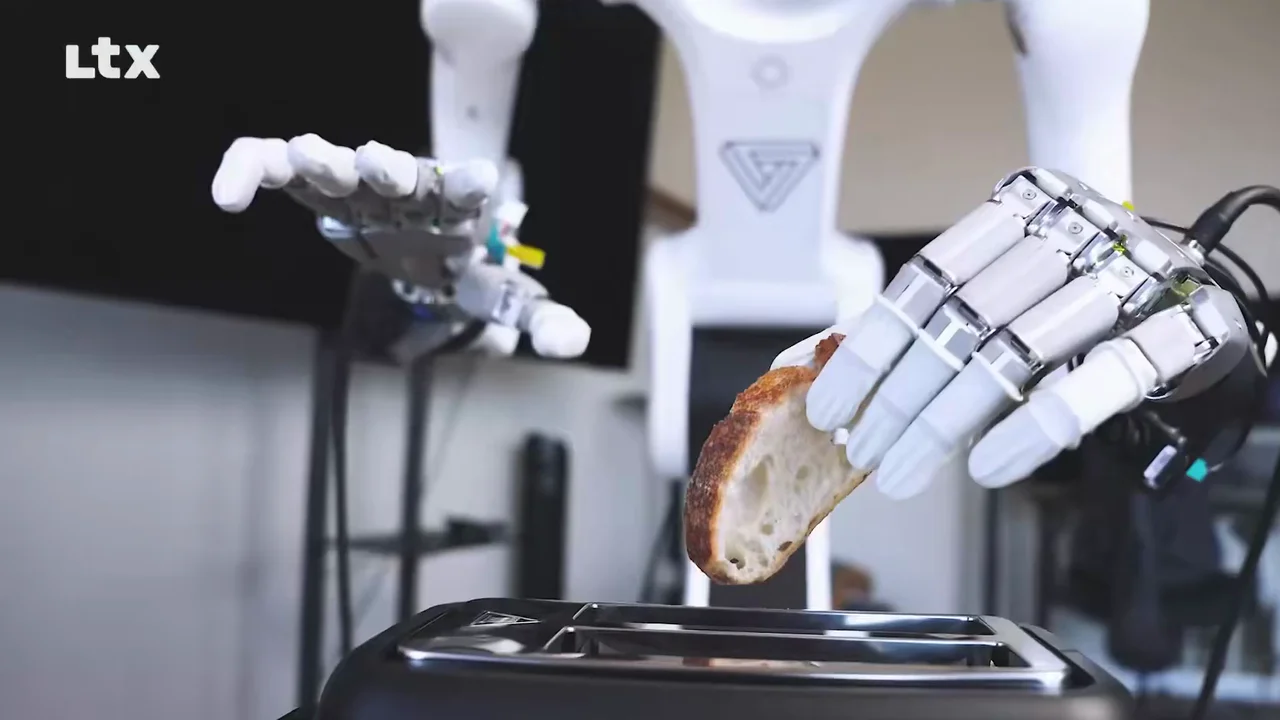
Markov Robotics Innovates Dexterous Manipulation with Video-Based Policy on LTX-2.5
Markov Robotics has introduced a novel approach to dexterous manipulation using a video model as the policy for its LTX-2.5 robot. This method allows the robot to understand object interactions in real-time, enhancing its ability to perform tasks in unfamiliar environments. By leveraging a world model that incorporates physical knowledge, the robot can adapt its grip based on the object's characteristics, such as applying gentle pressure for fragile items like glass and firmer grip for sturdier objects like rocks. This innovation addresses a significant challenge in robotics, where the development of effective software has not kept pace with advancements in hardware. Markov's approach emphasizes the importance of policies in robotic performance, suggesting that the future of dexterous manipulation lies in integrating high-fidelity sensory data with video-based expectations. The company's method of using a head cam to capture scenes and generate action videos represents a shift in how robots can learn and execute tasks. Looking ahead, the robotics community will be watching how Markov's techniques influence the broader field, particularly as more organizations explore world models for robotic applications. The effectiveness of this approach and its potential to streamline the training process for robots could set new standards in the industry. No further timeline was disclosed at the time of publication.
LTX Markov Robotics
LTX Unveils LTX-2.5 Open World Model for Enhanced Video and Physical AI Applications
LTX has introduced LTX-2.5, an advanced version of its open-weights world model, enhancing capabilities for video generation and physical AI. This model boasts improvements in visual quality, prompt understanding, and generation speed, allowing developers to customize it on their hardware. With over 33 million downloads, LTX-2.5 is positioned as a foundational model for applications in film production, robotics, and real-time rendering. The significance of LTX-2.5 lies in its ability to model environmental changes over time, a critical feature for robotics and physical AI. According to Zeev Farbman, co-founder and CEO of LTX, the model addresses challenges unique to world models, such as maintaining consistency in motion and sound. By offering an open model, LTX empowers teams to retain control over their hardware and intellectual property while delivering industry-leading quality. Looking ahead, LTX has rebuilt much of the generation pipeline for LTX-2.5, introducing features like native multishot generation and a new diffusion video decoder. These enhancements aim to improve visual output and prompt understanding, making LTX-2.5 a versatile tool for developers. No further timeline was disclosed at the time of publication.
Computing Design Software artificial intelligence asteria comfyui
LTX-2.5 Launches with Fast AI Video Generation and Open Weights Integration
LTX, a company spun out of Lightricks, has launched LTX-2.5, an advanced open-weights video model that can generate a 10-second video from an image in just 6.8 seconds using NVIDIA superchips. This model is now integrated into ComfyUI and available on Hugging Face, supporting organizations with under $10 million in annual revenue for free. The significance of LTX-2.5 lies in its innovative features, including a new diffusion video decoder that enhances video quality and native multishot generation for consistent outputs. LTX claims its model has surpassed 33 million downloads, making it the most popular open world model line, and it aims to provide flexibility and efficiency in video generation compared to closed API competitors. Looking ahead, LTX is focused on expanding its capabilities and refining its technology. The company emphasizes the importance of open weights for diverse use cases in video and world models, contrasting its approach with the trend towards closed models in the industry. No further timeline was disclosed at the time of publication.
Technology
NVIDIA RTX Accelerates 4K AI Video Generation on PC With LTX-2 and ComfyUI Upgrades
In 2025, advancements in artificial intelligence on personal computers reached a significant milestone, with small language models (SLMs) achieving nearly double the accuracy compared to the previous year. This improvement has notably narrowed the performance gap between these PC-class models and larger, cloud-based language models (LLMs). The surge in AI development is attributed to enhanced developer tools and techniques that have emerged, enabling more efficient training and deployment of SLMs. As a result, users can now access more powerful AI capabilities directly on their PCs, marking a pivotal shift in the landscape of AI technology.
Robotics needs a service framework.
RSF defines a common language for robot service capability, lifecycle operations, certification pathways, and service-provider networks.
Join the RobotToday community on LinkedIn
Daily robotics news, in-depth analysis, conference highlights, and discussions with professionals worldwide.