Industry Briefing
A single destination for timely, editor-curated robotics news from around the world.

Alaska Center for Unmanned Aircraft Systems Integration Tests Drone Delivery of Blood Samples for Anti-Doping Agency
The Alaska Center for Unmanned Aircraft Systems Integration (ACUASI) successfully conducted a test flight carrying chilled human blood samples over a distance of 1,000 kilometers for the International Testing Agency (ITA). This 8-hour, 47-minute round trip from Nenana aimed to assess the viability of long-range drones in transporting biological samples without degradation. This initiative is significant as it explores the potential of unmanned aircraft to enhance the efficiency of medical sample transport, particularly in remote areas. The ITA's interest in utilizing drones stems from their ability to cover greater distances at lower costs compared to traditional crewed aircraft, which could revolutionize the logistics of anti-doping efforts and medical testing. Looking ahead, the results from this test could pave the way for broader applications of drone technology in healthcare and research. ACUASI's capabilities, combined with the operational efficiency demonstrated during this flight, suggest a promising future for drone-assisted medical logistics, especially in underserved communities in Alaska and beyond. No further timeline was disclosed at the time of publication.
Delivery Drone News Drone News Feeds Logistics Medical Medical Delivery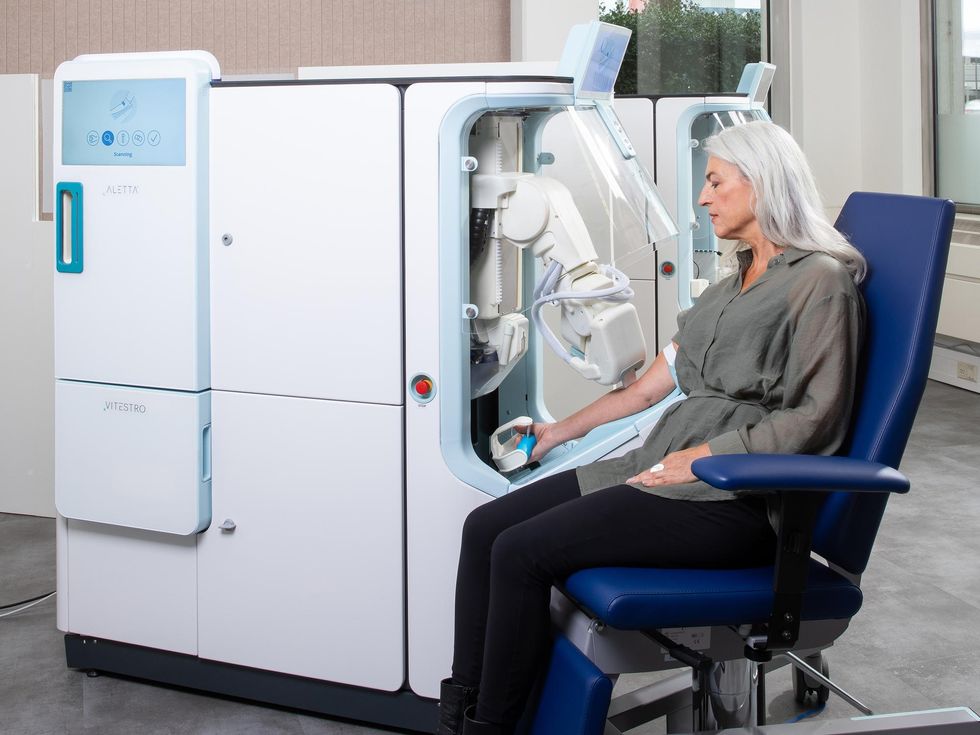
Aletta: The First Autonomous Blood-Draw Device Approved in the U.S.
Aletta, developed by Vitestro, is the first autonomous blood-draw device authorized for use in the U.S. by the FDA on August 19. This innovative system utilizes imaging technologies, robotics, and AI to perform blood draws without human intervention, achieving a 94.5% success rate in clinical trials involving over 1,600 participants. The significance of Aletta lies in its potential to alleviate staffing shortages in clinical labs, where phlebotomist turnover rates are high. With the ability for one phlebotomist to supervise multiple Aletta machines, this technology could enhance lab capacity for routine diagnostic testing, addressing critical operational challenges. Looking ahead, while Aletta shows promise, concerns about its performance across different skin tones remain. Vitestro claims that the ultrasound component mitigates these issues, but further evidence is needed to ensure the device's efficacy for all patients. A U.S.-based trial is planned to assess sample quality and performance in diverse populations.
Medical-robots Blood Robotics
FDA Approves Vitestro's Aletta Robot for Autonomous Blood Sampling
Vitestro, a medical technology company based in Utrecht, Netherlands, has received FDA approval for its Aletta device, which autonomously performs venipuncture for outpatient adults. This marks Aletta as the first robot capable of conducting blood sampling without direct human intervention, having previously secured CE certification in Europe. The significance of this approval lies in the establishment of a regulatory framework for autonomous blood sampling robots, indicating a shift towards integrating robotic solutions in clinical settings for high-frequency medical procedures. Blood sampling is one of the most commonly performed invasive medical operations worldwide, with billions conducted annually, highlighting the need for efficient and reliable solutions. Looking ahead, the Aletta robot employs multimodal imaging technology to visualize veins and utilizes AI algorithms to determine optimal puncture paths. As healthcare faces a shortage of trained personnel, the introduction of such robotic systems could alleviate the burden on nurses and improve patient care. No further timeline was disclosed at the time of publication.
Medical Robotics Blood Sampling Healthcare Technology Automation
Archer First Response Systems Launches Whole Blood Drone Delivery in Florida
Archer First Response Systems (ArcherFRS) has initiated a drone program to deliver whole blood directly to emergency scenes in Hillsborough County, Florida. This program, a collaboration with several local organizations, aims to provide critical blood supplies to severe hemorrhagic trauma incidents within an average of three minutes, marking a significant advancement in emergency medical services. The importance of this initiative lies in its potential to enhance patient outcomes during critical situations. By utilizing drones for blood delivery, ArcherFRS is addressing the challenges of timely medical intervention in trauma cases. The program operates from two fire stations and covers a service area of approximately 70 square miles, ensuring rapid response capabilities. Looking ahead, the program is part of the ArcherFRS Champion Hospital Partner Program, which aims to integrate advanced medical technologies into emergency response. No further timeline was disclosed at the time of publication, but the collaboration between ArcherFRS and local healthcare providers is expected to evolve, potentially expanding the capabilities of emergency services in the region.
Applications Delivery Drone News Drone News Feeds Drones in the News emergency response
University of Hong Kong Develops AI Tool to Predict Heart Disease 15 Years Early
Researchers at the LKS Faculty of Medicine of the University of Hong Kong have created an AI tool called CardiOmicScore, which predicts serious cardiovascular diseases up to 15 years before symptoms appear. This innovative system utilizes data from a single blood test to assess the risk of six major cardiovascular diseases, including coronary artery disease and stroke. The significance of this development lies in its potential to identify individuals at high risk of cardiovascular diseases earlier than traditional methods. Current assessments often rely on standard clinical measurements, which may overlook early biological changes. CardiOmicScore aims to provide a more accurate and timely evaluation of cardiovascular health, addressing a critical gap in preventive care. Looking ahead, the research team emphasizes the importance of further validation and potential clinical applications of CardiOmicScore. As cardiovascular diseases remain the leading cause of death globally, advancements in predictive tools like this could significantly enhance early intervention strategies. No further timeline was disclosed at the time of publication.

This AI spots dangerous blood cells doctors often miss
A groundbreaking generative AI system has been developed that surpasses human experts in analyzing blood cells, achieving greater accuracy and confidence in detecting subtle signs of diseases such as leukemia. This advanced technology not only identifies rare abnormalities in blood samples but also has the capability to recognize its own uncertainty, enhancing its reliability as a support tool for clinicians. By integrating this AI into medical diagnostics, healthcare professionals can improve early detection and treatment of blood-related diseases, ultimately leading to better patient outcomes. The system represents a significant advancement in the intersection of artificial intelligence and medical science, promising to transform the way blood disorders are diagnosed and managed.
Robotics needs a service framework.
RSF defines a common language for robot service capability, lifecycle operations, certification pathways, and service-provider networks.
Join the RobotToday community on LinkedIn
Daily robotics news, in-depth analysis, conference highlights, and discussions with professionals worldwide.