

Physical AI Enhances Adaptability for Mid-Market Manufacturers Facing Disruption
- Published
- Source
- AutomationWorld.com
Mid-market manufacturers are increasingly turning to physical AI to enhance operational adaptability in the face of fluctuating production conditions. Traditional automation systems often struggle under the pressures of changing product mixes and workforce availability, making physical AI a crucial technology for real-time responsiveness. By enabling machines to perceive and react to their environments, physical AI can improve safety and efficiency without necessitating large-scale transformations.
The significance of physical AI lies in its ability to provide mid-market manufacturers with the tools to navigate variability in production schedules and equipment. For instance, AI-powered inspection systems and robotic solutions can adjust to real-time conditions, thereby maintaining throughput and safety. A notable example includes an automotive supplier that improved safety by integrating AI vision into existing cameras, allowing for better traffic management within the facility.
Looking ahead, mid-market manufacturers should consider phased approaches to adopting physical AI, focusing on specific operational challenges to build confidence and momentum. While technical limitations and funding concerns may pose challenges, subscription-based models can offer a flexible pathway for testing and scaling AI solutions, ultimately enhancing resilience and operational effectiveness.
Original report
Physical AI: New Possibilities for Mid-Market Manufacturers
AutomationWorld.com · (Wolfe Tone)This briefing is an independently written summary based on publicly available reporting and is provided for industry information and news discovery. The original report and source publication are credited and linked where applicable. RobotToday does not claim ownership of third-party source material.
Rights concerns? Contact [email protected] with the relevant URL and details. We will review the matter and take appropriate action where warranted.
More related news
- 1
- 2
- 3
- 4
- 5
- 6
- 7
- 8
- 9
- 10
- 11
- 12
Related Suppliers
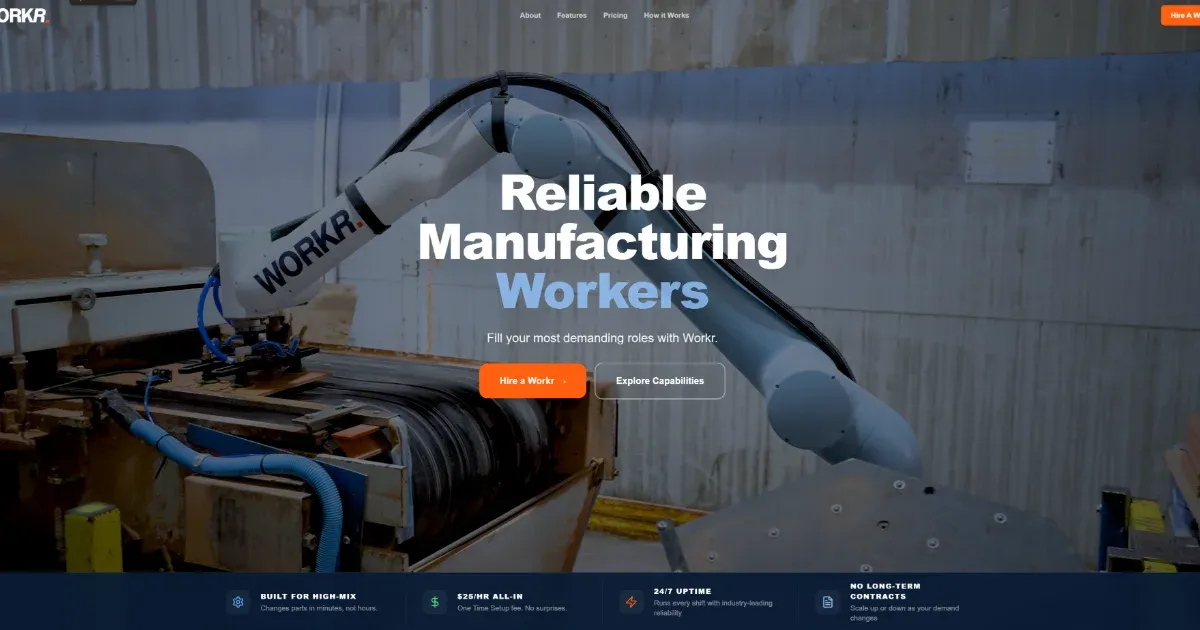
Workr Robotics
Ireland
Irish RaaS startup delivering AI-powered robotic workforce to manufacturers at $25/hour with no capital expenditure required.

EEP Robotics GmbH
Austria
Austrian owner-managed robotics integrator delivering gripper systems, palletizing, welding, and turnkey robotic cells for industrial manufacturers since 1997.

Void Robotics
United States
Marathon, Florida startup offering sub-$10K autonomous material transport robots at $1/hr; Voidwalking platform moves 50 lbs of goods using GPS navigation.
Autonomique
Canada
Builds physical-AI software for industrial robots, enabling autonomous contact-rich assembly and dexterous manipulation on production floors.
Real Time Automation, Inc.
United States
US-based manufacturer of industrial protocol gateways, edge data historians, and embedded connectivity software for factory floor automation.
Real-Time Innovations (RTI)
United States
RTI is the world's largest DDS middleware vendor, providing RTI Connext software as the backbone for autonomous vehicles, defense, and aerospace systems.

Lytx Inc.
United States
US provider of AI-powered video telematics, dashcam safety systems, and fleet management solutions for commercial vehicle fleets.

SiteVue AI, Inc.
United States
US AI video analytics SaaS for manufacturing: cycle time benchmarking, workforce productivity, and safety monitoring on existing cameras, deployable in days.

iXs Research Corporation
Japan
Japanese robotics firm developing AI-integrated inspection robots for social and industrial infrastructure.

Industrial Technology Research Institute (ITRI) 工業技術研究院
Taiwan
Hsinchu County, Taiwan applied-technology research institute founded 1973; over 6,500 staff developing autonomous mobile robots and AI perception systems.
Archetype AI
United States
Physical AI platform company deploying the Newton foundation model to fuse sensor data with language for real-world industrial intelligence.

Deplace AI
France
Paris-based physical AI startup capturing human motion demonstrations and converting them into multimodal action guidance priors for robotics models.
Robotics needs a service framework.
RSF defines a common language for robot service capability, lifecycle operations, certification pathways, and service-provider networks.
Join the RobotToday community on LinkedIn
Daily robotics news, in-depth analysis, conference highlights, and discussions with professionals worldwide.


