Industry Briefing
A single destination for timely, editor-curated robotics news from around the world.

RFID and Barcode Technology for Smarter Operations
Recent advancements in RFID and barcode technology are transforming business operations by enabling real-time asset and inventory tracking. These technologies enhance accuracy and speed in daily workflows, with barcodes facilitating quick scanning and RFID providing automated visibility on a larger scale. As a result, companies across various sectors—including manufacturing, healthcare, retail, and logistics—are experiencing reduced downtime and improved decision-making capabilities. This shift towards smarter operations is particularly evident in busy warehouses, where the integration of these technologies streamlines processes and enhances overall efficiency. The growing reliance on RFID and barcode systems underscores their critical role in optimizing business performance and adapting to the demands of modern supply chains.
Communications Internet Technology asset management asset tracking automation news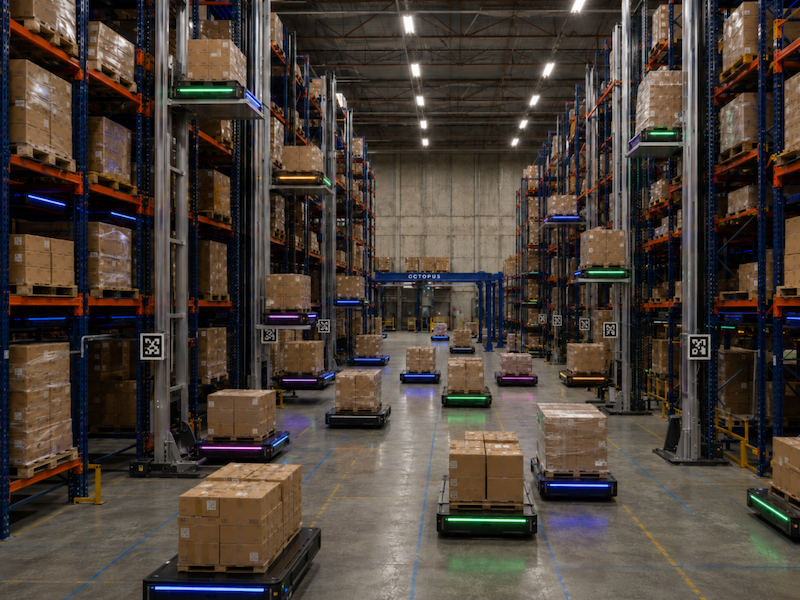
Real-Time Supply Chains Transform Industrial Real Estate and Inventory Management
Recent advancements in predictive analytics, robotics, and data-driven logistics are reshaping industrial real estate by reducing reliance on large inventories. Traditionally, warehouses were designed to manage uncertainty through storage, but the shift towards real-time coordination is changing this paradigm. As supply chains become more connected and visibility improves, the need for extensive inventory diminishes, leading to a redesign of facilities focused on efficient operations. This transformation is significant as it alters the fundamental structure of industrial real estate, moving away from storage-heavy models to those optimized for continuous movement. Just as the introduction of standardized shipping containers revolutionized logistics, the new design principles for automation and throughput will set long-lasting standards for future infrastructure. The choice of facilities that prioritize flow over storage will influence the development of buildings, vehicles, and logistics networks for years to come. Looking ahead, the role of intermediate facilities is evolving from inventory storage to dynamic transfer points, facilitating the movement of goods between transportation modes. As data accessibility increases and transportation systems become more coordinated, the industry must adapt to these changes. No further timeline was disclosed at the time of publication.
Features Logistics Supply chain automation autonomous logistics digital twins
How Pick and Pack Fulfillment is Transforming Order Delivery in the Automation Age
The modern supply chain has undergone a significant transformation, with consumers now expecting two-day shipping as a standard. This shift necessitates a complete rethinking of traditional logistics practices, moving away from manual processes to technology-driven solutions. Companies face challenges in managing increased order volumes while maintaining accuracy, highlighting the need for advanced robotics and smart software in logistics. The implementation of intelligent pick and pack fulfillment workflows is crucial for warehouses to enhance efficiency. By analyzing order data in real time, these systems optimize item retrieval and minimize unnecessary movement within the facility. Techniques such as batch picking and zone picking streamline operations, allowing workers to compile orders more quickly, which leads to faster delivery times and improved customer satisfaction. The rise of autonomous mobile robots (AMRs) marks a significant change in warehouse operations. These robots have evolved from being a novelty to a necessity, utilizing advanced navigation technologies to operate safely in dynamic environments. As logistics providers continue to adopt these innovations, the focus will be on further enhancing operational efficiency and meeting the growing demands of consumers.
Automation Logistics Supply chain amrs autonomous mobile robots e-commerce
Opinion: The AI infrastructure risk robotics leaders can’t afford to ignore
The robotics industry is experiencing a significant transformation, marked by advancements in autonomous mobile robots that are now navigating warehouses with enhanced precision and intelligence. As of October 2023, industrial robots are evolving to become smarter and more adaptable, while AI-powered vision systems are revolutionizing sectors such as manufacturing, logistics, and defense. This surge in technological capabilities is driven by the increasing demand for efficiency and automation across various industries, highlighting the critical role of innovation in shaping the future of robotics.
Aircraft Artificial Intelligence Engineering Features AI deployment AI infrastructure
Hamid Montazeri, SVP of Software & AI at Locus Robotics – Interview Series
Hamid Montazeri recently addressed the transformative effects of "physical AI" on warehouse operations and productivity. In a discussion held in October 2023, Montazeri highlighted how advancements in artificial intelligence are reshaping the logistics sector. He emphasized that the integration of AI technologies is not only streamlining processes but also enhancing efficiency within warehouses. This evolution is driven by the need for businesses to optimize their operations and reduce costs in an increasingly competitive market. Montazeri explained that the implementation of AI solutions involves automating routine tasks, improving inventory management, and enabling real-time data analysis, which collectively contribute to a more productive work environment. As companies continue to adopt these innovations, the landscape of warehouse management is expected to evolve significantly, paving the way for smarter and more agile operations.
Robotics needs a service framework.
RSF defines a common language for robot service capability, lifecycle operations, certification pathways, and service-provider networks.