

Industry Briefing
A single destination for timely, editor-curated robotics news from around the world.

NASA's Roman Space Telescope Successfully Launched Aboard SpaceX Falcon Heavy
NASA's Nancy Grace Roman Space Telescope was successfully launched aboard SpaceX's Falcon Heavy on August 30, 2023, at 07:26:49 a.m. EDT from Kennedy Space Center. This mission aims to position the telescope nearly 1 million miles from Earth, enabling it to capture unprecedented views of the universe and study phenomena such as dark matter and dark energy. The launch is significant as it marks a new era in astronomical discovery, with the Roman Space Telescope expected to provide the widest views of the universe ever captured. The precise timing of the launch was crucial, as it was an 'instantaneous' launch window, requiring exact timing to ensure proper orbital delivery and optimal viewing conditions for photographers. Looking ahead, the Roman Space Telescope's mission will likely lead to groundbreaking discoveries in astrophysics. No further timeline was disclosed at the time of publication, but the anticipation surrounding its findings continues to grow among the scientific community and space enthusiasts alike.
Launches & Spacecraft Space Exploration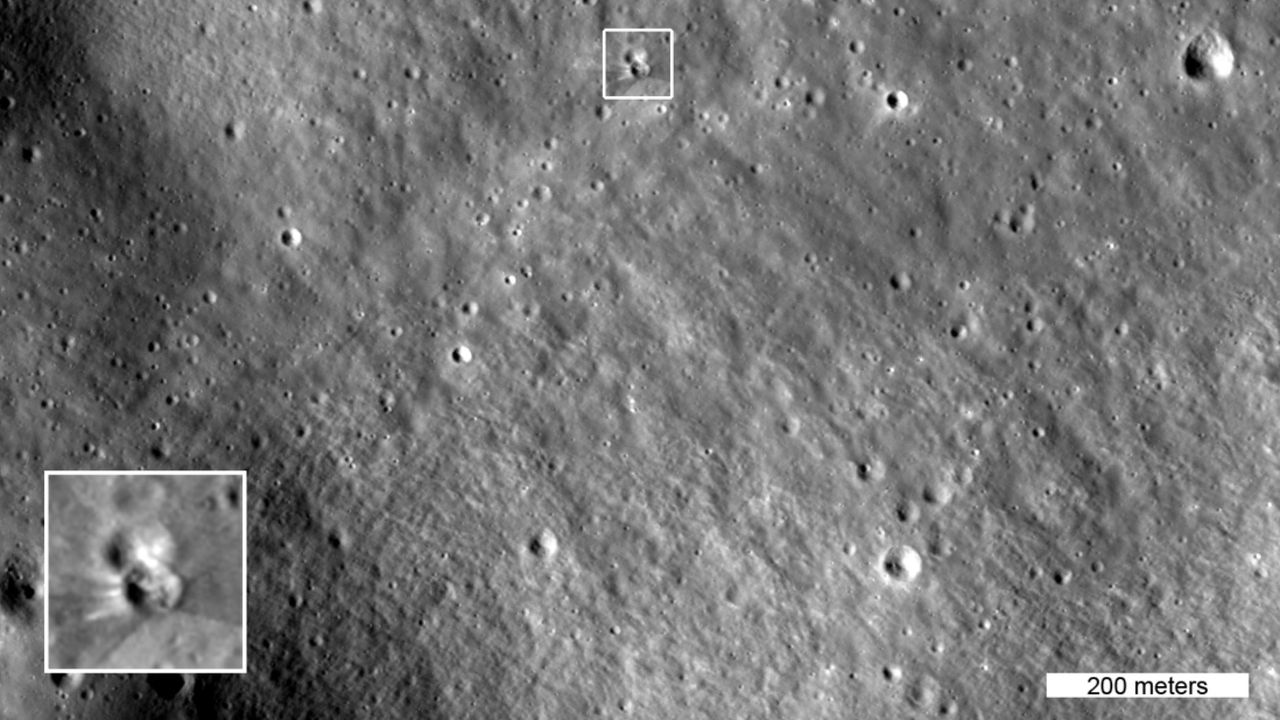
NASA's Lunar Reconnaissance Orbiter Captures Impact Site of SpaceX Falcon 9 on Moon
NASA's Lunar Reconnaissance Orbiter (LRO) has successfully imaged the impact site of the Falcon 9 upper stage that collided with the moon on August 5. The spacecraft captured detailed photos of the newly formed crater near Einstein Crater, measuring approximately 60 feet wide and less than 10 feet deep, shortly after the incident. This event is significant as it highlights the ongoing interactions between space debris and celestial bodies, as well as the capabilities of lunar observation technology. The LRO's high-resolution camera system, LROC, provided various angles of the impact site, revealing distinct ejecta patterns and surface alterations caused by the collision. Looking ahead, researchers will continue to analyze the crater and its features, with insights potentially informing future lunar missions. The LRO's imaging efforts were complemented by data from the Korea Pathfinder Lunar Orbiter, which previously identified the impact site, showcasing international collaboration in lunar exploration. No further timeline was disclosed at the time of publication.
The moon Astronomy Solar System
US Central Command Establishes First Multinational Attack Drone Unit, Task Force Falcon Strike
The US Central Command (Centcom) has announced the establishment of Task Force Falcon Strike, marking the creation of the nation's inaugural multinational and multidomain attack drone unit. This initiative is significant as it represents a strategic shift in the US military's approach to drone operations, emphasizing collaboration with international partners and enhancing operational capabilities across multiple domains. Looking ahead, the effectiveness and deployment of Task Force Falcon Strike will be closely monitored, as it sets a precedent for future multinational military collaborations in drone warfare. No further timeline was disclosed at the time of publication.
News
CENTCOM Initiates Multinational Falcon Strike Drone Task Force for One-Way Attacks
US Central Command (CENTCOM) has launched its first multinational attack drone task force, named Falcon Strike, which will utilize one-way attack drones. This initiative involves unmanned systems operated by US military personnel and regional partners, marking a significant escalation in the ongoing conflict involving Iran and its allied militias. The establishment of Task Force Falcon Strike is crucial as it aims to enhance regional security and deterrence capabilities amid rising tensions between Iran and the US, Israel, and Arab Gulf states. The task force will integrate various unmanned platforms, including the Low-Cost Uncrewed Combat Attack System (LUCAS) and other unmanned surface vessels, to strengthen military operations in the region. Looking ahead, CENTCOM plans to expand the capabilities of Falcon Strike as more regional partners formally join the initiative. This development follows the launch of Scorpion Strike in December 2025, which was CENTCOM's first one-way attack squadron in the Middle East. No further timeline was disclosed at the time of publication.
Air Warfare Global Land Warfare Naval Warfare Air Force Arab countries
Korean Lunar Orbiter Danuri Captures SpaceX Falcon 9 Rocket's Moon Impact Crater
The Korea Pathfinder Lunar Orbiter, Danuri, has successfully identified the impact crater created by SpaceX's Falcon 9 upper stage on the moon. This event occurred early on August 5, 2026, when the Falcon 9, which had launched on January 15, 2025, collided with the lunar surface. Danuri conducted eight imaging sessions around the impact site, providing valuable pre- and post-collision data. This discovery is significant as it allows researchers to analyze the changes in the lunar terrain caused by the impact, which occurred at approximately 5,400 mph (8,690 kph) and created a crater up to 89 feet (27 meters) wide. The data collected by Danuri will be integrated with future observations from NASA's Lunar Reconnaissance Orbiter, enhancing international collaborative research on lunar impacts. Looking ahead, the observations made by Danuri may be complemented by additional data from ground-based telescopes, which reportedly captured the ejected material from the impact. No further timeline was disclosed at the time of publication.
The moon Astronomy Solar System
SpaceX Falcon 9 Rocket Crashes into Moon, Scientists Seek Impact Imagery
In the early hours of August 5, a SpaceX Falcon 9 rocket's upper stage crashed into the moon at approximately 5,400 mph. This incident has prompted lunar orbiters, including NASA's Lunar Reconnaissance Orbiter and the Korea Pathfinder Lunar Orbiter, to capture imagery of the impact site. The availability of these images will depend on various factors such as lighting conditions and the spacecraft's orbital paths. The crash, which created a crater estimated to be up to 89 feet wide, was not the intended outcome for the Falcon 9 upper stage, which was meant to burn up in Earth's atmosphere. Instead, due to its mission parameters, the upper stage was unable to deorbit and was instead directed towards the moon. This event presents a unique opportunity for researchers to study the effects of artificial impacts on the lunar surface, as noted by NASA officials. Looking ahead, NASA's Meteoroid Environments Office plans to use ground-based telescopes to attempt to capture the impact flash and plume. However, the faintness of these phenomena and potential weather conditions may hinder observations. No further timeline was disclosed at the time of publication.
The moon Astronomy Solar System
SpaceX Falcon 9 Rocket to Impact Moon This Week After 18 Months in Orbit
On August 5, 2025, the upper stage of a SpaceX Falcon 9 rocket is set to collide with the moon, creating a crater approximately 89 feet wide. This unexpected trajectory change occurred after the rocket, which launched two lunar landers, was left in a high-Earth orbit due to fuel constraints. The significance of this event lies in its potential to enhance our understanding of lunar impacts and the risks posed by space debris. Astronomers are eager to observe the collision, which will help test methods for measuring impact events and assessing hazards for future lunar missions. Looking ahead, the impact will take place on the sunlit side of the moon, making it difficult for most Earth observers to see. However, it presents a valuable opportunity for researchers to study the effects of space debris on lunar infrastructure and astronaut safety. No further timeline was disclosed at the time of publication.
The moon Astronomy Solar System
SpaceX's Starship V3 Plans for 1 Million Starmind Satellites by 2030
SpaceX's Starship V3 is set to revolutionize satellite deployment, aiming to launch 1 million Starmind satellites by 2030. The spacecraft can carry over 100 tonnes to low Earth orbit (LEO), significantly more than the Falcon 9's capacity. As of May 2026, Starship has completed 12 flights, with the next mission scheduled for late July 2026, focusing on operational payloads including AI1 prototypes in early 2027. This ambitious plan is crucial for expanding orbital compute capacity, targeting an annual addition of 100 GW through a million tonnes of satellite hardware. SpaceX's strategy hinges on achieving a launch cadence of approximately 12,000 flights, equating to about three launches per day. The company has invested over $15 billion in the Starship program, with expectations to begin payload deliveries in the second half of 2026, starting with Starlink V3 satellites. Looking ahead, the successful deployment of the Starmind constellation will depend on Starship's ability to meet its cost targets of $10–20 million per flight. If achieved, this would make launching satellites more economical than building ground data centers. The next significant milestone will be the launch of AI1 prototypes in early 2027, with full-scale deployments commencing in 2028 from the new Gigasat factory in Texas.

Designed to Fly Like a Falcon, RoBird Takes Aim at Crop-Damaging Birds
A new application for the RoBird drone, designed to mimic the flight of a falcon, is emerging as a solution for agricultural crop protection in Queensland, Australia. Originally developed to prevent bird strikes at airports, this innovative flapping-wing technology is now being tested by local growers to safeguard their crops from damage caused by birds. The shift in usage highlights the versatility of the RoBird, as it adapts to address challenges in agriculture, demonstrating its potential to enhance farming practices while reducing reliance on traditional pest control methods.
Agriculture Applications Conservation Drone News Drone News Feeds Drones in the News
Saab’s 600th Seaeye Falcon Expands DISA International Fleet
Saab UK has marked a significant milestone with the delivery of its 600th Seaeye Falcon subsea vehicle, manufactured in Fareham, UK. This latest unit has been specifically built for DISA International, an international subsea specialist. The addition of this Falcon enhances DISA’s expanding fleet of Saab Seaeye vehicles, which are integral to the company’s high-performance inspection and survey operations throughout Europe. This achievement underscores Saab UK's commitment to advancing subsea technology and supporting its clients in the growing market for underwater exploration and inspection services.
saab seaeye falcon disaRobotics needs a service framework.
RSF defines a common language for robot service capability, lifecycle operations, certification pathways, and service-provider networks.
Join the RobotToday community on LinkedIn
Daily robotics news, in-depth analysis, conference highlights, and discussions with professionals worldwide.







