

Industry Briefing
A single destination for timely, editor-curated robotics news from around the world.

Mondo Robotics' Beni: A Tumbling Robot Camera with Significant Obstacle Avoidance Issues
Mondo Robotics has introduced Beni, a small bipedal robot designed to capture and record video while following users. Equipped with a built-in camera and sensors, Beni can perform tricks like flips and roll while tracking specified objects via an app. However, after several weeks of testing, reviewers found Beni's obstacle avoidance capabilities severely lacking. The importance of Beni lies in its potential as a fun companion for personal activities like sports and pet video recording. Despite its interesting features, the robot struggles significantly with obstacle avoidance, often losing track of its target in cluttered environments. Reviewers noted that even in open spaces, Beni failed to navigate around obstacles effectively, which detracts from its overall usability. Moving forward, it will be crucial to monitor Mondo Robotics' efforts to improve Beni's obstacle avoidance technology. Currently priced at $599, the robot's value is questionable given its primary flaw. If Mondo can address these issues, Beni could become a more appealing option for users engaged in various activities, but until then, recommendations are limited.
Robot Cameras Obstacle Avoidance Consumer Robotics Video Technology
Innovative Dual-Adaptive Control Enhances Obstacle Avoidance in Hybrid Boom Lifts
The Journal of Field Robotics has published an early view article detailing a dual-adaptive control system designed for hybrid boom lifts. This innovative approach aims to improve the smoothness of obstacle avoidance, enhancing operational safety and efficiency in various environments. The significance of this development lies in its potential to transform how hybrid boom lifts navigate complex work sites. By implementing dual-adaptive control, operators can expect reduced risk of accidents and increased productivity, making these machines more reliable for construction and maintenance tasks. Looking ahead, industry professionals should monitor the adoption of this technology in real-world applications. The effectiveness of dual-adaptive control in enhancing obstacle avoidance will be crucial for its acceptance and integration into existing hybrid boom lift systems. No further timeline was disclosed at the time of publication.
RESEARCH ARTICLE
MobileViT-Based Multimodal Perception Enhances UAV Obstacle-Avoidance Path Planning
A recent study published in the Journal of Field Robotics explores a novel approach to obstacle-avoidance path planning for unmanned aerial vehicles (UAVs). This method utilizes MobileViT-based multimodal perception combined with deep reinforcement learning to improve navigation capabilities in complex environments. The significance of this research lies in its potential to enhance UAV operational efficiency and safety. By integrating advanced perception techniques with reinforcement learning, UAVs can better adapt to dynamic obstacles, making them more reliable for various applications, including delivery services and surveillance. Looking ahead, the ongoing development of this technology could lead to more sophisticated UAV systems capable of autonomous navigation in challenging scenarios. No further timeline was disclosed at the time of publication.
RESEARCH ARTICLE
Underwater Swarm Formation Control Incorporating Obstacle Avoidance Using Visual Feedback
Recent research published in the Journal of Field Robotics explores a novel approach to formation control for underwater swarms. The study focuses on utilizing relative visual feedback to enhance obstacle avoidance capabilities, significantly improving the operational efficiency of underwater robotic systems. This advancement is crucial as it addresses the challenges faced by underwater robotics in dynamic environments, where obstacles can hinder navigation and mission success. By integrating visual feedback mechanisms, the proposed method allows swarms to adaptively respond to their surroundings, ensuring safer and more effective operations in complex underwater scenarios. Looking ahead, the implications of this research could lead to more sophisticated underwater robotic applications, including environmental monitoring and search-and-rescue missions. No further timeline was disclosed at the time of publication.
RESEARCH ARTICLE
Research on the Application of SSG‐RRT Path Planning Algorithm Integrated With Dynamic Obstacle Avoidance in Wheeled Picking Robot
A recent study published in the Journal of Field Robotics highlights advancements in robotic technology aimed at improving agricultural efficiency. Researchers from various institutions conducted the study to explore how autonomous robots can enhance crop management and reduce labor costs. The findings, released in early October 2023, indicate that these robots can perform tasks such as planting, monitoring, and harvesting with greater precision than traditional methods. The research was conducted in diverse agricultural settings, showcasing the robots' adaptability to different crops and terrains. By integrating advanced sensors and machine learning algorithms, the robots can analyze soil conditions and plant health, allowing for timely interventions that can lead to increased yields. This initiative is driven by the growing need for sustainable farming practices in response to global food demands and labor shortages in the agricultural sector. The study emphasizes that implementing robotic solutions could not only optimize resource use but also address environmental concerns associated with conventional farming techniques. As the agricultural industry faces mounting challenges, the deployment of these innovative robotic systems represents a significant step forward in modernizing farming practices and ensuring food security for the future.
RESEARCH ARTICLE
Visual 3D Spatiotemporal Fields‐Driven Obstacle Avoidance Using Model Predictive Control for Nursing Robots in Unstructured Environments
A recent study published in the Journal of Field Robotics highlights advancements in robotic technology aimed at enhancing agricultural efficiency. Researchers from various institutions collaborated to develop a new autonomous robot capable of performing tasks such as planting, weeding, and harvesting crops. This innovative technology was tested in fields across California during the summer of 2023, showcasing its potential to significantly reduce labor costs and increase productivity for farmers. The motivation behind this development stems from the growing demand for sustainable farming practices and the need to address labor shortages in the agricultural sector. By integrating advanced sensors and machine learning algorithms, the robot can navigate complex field environments and make real-time decisions, improving its operational effectiveness. The study emphasizes the importance of robotics in modern agriculture, particularly as the industry faces challenges related to climate change and food security. The researchers believe that widespread adoption of such technology could lead to more efficient resource use and a reduction in the environmental impact of farming practices. As the agricultural landscape continues to evolve, this breakthrough represents a significant step toward the future of farming, where robotics play a crucial role in meeting global food demands.
RESEARCH ARTICLE
DJI to launch Lito X1 series on April 23, likely to feature 360-degree obstacle avoidance system
Chinese drone manufacturer DJI has announced the upcoming launch of its Lito X1 series, scheduled for April 23. This event marks the introduction of what is anticipated to be the company's first new consumer drone line for 2023. The Lito X1 model has been referenced in filings with the Federal Communications Commission under the designation SS3-DGP14, and it is expected to succeed the Mini 5 Pro, indicating DJI's ongoing commitment to innovation in the consumer drone market.
News Feed
Hybrid Velocity Obstacle‐Nonlinear Control Method for Real‐Time Collision Avoidance of Nonholonomic Mobile Robots
In May 2026, researchers published a study in the Journal of Field Robotics, exploring advancements in robotic technology and its applications in various fields. The study highlights the integration of artificial intelligence and machine learning in enhancing the capabilities of field robots. Conducted by a team of engineers and scientists, the research aims to address challenges faced in agriculture, search and rescue operations, and environmental monitoring. The findings demonstrate how these innovations can improve efficiency and accuracy in tasks traditionally performed by humans, thereby reducing labor costs and increasing safety in hazardous environments. The team employed a series of experiments to test the robots' performance in real-world scenarios, showcasing their ability to navigate complex terrains and make autonomous decisions. This research is significant as it underscores the potential of robotics to transform industries by providing solutions that are not only effective but also sustainable. The authors emphasize the importance of continued investment in robotic research to further develop these technologies and expand their applications.
RESEARCH ARTICLE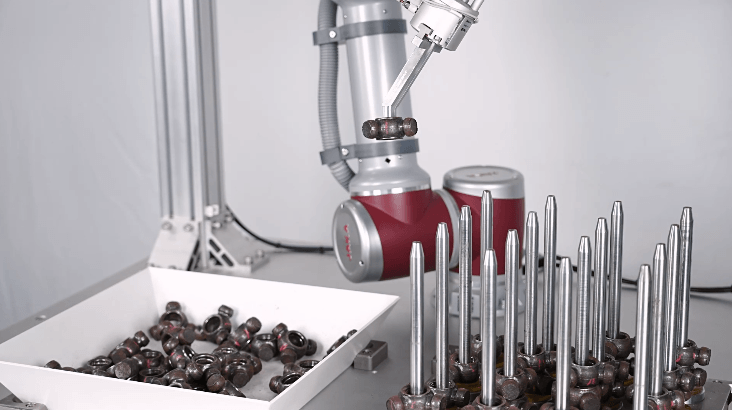
Understanding Robot Path Planning for Obstacle Avoidance with an Industrial Arm
As manufacturing environments grow increasingly complex, the importance of robot path planning in industrial automation has surged. JAKA, a leader in collaborative robotics, emphasizes that effective obstacle avoidance is now a fundamental capability of industrial arms, directly impacting productivity and safety. Modern factories require robots to navigate shared spaces, adapt to layout changes, and respond to real-time production demands. The JAKA A12L, an intelligent visual perception robot, exemplifies this advancement by integrating visual sensing with motion control. This integration allows the robot to continuously assess its surroundings, identifying both static and dynamic obstacles, and to calculate safe, efficient trajectories without interrupting workflow. By combining auto focus and 2.5D vision, the A12L simplifies deployment and minimizes external complexity. In practical applications, this obstacle-aware path planning enhances operational consistency, enabling industrial arms to perform tasks like material handling and assembly while safely coexisting with human operators. This approach reduces the need for rigid safety barriers and frequent manual adjustments, allowing production lines to remain flexible as layouts evolve. JAKA's commitment to merging perception, planning, and motion control aims to create safer and smarter industrial applications. By making visual perception and path planning more accessible, the company helps manufacturers build adaptable automation systems that align with real production needs, fostering a collaborative environment between humans and robots.

DJI launches Neo 2, its lightest follow-me drone with omnidirectional obstacle avoidance
DJI has introduced the Neo 2, a lightweight follow-me drone weighing just 151 grams, aimed at users seeking a personal aerial photographer. This innovative drone features full omnidirectional obstacle avoidance, gesture control, and smart selfie capabilities, enabling effortless palm takeoff and automatic subject tracking for everyday photography. The Neo 2 is equipped with a 1/2-inch 12 MP CMOS sensor, enhancing its ability to capture high-quality images while in flight. The launch of this drone reflects DJI's commitment to making aerial photography accessible and user-friendly for a broader audience.
News FeedRobotics needs a service framework.
RSF defines a common language for robot service capability, lifecycle operations, certification pathways, and service-provider networks.
Join the RobotToday community on LinkedIn
Daily robotics news, in-depth analysis, conference highlights, and discussions with professionals worldwide.







