


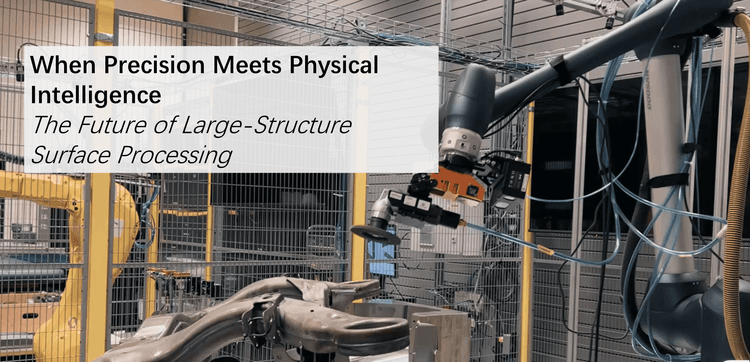
Physical AI is redefining complex surface processing. This article analyzes MARI’s AARS system, showing how physics-informed AI enables adaptive, CAD-free automation for large structures and high-mix manufacturing.
From Structural Rigidity to Physical Intelligence
For decades, large-structure and complex-surface machining has followed a well-defined technological trajectory: increase structural rigidity, constrain kinematics, and approach machine-tool-level accuracy through mechanical determinism. Parallel kinematic machines (PKMs) and heavy-duty five-axis CNC systems represent the apex of this philosophy, suppressing uncertainty through stiffness and geometric closure.
However, real-world manufacturing conditions are changing—and not incrementally, but structurally.
In many emerging scenarios, reliable CAD models are unavailable or deviate significantly from physical parts. Components are increasingly large, irregular, or permanently installed, making traditional machine-tool processing impractical. At the same time, high-mix, low-volume (HMLV) production is becoming the norm rather than the exception. Under these conditions, rigidity alone no longer resolves uncertainty.
It is within this context that Maple Advanced Robotics Inc. (MARI) introduced the Autonomous Adaptable Robot System (AARS). Rather than attempting to become a “more precise machine tool,” AARS addresses a more fundamental question: Can a robot understand the physical reality of a workpiece and act autonomously within an uncertain environment?
AARS Is Not Competing on Stiffness—By Design
MARI’s Automated Sanding in High Mix Manufacturing whitepaper makes the system’s positioning unusually explicit. AARS is not intended for micron-level high-stiffness cutting, nor for heavy-load material removal where structural rigidity defines accuracy. Instead, it targets processes such as sanding, polishing, surface repair, coating preparation, and finishing—operations that traditionally rely on human skill and are notoriously difficult to automate consistently. In these applications, the central challenge is not defining a geometric path in advance, but determining how the tool should interact with a real, imperfect surface in real time. This distinction is critical. AARS does not seek to eliminate uncertainty through structure; it seeks to model, interpret, and manage uncertainty through Physical AI.
Physical AI in Practice: From Point Clouds to Behavior
One of the most significant engineering contributions highlighted in the whitepaper is AARS’s ability to operate without CAD models. Using integrated 3D vision, the system captures point clouds of real workpieces and generates robot trajectories directly on measured geometry.
Crucially, this process is not offline. In Scan&Go mode, trajectory generation can be completed in seconds—often under one second—allowing the robot to respond dynamically rather than execute pre-scripted motion. The robot is not merely following a predefined path; it is generating behavior based on perceived physical reality.
This capability is reinforced by force-aware execution. AARS integrates main force control, real-time feedback, and curvature-aware contact modeling to continuously regulate tool–surface interaction. Rather than compensating for errors after the fact, physical constraints are embedded directly into motion planning and execution. In industrial deployments, this approach enables stable A-class surface quality and near-100% yield in demanding finishing tasks.
Standardized Systems for Non-Standardized Worlds
A key insight from the whitepaper is MARI’s philosophy of “using standardized products to serve non-standardized scenarios.” AARS operationalizes this through a layered architecture:
- Scan&Go for autonomous perception and trajectory generation
- Drag&Go for no-code, logic-based task configuration
- Plug&Go for modular, rapidly deployable hardware integration
From an engineering standpoint, the implications are significant. Trajectories can be generated in seconds, task logic can be configured in minutes by non-experts, and overall system integration costs can be reduced by more than 50%. For large structures and on-site processing—where custom fixtures and repeated reprogramming are impractical—this architecture fundamentally changes deployment economics.
Industrial Validation in High-Mix, Low-Volume Production
The value of Physical AI becomes particularly clear in real production environments. In automotive B-pillar polishing and paint rework applications, AARS systems have demonstrated the ability to handle more than twenty part variants within the same workstation.
In these deployments, a single robot replaced approximately 4.5 manual operators, increased production pace by around 20%, and achieved a payback period of roughly 1.5 years. Importantly, these gains did not come from higher speed alone, but from eliminating the need for repeated programming with every product change. The system’s adaptability—not raw mechanical performance—proved decisive.
AARS and PKM: Different Problems, Complementary Roles
Within the broader landscape of large-structure flexible machining, AARS and parallel kinematic machines should not be viewed as competitors. They address fundamentally different classes of problems.
Dimension | Parallel Kinematic Machines (PKM) | AARS (Physical AI Approach) |
Structural rigidity | Very high | Limited |
Absolute accuracy | Micron-level | Sub-millimeter (typically 0.1–0.5 mm) |
Dependence on CAD | Strong | None |
Adaptability to variation | Low | Very high |
On-site processing | Constrained | Strong advantage |
Suitability for HMLV | Low | Core strength |
PKMs pursue structural determinism, suppressing uncertainty through mechanical design. AARS, by contrast, accepts uncertainty as a given and manages it through perception, physical modeling, and adaptive control. One optimizes geometry; the other optimizes interaction.
Why Physical AI Matters for the Future of Large-Structure Processing
AARS does not challenge the precision limits of machine tools, nor does it attempt to replace high-stiffness systems where deterministic accuracy is paramount. Its significance lies elsewhere: it expands the boundary of what can be automated when geometry is uncertain, environments are variable, and human skill has traditionally been indispensable.
As manufacturing continues to shift toward large, complex, and highly customized structures, automation will increasingly depend not only on stronger machines, but on systems that understand physics in context. In this sense, AARS represents not an endpoint, but a starting point for Physical AI as a practical industrial paradigm.
Such integration introduces an intelligence layer that operates within bounded constraints, refining trajectories and force profiles without undermining certified kinematics. The outcome is not reduced precision, but increased robustness. As component scale grows and customization intensifies, combining structural determinism with physical intelligence may define the next generation of large-structure processing systems.
RobotToday Editorial Perspective
In the next decade, competition in large-structure flexible machining will not be decided solely by mechanical architecture. It will hinge on which systems can most effectively interpret and act within the physical world. Physical AI marks the beginning of that transition.
This three-part analysis explores how flexible machining is reshaping the manufacturing of large-scale structures—from system architecture to real-world deployment.
FLexible Machining of Large Structures (Part I)
An overview of flexible machining technologies for large-scale structures, examining system architectures, tooling strategies, and the shift from fixed gantry setups to adaptive manufacturing platforms.
Flexible Machining of Large Structures (Part II)
A deeper look at process control, metrology integration, and error compensation strategies that enable precision machining across oversized and complex geometries.
Flexible Machining of Large Structures (Part III)
Case studies and industrial deployment scenarios highlighting cost efficiency, scalability, and the transition from prototype systems to production-ready flexible machining solutions.









Leave a comment