


The Rise of Mobile Robots and the Industrial Shift Behind CES 2026’s Scan&Go Award
Introduction
In aerospace, wind energy, and shipbuilding, the machining of large structures—such as aircraft fuselages exceeding 20 meters or wind turbine blades longer than 100 meters—has long faced fundamental challenges. Transportation is difficult and costly; traditional gantry machines require enormous footprints and capital investment; flexibility is limited. When on-site repair or irregular geometries are involved, manual operations still dominate, resulting in low efficiency and elevated safety risks.
A new paradigm—“workpiece fixed, equipment moves”—is emerging as a solution. By allowing machining systems to actively approach the workpiece, in-situ automation becomes possible, transportation is minimized, flexibility is dramatically improved, and the approach aligns naturally with the goals of Industry 4.0 and intelligent manufacturing.
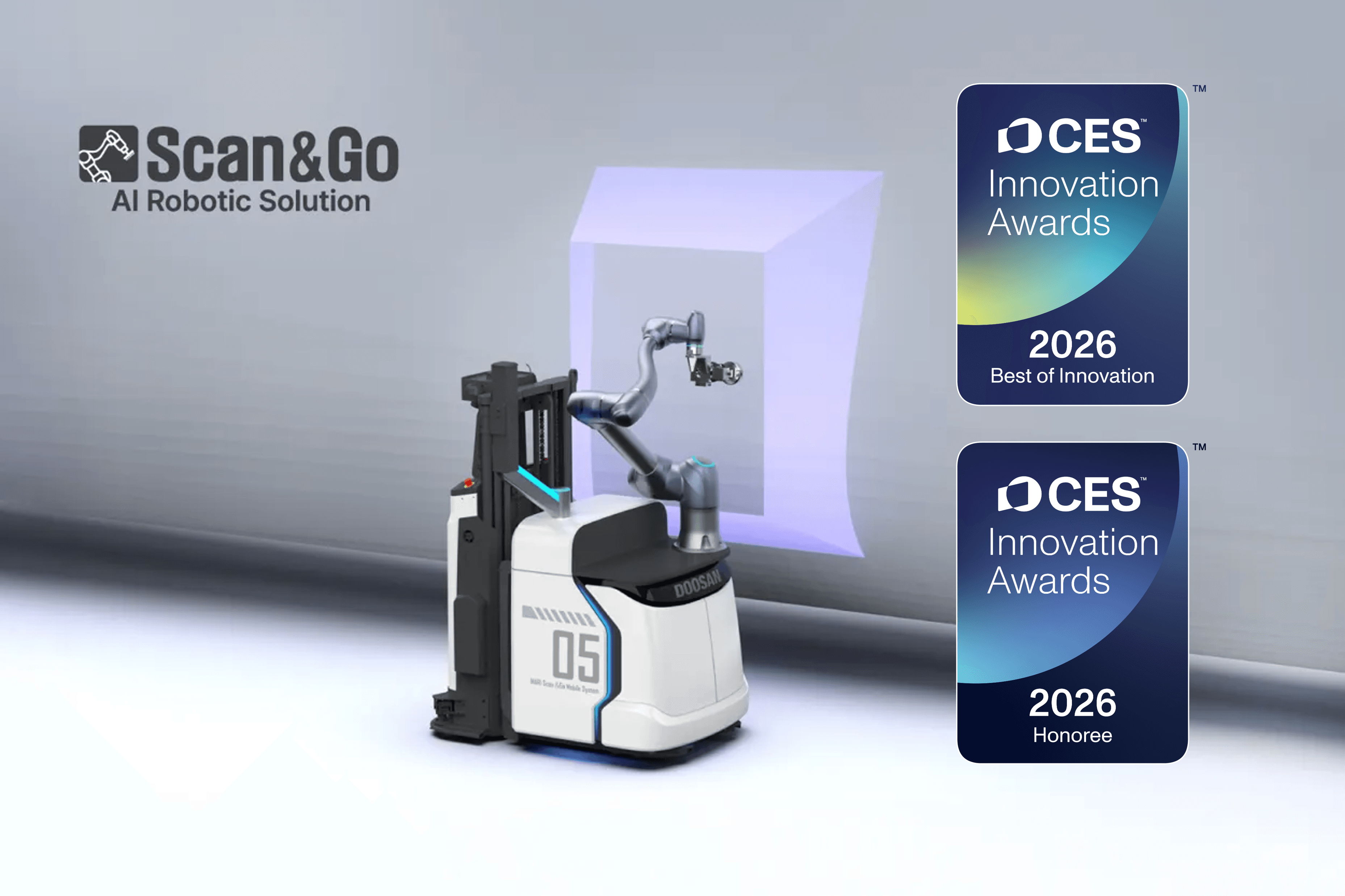
At the start of 2026, the Scan&Go autonomous mobile robot solution jointly launched by Doosan Robotics and Maple Advanced Robotics won both “Best of Innovation” in the Artificial Intelligence category and Honoree in the Robotics category at CES. This recognition marks a decisive step for Physical AI—from laboratory concepts to industrial deployment.
Scan&Go requires no CAD models and no programming. Using real-time 3D vision, it scans complex geometries, automatically generates optimized toolpaths, and executes sanding, grinding, and inspection tasks. Already adopted by leading wind energy companies, the system supports large composite structures such as aircraft fuselages, wind turbine blades, and building façades, significantly reducing labor risk and operational cost.
This milestone event has ignited global interest in mobile machining for large structures.
A Brief History of Technology Evolution
Mobile machining of large structures traces back to the 1990s–2000s, when parallel kinematic machines (PKM) emerged to overcome the limited stiffness of serial robots and the immobility of massive gantry systems. The Tricept architecture—invented by Karl-Erik Neumann and later commercialized by Loxin—along with hybrid parallel systems such as Exechon, delivered high stiffness and large payload capacity. These systems were rapidly adopted in aerospace for fuselage drilling and riveting by Airbus and Boeing.
During the 2010s, mobile platform integration gained traction. AGVs and AMRs carrying PKM or serial robotic arms enabled semi-mobile machining, expanding work envelopes and addressing ultra-large structures such as wind turbine blades.
In the 2020s, AI-driven autonomy accelerated adoption. Advances in 3D vision, point-cloud processing, and Physical AI algorithms allowed systems to adapt in real time to non-repetitive geometries—without pre-programming. Scan&Go represents the current pinnacle of this evolution: mounted on an autonomous forklift chassis and certified to the highest safety level (PL e, Cat 4), it enables true “scan-and-machine” workflows. This shift marks a transition from high-stiffness mechanical dominance to high-intelligence autonomy.
Comparison of Mainstream Approaches Today
The current market follows three distinct technological routes: European high-stiffness PKM, Korean AI-driven autonomy, and Chinese hybrid in-situ machining.
European High-Stiffness PKM (Mature Aerospace Applications)
- Loxin Tricept series: Hybrid parallel kinematics, repeatability ~0.06 mm, suitable for heavy drilling, milling, and riveting.
- Cognibotics SigmaTau: Lightweight parallel robot with high dynamics (up to 2G acceleration), optimized for finishing large castings.
- Starrag Ecospeed: Traditional gantry combined with robotic assistance for heavy titanium machining.
These solutions deliver exceptional accuracy and rigidity but rely on rails or pre-defined programming, limiting flexibility.
Korean AI-Driven Autonomous Systems
• Scan&Go by Doosan Robotics: A serial collaborative robot mounted on an autonomous forklift AMR, using real-time point-cloud perception and Physical AI. No CAD models, no code, sub-millimeter accuracy, and fence-free operation. Proven in wind energy and aerospace composite repair.
Chinese Hybrid In-Situ Machining
• Tsingdraw Intelligent (team led by Professor Liu Xinjun, Tsinghua University): Hybrid serial-parallel structures combined with portable mobile or adsorption platforms. Repeatability of 0.014–0.035 mm. Successfully applied to in-situ milling of the Tianzhou cargo spacecraft full cabin—achieving flatness of 0.03 mm and surface roughness Ra 0.5—tripling efficiency and reducing transport time by over 70%. Certified as China’s first domestically developed system for machining weak-stiffness frame structures.
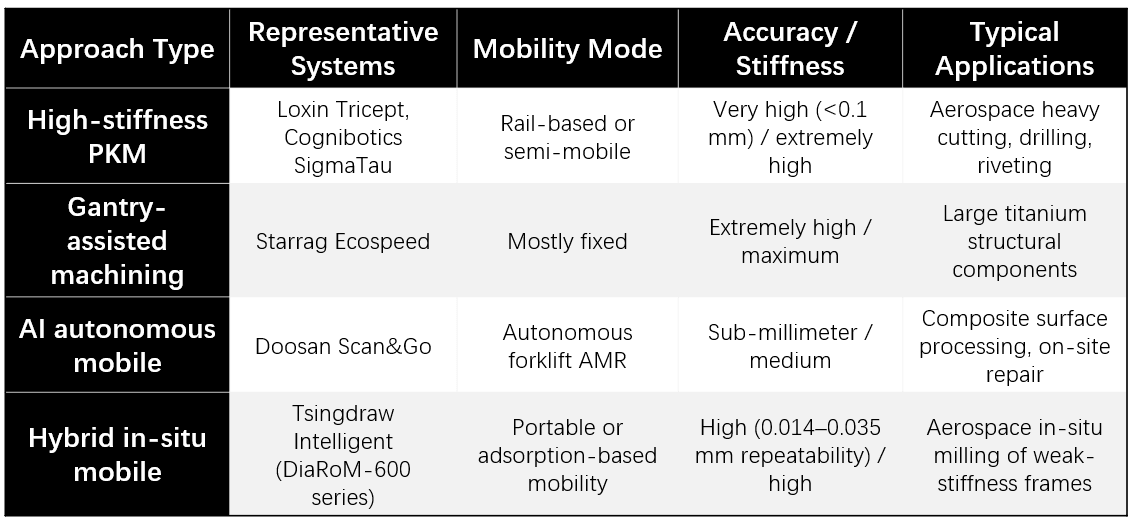
European high-stiffness systems dominate mature aerospace applications; Korean AI-driven autonomy introduces a disruptive leap in flexibility; Chinese hybrid in-situ solutions fill the gap between portability and engineering-grade precision. Together, they form a three-pillar competitive landscape.
Conclusion
Flexible machining of large structures is approaching a critical inflection point. European high-stiffness solutions remain robust and reliable; Korean AI-driven autonomy, exemplified by Scan&Go, offers unprecedented flexibility; Chinese hybrid in-situ systems demonstrate scalable engineering implementation. These paths will coexist and jointly propel industrial transformation.
Yet widespread adoption of mobile machining remains constrained. The trade-off between stiffness, accuracy, and autonomy continues to be the core bottleneck. In Part II, we will analyze five fundamental challenges, emerging solutions, and the most likely breakthroughs over the next five years. Stay tuned.
This three-part analysis explores how flexible machining is reshaping the manufacturing of large-scale structures—from system architecture to real-world deployment.
FLexible Machining of Large Structures (Part I)
An overview of flexible machining technologies for large-scale structures, examining system architectures, tooling strategies, and the shift from fixed gantry setups to adaptive manufacturing platforms.
Flexible Machining of Large Structures (Part II)
A deeper look at process control, metrology integration, and error compensation strategies that enable precision machining across oversized and complex geometries.
Flexible Machining of Large Structures (Part III)
Case studies and industrial deployment scenarios highlighting cost efficiency, scalability, and the transition from prototype systems to production-ready flexible machining solutions.








Leave a comment