


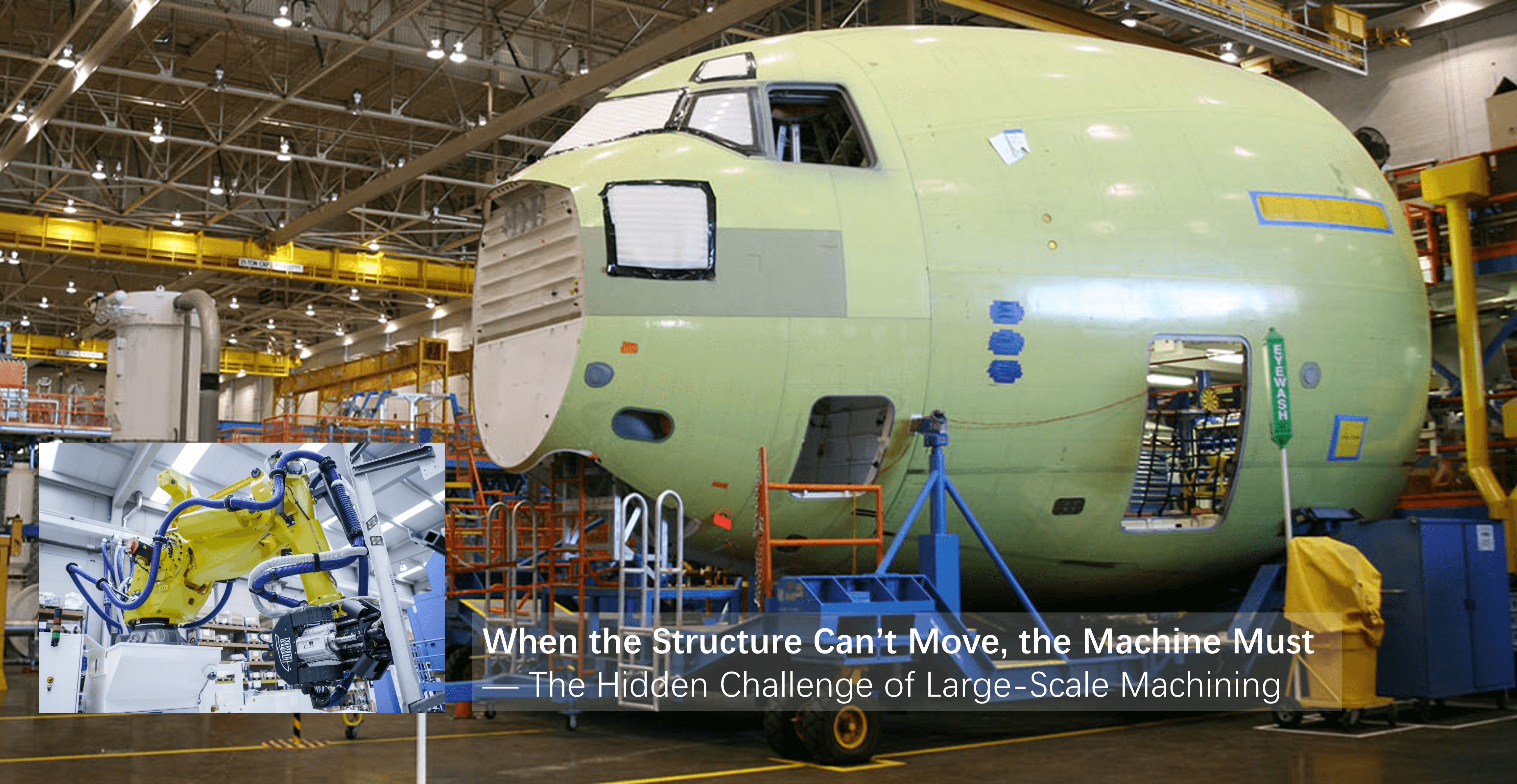
The Trade-Off Between Stiffness, Accuracy, and Intelligence — and Where the Next Five Years Are Headed
Introduction
As discussed in Part I, large-structure machining remains a structural bottleneck for aerospace, wind energy, and shipbuilding. Mobile robotic machining is emerging as a transformative solution—and the CES 2026 recognition of Scan&Go signals a broader industrial shift.
From the era of stiffness-first parallel kinematic machines (PKM) to the rise of AI-driven autonomy represented by Scan&Go, three technological routes now coexist. Yet the paradigm of “workpiece fixed, equipment moves” has not fully displaced traditional machine tools or manual operations.
The reason lies in a set of deeply intertwined technical constraints. Insufficient stiffness, challenges in maintaining absolute accuracy, and limits to real-world autonomy continue to restrict adoption—especially in heavy cutting and high-precision scenarios. This article examines five core technical challenges, the solutions emerging across the industry, and the most likely breakthroughs over the next five years.
Five Core Technical Challenges
At the heart of mobile machining lies a fundamental trade-off between stiffness, accuracy, and autonomy.
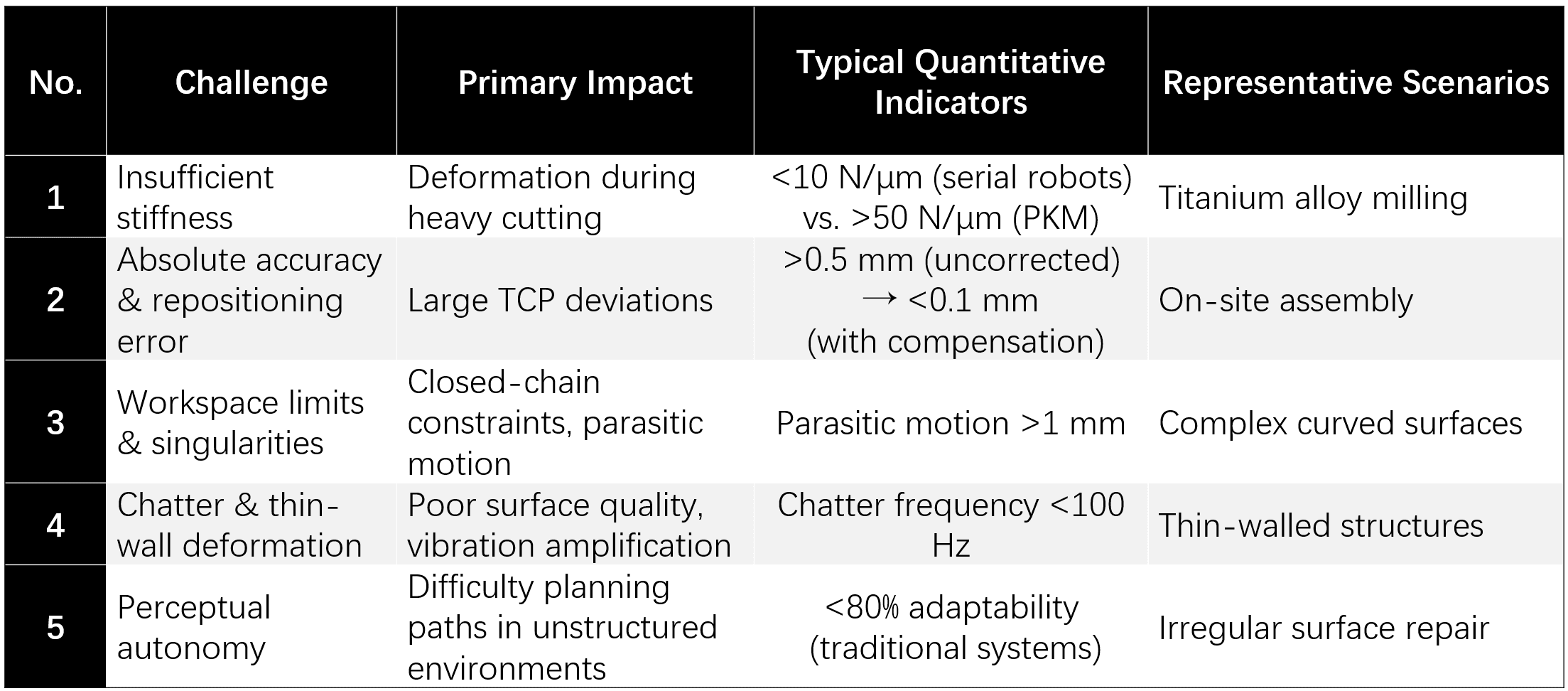
These challenges compound one another, significantly limiting the feasibility of mobile machining in heavy-duty and high-precision applications.
Key Solutions and Industry Trends
To overcome these constraints, the industry is converging toward hybrid mechanical structures combined with AI-driven intelligence.
Hybrid and Parallel Kinematic Optimization
European solutions such as Loxin Tricept and Exechon-style hybrid PKM systems enhance stiffness through closed-loop kinematics while extending reach via mobile platforms. This approach balances rigidity and workspace more effectively than serial robots alone.
Advanced Accuracy Compensation
Laser tracking, force-feedback control, and modular calibration techniques are pushing absolute positioning errors below 0.1 mm. Hybrid in-situ systems from Tsingdraw Intelligent have already demonstrated repeatability of 0.014 mm and absolute accuracy of approximately 0.015 mm in real industrial deployments.
AI-Driven Multimodal Perception
The Scan&Go solution from Doosan Robotics exemplifies the next direction: Physical AI that fuses real-time 3D point clouds with force and vision sensing. By eliminating CAD models and manual programming, such systems dramatically improve adaptability in non-repetitive environments.
Multi-Robot Cooperative Machining
Emerging “mirror machining” or dual-robot configurations—where one system machines while another provides adaptive support—are gaining traction. These setups suppress chatter and deformation, making them especially effective for thin-walled structures.
The Next Five Years: Where Breakthroughs Will Occur
Looking ahead, three developments are likely to define the next phase of mobile large-structure machining:
- Reconfigurable hybrid robots that dynamically balance stiffness and reach
- Digital twin–based predictive compensation, enabling real-time error forecasting and correction
- AI-augmented autonomy, allowing systems to adapt continuously to material, geometry, and environmental uncertainty
Chinese hybrid in-situ machining solutions have already reached national-level applications. Notably, Tsingdraw systems have been deployed for full-cabin in-situ milling of the Tianzhou cargo spacecraft, combining engineering-grade precision with significant cost advantages. This combination positions them to accelerate global adoption as the technology matures.
Conclusion and Outlook
Flexible machining of large structures is transitioning from a stiffness-dominated paradigm to an era defined by intelligence and autonomy. Innovations such as Scan&Go demonstrate that AI-driven autonomy can meaningfully address long-standing bottlenecks. When combined with hybrid kinematic structures and cooperative robotics, mobile machining systems are poised to reduce cost, improve safety, and expand application scope.
Driven by aerospace and new-energy demand, market penetration is set to rise rapidly. Chinese players—particularly university-led industrial teams such as Tsinghua’s spin-offs—are leveraging AI capabilities and cost efficiency to accelerate their global footprint.
The era of truly mobile, intelligent large-structure machining is no longer theoretical—it is fast approaching reality.
This three-part analysis explores how flexible machining is reshaping the manufacturing of large-scale structures—from system architecture to real-world deployment.
FLexible Machining of Large Structures (Part I)
An overview of flexible machining technologies for large-scale structures, examining system architectures, tooling strategies, and the shift from fixed gantry setups to adaptive manufacturing platforms.
Flexible Machining of Large Structures (Part II)
A deeper look at process control, metrology integration, and error compensation strategies that enable precision machining across oversized and complex geometries.
Flexible Machining of Large Structures (Part III)
Case studies and industrial deployment scenarios highlighting cost efficiency, scalability, and the transition from prototype systems to production-ready flexible machining solutions.







Leave a comment