
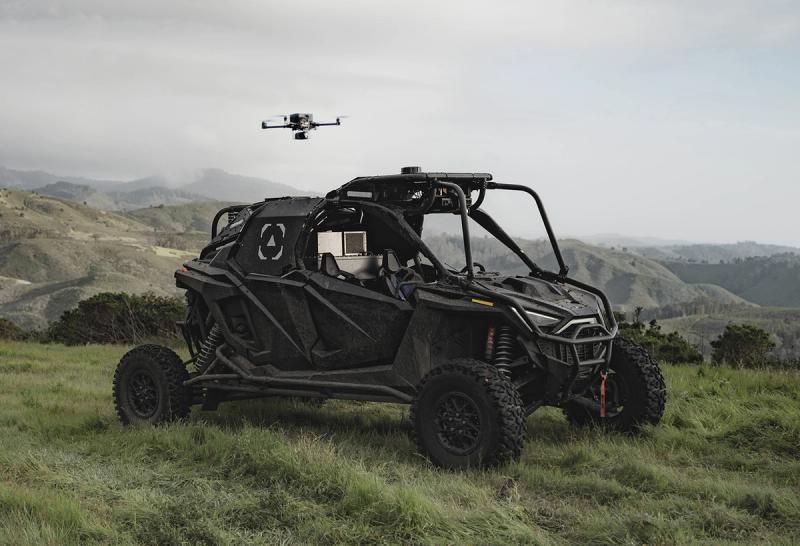
"Foundation Model for Defense Robotics"
Sunnyvale defense AI startup building Fury, a vision-language-action foundation model enabling single-operator command of multiple autonomous unmanned.
Scout AI is a defense technology company founded in August 2024 and headquartered in Sunnyvale, California. The company builds AI foundation models that enable autonomous operation of unmanned military platforms across ground, air, maritime, and space domains. Scout AI focuses exclusively on defense and national security applications, developing software that allows a single warfighter to command multiple autonomous robots through plain natural language or voice input.
Scout AI's primary product is Fury, a Vision-Language-Action (VLA) foundation model for defense robotics. Fury takes real-time camera input — either standard RGB or thermal imagery — combined with natural language or voice commands and outputs direct motor control signals to unmanned platforms. The model is designed to operate in GPS-denied and communications-denied environments where conventional autonomous systems typically fail. Fury is compatible with commercial off-the-shelf hardware; a single camera stream is sufficient to enable autonomous operation, lowering integration barriers for existing defense platforms. The model supports one-to-many coordination: one operator commanding a squad of heterogeneous autonomous systems through conversational instructions rather than manual teleoperation.
The company also offers Ox, a command-and-control orchestrator for autonomous vehicle coordination. Scout AI publicly demonstrated a fully autonomous end-to-end strike mission executed by AI agents during its first year of operations.
Scout AI was co-founded by Colby Adcock (CEO), a former technology private equity executive and board member at Figure AI, and Collin Otis (CTO), previously founding engineer and Director of Autonomy and AI at Kodiak Robotics and Head of Data Science at Uber ATG. The team has grown to approximately 34 to 40 employees.
The company raised a $15 million seed round in April 2025 led by Align Ventures and Booz Allen Ventures, followed by a $100 million Series A in April 2026 led by Align Ventures and Draper Associates, with co-investors including Decisive Point, Booz Allen Ventures, BVVC, and several other defense-focused funds — totaling approximately $115 million raised. In its first year Scout AI booked $11 million in U.S. Department of Defense contracts and won the U.S. Army xTechOverwatch Competition.
Primary type & automation activities this supplier delivers:
Vision-Language-Action foundation model enabling one warfighter to command multiple autonomous unmanned platforms via natural language in GPS-denied environments.
Contact Scout AI
WEBSITE
https://scoutco.aiHEADQUARTERS
United States
Company Facts
Founded
2024
Primary Role
Software/Algorithm
Company Size
-
Primary Region
North America
Annual Sales
-
Funding Stage
-
Funding Total
-

The U.S. Army has officially transitioned from using Infantry Squad Vehicles (ISVs) to Polaris MRZR platforms for its Unmanned Systems (UxS) autonomy program. This change, confirmed by Michael Rose, chief technology officer for CPE Mission Autonomy, aims to enhance off-road autonomy testing. The MRZR platforms will allow multiple companies to test their autonomy software in a standardized environment, facilitating direct comparisons of technological capabilities. This shift is significant as it marks a departure from the Army's previous plans to enhance ISVs with autonomy software from Forterra, Overland AI, and Scout AI. The decision to adopt MRZR platforms is based on evolving technological needs and aims to address challenges identified in the initial UxS program, including safety risks and financial constraints. The Army has received 12 MRZR Alphas from Polaris for this initiative, indicating a commitment to advancing unmanned ground vehicle capabilities. Looking ahead, the Army is evaluating various autonomy software providers for the MRZR platforms, although specific companies involved have not been disclosed. The ongoing participation of Forterra, Overland AI, and Scout AI in the UxS program suggests a competitive landscape as the Army seeks to refine its approach to unmanned systems. No further timeline was disclosed at the time of publication.
BreakingDefense Aug 11, 2026 Land Warfare Army autonomy Drones ground autonomy GVSETS 2026Kraken Technology Group and Capewell, in collaboration with the Royal Navy, have successfully executed the world's first airdrop of an uncrewed surface vessel (USV) from an A400M military transport aircraft. This milestone was achieved during trials where the K3 SCOUT USV was deployed from 1,300 feet into waters with Sea State 4 conditions, demonstrating a new capability for rapid insertion of maritime vessels into challenging environments. The significance of this achievement lies in its potential to enhance military operations by allowing for quick deployment of high-performance USVs in contested areas. The trials utilized Kraken's K3 SCOUT airdrop kit and Capewell's Universal Maritime Craft Aerial Delivery System (UMCADS), showcasing a new IN-Release system that ensures reliable load disconnect across various applications, thereby improving operational flexibility and response times. Looking ahead, Kraken and Capewell plan to further develop their partnership to enhance operational capabilities with their modular platforms. No further timeline was disclosed at the time of publication, but the successful completion of four live airdrops in six days indicates a strong foundation for future advancements in USV deployment strategies.
ROVplanet.com Jul 08, 2026 usv airdrop kraken technology group capewell royal navy project beehiveScout AI, a defense-focused artificial intelligence startup, has successfully secured $100 million in an oversubscribed Series A funding round aimed at advancing its foundation model for autonomous military operations. The funding, which was co-led by Align Ventures and Draper Associates, attracted investments from several notable firms including Decisive Point, Booz Allen Ventures, BVVC, Neman Ventures, Evolution VC Partners, and Heraclitus Capital Management, among others. This significant financial backing will enable Scout AI to enhance its technological capabilities and accelerate the development of solutions designed to improve military efficiency and effectiveness. The funding round reflects growing interest and investment in AI technologies within the defense sector, highlighting the increasing reliance on advanced technology for national security operations.
AIInsider Apr 29, 2026 AI AI Funding & Investment Robotics Align Ventures autonomous autonomous uncrewed surface vessel technologyScout AI is currently developing advanced AI agents designed to empower individual soldiers with the ability to manage fleets of autonomous vehicles. This innovative training initiative is taking place at Scout AI's dedicated training ground, where the focus is on enhancing military capabilities through cutting-edge technology. The project aims to improve operational efficiency and decision-making on the battlefield by integrating AI systems that can seamlessly coordinate multiple vehicles. As of October 2023, the training program is leveraging extensive data to refine these AI agents, ensuring they are equipped to handle complex scenarios in real-time. This initiative reflects a broader trend in military modernization, emphasizing the importance of automation and artificial intelligence in future combat operations.
TechCrunch Apr 29, 2026 AI Robotics ExclusiveDemolition and hazardous-work robots are construction automation's fastest-growing safety segment. This analysis covers Brokk SmartPower+, Husqvarna DXR, AI-guided asbestos removal, confined-space inspection drones, and regional adoption across Japan, the EU, and South Korea — with market sizing, technology assessment, and a 2030 outlook.
BySimon Dicky Apr 07, 2026RobotToday's weekly industry briefing for March 21–28, 2026 covers Physical Intelligence's $1B raise, Amazon's Fauna Robotics acquisition, Agile Robots' DeepMind partnership, the launch of Europe's first robotaxi service, DJI's Avata 360 drone, Skydio's $52M Army order, and the latest in humanoid, AMR, and drone technology.
ByRobotToday Reporter Mar 28, 2026The global counter-drone (C-UAS) sector is scaling fast. New EU and US factories, an ․87M US Army contract, and the 2026 FIFA World Cup deployment mark a turning point for autonomous anti-drone technology. Read RobotToday’s March 2026 briefing.
ByThomas Siew Mar 23, 2026Amazon acquires Rivr (fmr. Swiss-Mile), an ETH Zurich spinout, to scale wheel-legged robots for doorstep delivery — marking a turning point for hybrid mobility robotics.
ByRobotToday Reporter Mar 20, 2026An evidence-based deep dive into the crop monitoring and aerial scouting segment of agricultural robotics. Covers the market opportunity (ex-China) across North America, EU, Japan, and Israel; key players including Taranis, BASF xarvio, and DJI; emerging technologies such as edge AI, hyperspectral imaging, and satellite–drone fusion; and the structural challenges limiting wider adoption — connectivity gaps, false positives, data fragmentation, and small-farm exclusion.
BySarah Bakery Mar 19, 2026Construction robots can lay 6× more bricks than humans—but unions, labor law, and political calculus are keeping them off U.S. sites. How Japan, Singapore, and Europe are winning the race instead.
BySarah Bakery Feb 16, 2026Laser weeding robots in 2025 are reshaping agriculture, with Carbon Robotics leading globally while HG Tech pushes competitive innovation from China.
ByFrederick Lee Nov 23, 2025Tesla Optimus Gen-3 hand redesign adopts gearbox, lead screw, and tendon drive as supply chain shifts toward cost compression and China-based scaling.
ByRobotToday Reporter Sep 28, 2025


