

| DATE | 19 March 2026 |
| COMPANIES | Amazon · Rivr (fmr. Swiss-Mile) |
| DEAL TERMS | Undisclosed; seed valuation ~$110 million (August 2024) |
| PRIOR BACKING | Bezos Expeditions & HongShan (co-leads), Amazon Industrial Innovation Fund — $22.2 million seed round (2024) |
| HQ | Zurich, Switzerland — spun out of ETH Zurich Robotics Systems Lab |
The Deal
Amazon has acquired Rivr, a Zurich-based developer of wheel-legged delivery robots, the company confirmed on 19 March 2026. Financial terms were not disclosed. The deal was communicated first in a notice to third-party delivery service partners (DSPs), with the announcement reaching the press the same day through Rivr co-founder and CEO Marko Bjelonic's LinkedIn post and subsequent confirmation by an Amazon spokesperson.
The acquisition formalises a relationship that predates Rivr's public pilots. Amazon's Industrial Innovation Fund and Bezos Expeditions co-invested — alongside HongShan — in the company's $22.2 million seed round that closed in 2024. At the time of the seed close, Rivr was valued at approximately $110 million.
Amazon says it plans to begin small-scale field testing with third-party DSP contractors, using real-world delivery data to iterate before any wider rollout. The company shut down its own Scout sidewalk delivery programme in 2022, making this acquisition its clearest re-entry into last-mile robotics.
"This step will accelerate our vision of building General Physical AI through doorstep delivery, bringing robotics and AI closer to real-world deployment at scale."
— Marko Bjelonic, Co-founder & CEO, Rivr
What Rivr Is
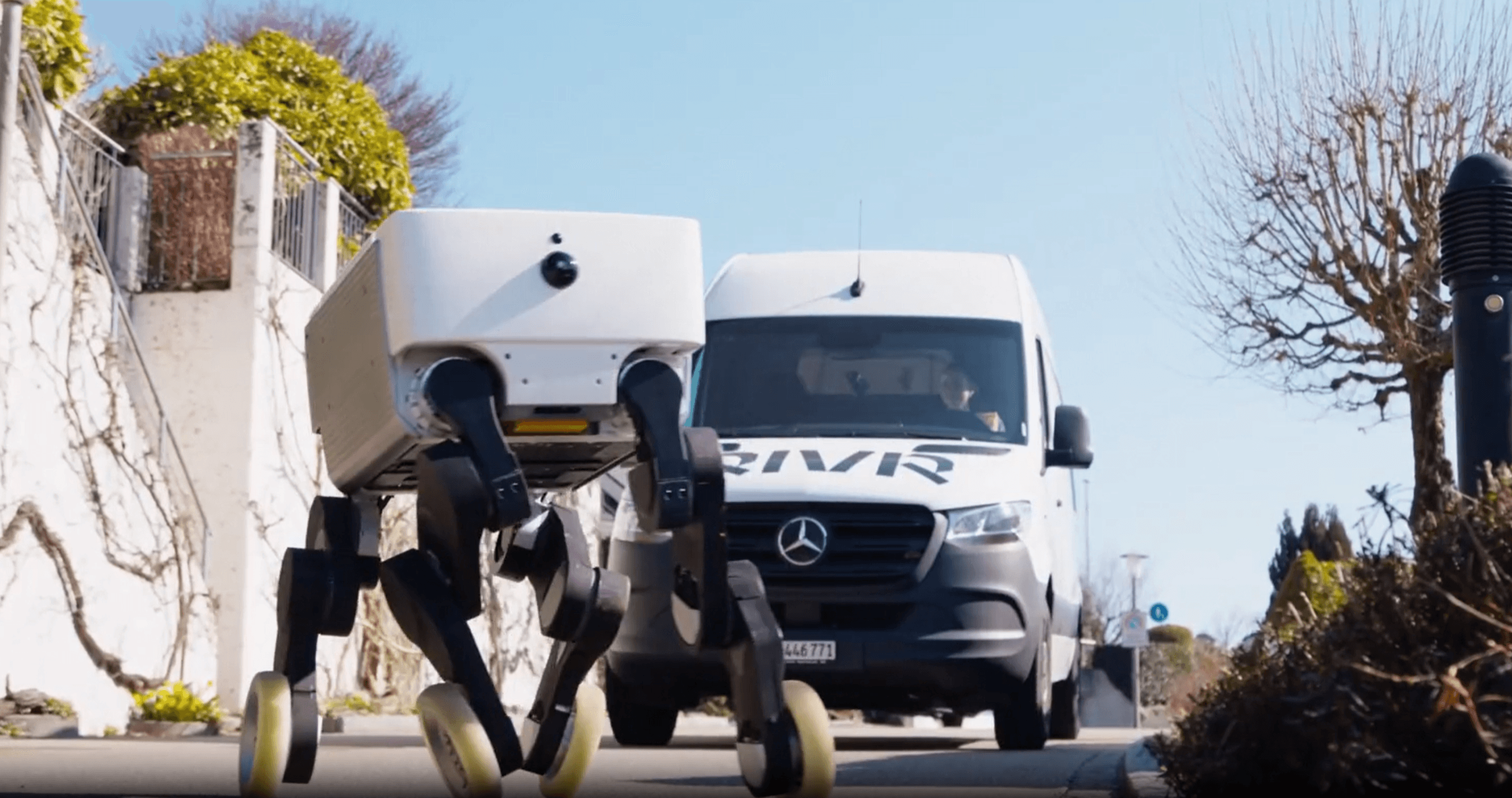
Rivr originated as Swiss-Mile, a spinout of the Robotics Systems Lab at ETH Zurich. The company used Unitree's quadruped hardware as its base platform before developing its own systems, including the second-generation RIVR TWO. It rebranded from Swiss-Mile to Rivr in early 2025.
The core technology is a four-legged robot fitted with wheels at the end of each limb — a hybrid form factor that combines rolling efficiency with legged mobility. Key technical characteristics:
rolling at up to 15 kph on flat terrain, transitioning seamlessly to stepping over kerbs, stairs, snow, and uneven surfaces Dual-mode locomotion:
30 kg cargo bin for parcel or food delivery Payload:
LiDAR and vision fusion enabling centimetre-level navigation Autonomy stack:
real-world adaptive control trained on proprietary delivery data Physical AI:
Unlike conventional sidewalk robots — which are typically blocked by stairs, gates, and kerbs — RIVR TWO is designed to handle the full range of residential terrain between the delivery vehicle and the customer's door.
Pilot History
Rivr has conducted field trials across three markets prior to acquisition:
partnership with Veho, an alternative parcel delivery platform; initial goal of scaling to 100 bots by end of 2025 — status unconfirmed at acquisition Austin, Texas (May 2025):
partnership with Just Eat Takeaway.com for food delivery pilots Europe (August 2025):
earlier food delivery testing in the company's home market Zurich:
Amazon's notice to delivery service partners indicates that Rivr robots will be tested specifically for "helping DAs carry packages from delivery vehicles to customer doorsteps" — an assistive model rather than autonomous replacement of delivery personnel.
Why Amazon Is Moving Now
CLOSING THE LAST-METER GAP
Conventional wheeled sidewalk robots are routinely defeated by stairs, building entry points, kerbs, and weather variability. Wheel-legged systems address each of these constraints, making them viable for the dense residential and suburban environments that account for the bulk of Amazon's delivery volume.
LEVERAGING LOGISTICS SCALE
Amazon deployed its one millionth robot across its fulfilment network in October 2024, following the 2012 acquisition of Kiva Systems for $775 million. That infrastructure gives Amazon the operational scale to iterate Rivr hardware rapidly using real-world delivery data — an advantage no independent robotics startup can replicate. Paolo Pirjanian, who joined Amazon as Vice President of last-mile delivery automation in October 2025, is positioned to lead this integration.
LABOUR AND SAFETY OUTCOMES
Amazon is framing the technology explicitly as assistive — reducing physical strain on delivery associates, increasing per-route package volume, and improving consistency in difficult terrain. The company noted potential to "improve safety outcomes" for drivers as a primary motivation alongside operational efficiency.
Industry Impact
This is the first major acquisition of a pure-play wheel-legged logistics robotics company. Its structural implications are significant across several dimensions.
COMMERCIAL VALIDATION OF THE FORM FACTOR
Wheel-legged robotics has until now remained primarily in the pilot and research phase. Amazon's acquisition signals that at least one major operator believes the technology is ready for operational deployment — a threshold that will accelerate both investment and competitive development.
CAPITAL INFLOW AND COMPETITIVE RESPONSE
The deal is expected to prompt increased venture capital and strategic investment into wheel-legged and hybrid-mobility robotics globally. Logistics operators — large retailers, courier networks, and parcel carriers — will likely accelerate their own exploration of competing technologies to avoid ceding last-mile ground to Amazon.
CONVERGENCE OF PHYSICAL AI AND ROBOTICS
Rivr's emphasis on proprietary training data and Physical AI aligns with the broader trajectory of embodied intelligence becoming deployment-ready. Amazon's scale provides a training data advantage that could compound rapidly: more deliveries yield better models, which improve robot performance, which enables more deployments.
Global Landscape: China vs. West
The acquisition highlights an emerging division of comparative strengths in the wheel-legged robotics sector.
Chinese manufacturers — including Unitree (Go2-W), Yushu Technology, Deep Robotics, and others — lead on mass production, cost control, and rapid industrial deployment. The domestic ecosystem spans consumer, inspection, security, and logistics segments, with hardware commercialised at price points that Western competitors have not matched.
European and US players, by contrast, have shown strength in advanced AI control systems, niche logistics applications, and hybrid-mobility innovation — much of it flowing from academic pipelines centred on ETH Zurich. Rivr is the most prominent example of this lineage.
Amazon's move narrows the commercialisation gap by pairing Western AI capabilities with hyperscale deployment infrastructure. Whether it reshapes the competitive balance or simply accelerates parallel development in China remains to be seen.
Challenges Ahead
sidewalk and public-space robot policies vary significantly by city and region, and approval timelines remain uncertain in most key markets Regulatory approval:
residential deployment of quadruped robots raises perception questions that Amazon will need to manage proactively Public acceptance:
hardware cost versus per-delivery efficiency gains must be proven at scale before broad rollout is viable Unit economics:
edge-case handling in dense urban environments — weather, crowds, unexpected obstacles — remains an open engineering challenge Operational robustness:
Outlook
Amazon's acquisition of Rivr marks a clear pivot: wheel-legged robots are moving from technical curiosity to logistics infrastructure. The immediate focus is narrow — assisting delivery associates on the final steps from van to doorstep — but the long-term potential extends to industrial inspection, emergency response, campus logistics, and beyond.
For RobotToday readers, the signal is unambiguous. Hybrid mobility plus Physical AI plus real-world training data is the architecture the largest logistics operator on the planet has chosen to back. The deployment race has begun in earnest.









Leave a comment