


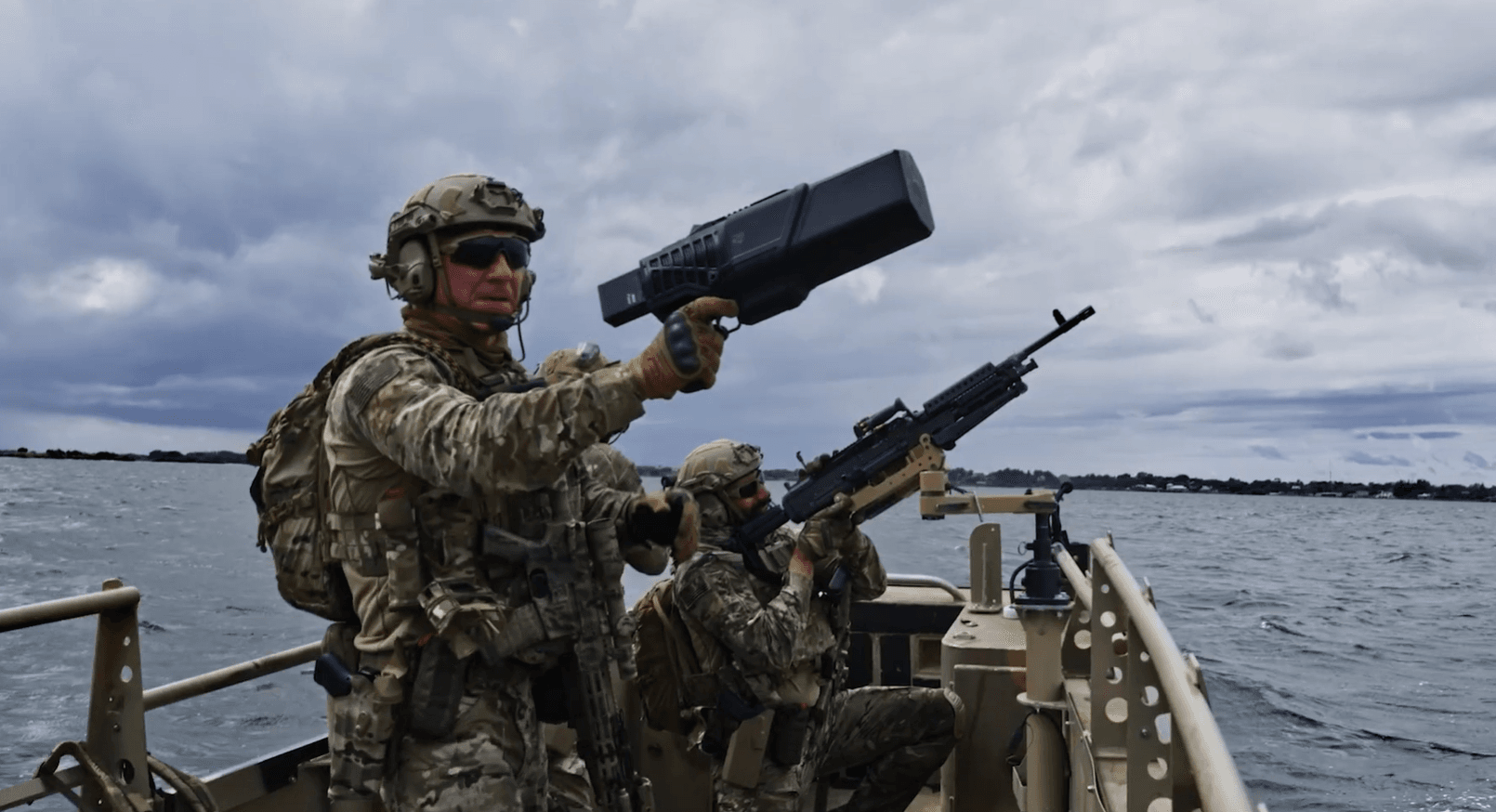
A surge in contracts, new manufacturing lines, and landmark event deployments signal that C-UAS technology has moved decisively beyond the experimental stage — but airspace governance and operator training remain unresolved fault lines.
EXECUTIVE SUMMARY
The global counter-unmanned aircraft system (C-UAS) sector is undergoing a structural shift. Where once governments debated whether to invest in drone-defence capabilities, they are now racing to determine which technologies can scale quickly enough to meet a threat that is evolving faster than most procurement cycles. Evidence gathered across February and March 2026 points to a market in high-growth “scale-up” mode: new factories opening on both sides of the Atlantic, multi-million-dollar contracts flowing to AI-first platforms, and a regulatory framework beginning to take shape in the United States and European Union.
Four forces are converging simultaneously. Production capacity is expanding as European and North American firms establish or expand domestic manufacturing. Artificial intelligence is migrating from software platforms into real-time edge hardware that fuses radar, optical, and radio-frequency signals. Procurement is accelerating, led by a landmark US Army award, a FIFA World Cup security contract, and a series of smaller but strategically significant state and local deals. And regulators, for the first time, are equipping non-federal agencies with defined legal authority to operate counter-drone systems.
The 2026 FIFA World Cup — 48 teams, 16 US cities, the largest tournament in the event’s history — will serve as the sector’s most visible real-world stress test. What happens in those stadiums this summer will likely shape procurement preferences for years to come.
| “Governments are no longer debating whether counter-drone systems are necessary. They are deciding which technologies can scale fast enough.” |
1. MARKET DEVELOPMENTS
European Manufacturing Push
Two European-linked companies announced significant production expansions within days of each other in mid-March. Alpine Eagle, the Munich-based airborne counter-drone specialist, confirmed plans to scale manufacturing of its Sentinel system in response to rising government demand across European defence markets. The company describes Sentinel as a “fast, deployable” solution suited to the rapid-response requirements emerging from the Ukraine conflict experience. Separately, DroneShield — the Australian firm that has built a strong European client base — opened its first dedicated EU production line, responding to anti-UAS procurement momentum across the region and, in part, to emerging preferences for non-Chinese supply chains in sensitive defence procurement.
US Domestic Supply Chain Build-Out
MyDefence, the Danish counter-drone specialist with a growing American footprint, inaugurated a new C-UAS production and innovation facility in Oklahoma City in late February. The company frames the site as a hub for plug-and-play counter-UAS solutions tailored to US defence and security partners. Fortem Technologies, meanwhile, secured a multimillion-dollar contract to provide drone-intercept protection at the 2026 FIFA World Cup before announcing a further integration with Lockheed Martin: Fortem’s TrueView radar sensors and DroneHunter autonomous interceptors will feed into Lockheed’s Sanctum C-UAS Mission Management software for critical infrastructure protection work.
Contracts and Capital
The most consequential contract of the period was the US Army’s ․87 million award to Anduril Industries, announced in mid-March. The deal places Anduril’s AI-powered Lattice software at the core of the Army’s counter-drone task force, with a specific mandate to link sensors and shooters — compressing the detect-to-engage timeline in a way that earlier, operator-intensive systems could not achieve. The Defense Innovation Unit concurrently issued a Commercial Solutions Opening titled “Counter UAS Sensing for Homeland and Mobile Defense,” signalling that the procurement pipeline extends well beyond the Army.
On the investment side, market observers have noted strong stock performance from DroneShield and Electro Optic Systems. A Danish kinetic-energy counter-drone startup, Shotling, raised ․76 0,000 in seed funding — oversubscribing its target round — betting on raw mechanical force rather than electronic warfare as a cost-effective defeat mechanism against FPV drones.
2. TECHNOLOGY HIGHLIGHTS
AI-Powered Sensor Fusion
Multi-sensor fusion — combining radar, optical cameras, and RF/Remote ID receivers into a unified detection picture — is rapidly becoming the baseline architecture for fixed and semi-fixed counter-drone installations. MatrixSpace introduced its Fusion 360 platform in February, integrating all three sensor modalities at the point of detection and relaying verified threat data through an edge-to-cloud pipeline. The company also updated its underlying AI Software Platform to support simultaneous tracking of multiple drone contacts in real time, an important capability as adversaries increasingly deploy drone swarms rather than single platforms. Fortem’s pairing of TrueView radar with DroneHunter interceptors represents a similar philosophy: detect autonomously, respond autonomously.
Directed Energy and Kinetic Defeat
Directed energy had a busy few weeks. A US defence startup demonstrated hypersonic missiles launched from a pickup-truck-mounted launcher — a portable kinetic defeat solution designed for forward-deployed units. Nuburu, a US laser company, completed a proof-of-concept for a rifle-mounted multi-beam laser weapon capable of blinding drone optical systems. Both technologies were broadly representative of a wider trend on display at the Singapore Airshow in February, where counter-drone hardware — laser turrets, jammer guns, and mobile interceptors — competed for floor space with conventional fighters and commercial aircraft. The optics were symbolic: C-UAS is no longer a niche exhibit.
Software-Defined and Cyber Defeat
Sentrycs, an Ondas Inc. subsidiary, delivered its C-UAS solution to a German state police department ahead of launching its new portable Scout system at the Enforce Tac exhibition in Munich. Scout employs a “Cyber over RF” or Protocol Manipulation technique that commandeers a drone’s communication link rather than physically destroying it — an attractive option for law-enforcement agencies operating in civilian environments where collateral-damage risk from kinetic defeat is unacceptable.
The ․20 Countermeasure
In a study that generated considerable attention, researchers at the University of California, Irvine demonstrated that a standard umbrella can defeat AI-enabled autonomous target-tracking drones by exploiting a blind spot in their machine-vision algorithms. The finding is a useful reminder that as C-UAS systems grow more sophisticated, so do the techniques — cheap or otherwise — available to those seeking to evade them. For defence planners, it underscores the limits of any single-layer detection approach.
| The 2026 FIFA World Cup will be the largest real-world stress test the C-UAS sector has yet faced — 48 teams, 16 US cities, and an autonomous drone-intercept system protecting every venue. |
3. REGULATION, TRAINING & OPERATIONAL CHALLENGES
Expanding Legal Authority
A significant policy development occurred on 10 March, when federal officials used the DRONERESPONDERS National Public Safety UAS Conference in Williamsburg, Virginia, to outline how the Safer Skies Act would create a formal pathway for state and local agencies to conduct C-UAS operations. Currently, counter-drone authority in the United States is largely restricted to federal entities. The FBI outlined how training certifications and inter-agency coordination frameworks under the Act would begin to extend that authority downward — a shift with substantial procurement implications for cities and counties that host large public events or manage critical infrastructure.
Workforce Development
On the training side, the FBI confirmed it is on track to qualify 60 state and local officers in drone mitigation by June 2026 — in time for the World Cup. Warren County Community College in New Jersey launched what appears to be one of the first dedicated counter-drone security curricula at a US community college level, aimed at both students and working professionals seeking to qualify for the growing number of C-UAS operator roles in law enforcement and private security.
The Airspace Friction Problem
Two incidents in the El Paso area illustrated the operational tension that still exists between counter-drone capability and civilian airspace management. In both cases, C-UAS systems operating in the West Texas border region triggered airspace closures that disrupted commercial aviation. In the more serious incident, Democratic lawmakers alleged that a US military system had shot down a Customs and Border Protection drone. Whether or not that allegation proves accurate, it points to a coordination failure — specifically, the absence of a reliable mechanism for identifying and distinguishing friendly drones from hostile ones before engaging. Improved Remote ID integration and inter-agency de-confliction protocols are widely seen as prerequisites for safe large-scale C-UAS deployment near civil aviation corridors.
4. KEY PLAYERS: A SECTOR SNAPSHOT
The table below summarises the primary companies active in the counter-drone sector and their positioning as of March 2026.
| Company | HQ / Region | Core Capability | Recent Developments |
|---|---|---|---|
| DroneShield | Australia / EU | RF detection, jamming, AI sensor fusion (DroneSentry) | First EU production line opened; strong market performance |
| Fortem Technologies | United States | Autonomous interceptors (DroneHunter®), TrueView radar | FIFA World Cup contract; integration with Lockheed Martin Sanctum |
| Anduril Industries | United States | AI sensor-to-shooter linking, Lattice platform | ․87 million US Army C-UAS task force award |
| Alpine Eagle | Germany | Airborne C-UAS (Sentinel system) | Scaling EU production to meet rising government demand |
| MyDefence | Denmark / US | Plug-and-play detection & jamming (wearable/fixed) | New Oklahoma City production facility opened February 2026 |
| MatrixSpace | United States | AI radar & multi-sensor fusion (Fusion 360) | Expanded AI platform; portable real-time detection |
| Sentrycs (Ondas Inc.) | Israel / US | Cyber over RF / Protocol Manipulation (Scout) | Delivered to German state police; Scout launched at Enforce Tac |
| RTX (Raytheon) | United States | Layered systems (KuRFS radar, Coyote interceptors) | Major US Army awards; global defence contracts |
| Lockheed Martin | United States | Integrated C-UAS (Sanctum software) | Partnership with Fortem for critical infrastructure protection |
| Dedrone (Axon) | United States | AI-driven detection & mitigation platform | Strong civilian and defence presence across multiple sectors |
| D-Fend Solutions | Israel | Cyber takeover / EnforceAir | Leading position in non-kinetic defeat; law enforcement focus |
| RAFAEL ADS | Israel | Integrated multi-domain defence systems | Consistently ranked in top global C-UAS capability assessments |
| Epirus | United States | High-power microwave / directed energy | Emerging as a non-kinetic defeat option for force protection |
5. OUTLOOK: 2026–2027
The counter-drone market’s near-term trajectory is shaped by three dynamics. First, the World Cup deployment will generate high-visibility data on how autonomous intercept systems perform in complex, multi-venue environments. Success will validate layered C-UAS architecture; any high-profile failure will provoke a policy and procurement reset. Second, the passage and implementation of the Safer Skies Act — if it proceeds on the timeline outlined by the FBI — will open a new procurement tier at the state and local level, broadening the addressable market for compact, affordable C-UAS solutions considerably. Third, the FPV drone threat — increasingly prominent in conflict zones — is beginning to influence commercial and border-security threat modelling, driving interest in lower-cost kinetic defeat mechanisms and in AI systems capable of identifying and engaging fast, low-signature targets.
Supply-chain resilience will also matter. The preference shown by European governments for EU-manufactured counter-drone hardware, and the parallel US emphasis on domestic production, suggests that country-of-origin considerations will increasingly function as a procurement filter alongside pure performance metrics.
CONCLUSION
The counter-drone sector has crossed a threshold. Production lines are open, procurement budgets are committed, and regulatory frameworks are taking shape. The questions driving the industry forward are no longer whether to invest in C-UAS capability, but which architectures scale safely alongside civilian airspace, which defeat mechanisms are appropriate for which operational contexts, and how to build and sustain the human expertise needed to operate systems that are themselves increasingly autonomous. The answers will emerge, in part, from what happens over 16 American cities this summer.
Sources include reporting from Dronelife, DroneDJ, Business Insider, Interesting Engineering, and Seeking Alpha. This briefing was compiled and edited by the RobotToday editorial desk.










Leave a comment