


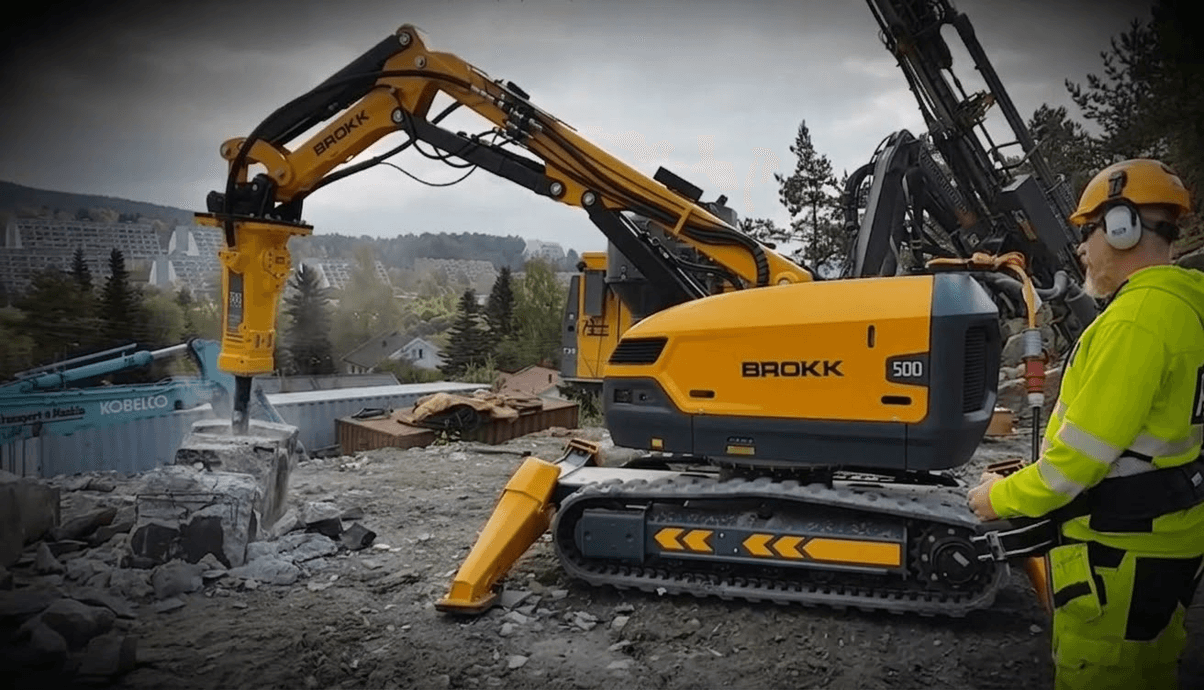
Demolition Robots: Where Zero Fatalities Becomes a Market Argument
Remote-operated demolition and hazardous-work robots are the fastest-growing segment in construction automation. AI, LiDAR, and over-the-air upgrades are reshaping a market once dominated by brute hardware. The question is no longer whether robots should replace humans in dangerous demolition. It is how fast that replacement will scale.
Market Snapshot: A Sector in Acceleration
The demolition robot market is growing fast. One set of estimates values it at USD 708 million in 2024, projecting growth to USD 2.5 billion by 2035 at a 12.1% compound annual rate. A second estimate pegs the broader segment at USD 12.8 billion in 2025, reaching USD 31.2 billion by 2034. The wide range reflects fragmented methodology, not fragmented demand.
Note: Market size figures vary significantly across research providers. All figures above are sourced from commercial market reports and have not been independently verified by third parties.
Adoption of demolition robots has grown by over 45% across industries in recent years. Nearly 40% of construction firms now deploy them to reduce on-site hazard. Both figures come from commercial market reports and have not been independently verified.
Asia-Pacific is the fastest-growing region. Europe holds the largest current share. Both are accelerating. The driver is not technology for its own sake. Construction remains one of the most dangerous industries globally. Deaths, injuries, and regulatory fines from confined-space and demolition work carry direct financial cost. Robots remove that cost. That logic alone explains adoption better than any feature roadmap.
12.1%
Projected CAGR for demolition robot market, 2025–2035 (Industry Today / Wise Guy Reports). Not independently verified.
New Products: Brokk Sets the Pace in 2024–2025
Brokk (Sweden) dominates the global demolition robot segment and delivered its most significant product cycle in years. At World of Concrete 2024 in Las Vegas, it unveiled the SmartPower+ generation — a five-model range covering the 70+, 170+, 200+, 300+, and 500+. The headline claim is 87% fewer cables and connectors compared to the previous generation. That reduction directly extends machine life and cuts maintenance time in abrasive environments.
The SmartPower+ generation introduced IP65-rated dust and water protection across all models. The new control box weighs under 3 kg and recharges faster than its predecessor. It uses a tilted joystick designed to reduce operator fatigue on long shifts. The system includes visual status indicators, two-way machine communication, and a QuickSwitch function for rapid tool changes.
In April 2025, Brokk launched the 130+ at Bauma in Munich. This model combines a newly developed BHB 175 breaker with an upgraded powertrain. Brokk's CEO Martin Krupicka described it as delivering greater hitting force and higher impact frequency without increasing machine size. The 130+ is enabled for over-the-air software updates — a significant capability shift for an industry where firmware upgrades have historically required service visits.
Husqvarna's DXR range (Sweden/EU) remains the key competitor. Its DXR 315 delivers 27 kW in a compact form factor with a telescopic arm, and the DXR 145 targets the most confined working environments. The DXR series previously served nuclear decommissioning work at Fukushima, deploying the DXR-140 and DXR-310 for concrete demolition in highly contaminated zones. Husqvarna's current line averages over 20% higher power than prior-generation models.
| Model | Manufacturer | Power | Key Technology | Application Focus |
| Brokk 130+ | Brokk (Sweden) | — | SmartPower+, BHB 175 breaker, OTA updates | Mid-range confined demolition |
| Brokk 500+ | Brokk (Sweden) | High-output electric | SmartPower+, IP65, 87% cable reduction | Heavy industrial / nuclear |
| Husqvarna DXR 315 | Husqvarna (Sweden/EU) | 27 kW | Telescopic arm, compact form factor | Versatile / indoor demolition |
| Husqvarna DXR 145 | Husqvarna (Sweden/EU) | 18.5 kW | 360° rotating arm, low weight | Confined space, narrow access |
Sources: Company press releases and product pages. Specifications are manufacturer-stated and have not been independently verified.
Beyond Breaking Concrete: Asbestos, Confined Spaces, and Hazmat
Demolition robots are increasingly deployed beyond structural teardown. Asbestos abatement is a growing application. Robots equipped with high-precision cutting tools, vacuum systems, and real-time sensors can now perform removal in air ducts, crawl spaces, and ceiling voids. AI-guided asbestos identification entered commercial use in 2025. Systems trained on visual and spectral data detect asbestos-containing materials. They determine the safest removal method before physical work begins.
A case cited by US industry sources involved New York City school buildings. The city's Department of Education deployed robotic systems for asbestos removal across multiple sites over a summer break. The project reportedly completed 30% faster than planned, with lower labour costs. This figure is based on a single operator's disclosure and has not been independently audited.
Industrial operators in oil and gas have set public targets for no human entry to confined spaces. DOW Chemical, Chevron, Shell, and others have maintained such goals since at least 2020. Robots are the only viable path to meeting them. This creates a clear pull from buyers — not just a push from vendors developing products in search of applications.
"The case for demolition robots does not rest on performance metrics. It rests on a simpler premise: humans should not be where structures collapse, radiation accumulates, or asbestos fibres float freely."
Regional Adoption: Japan, EU, and Korea Lead the Way
Japan has the most mission-critical use case in the world. The Fukushima Daiichi decommissioning is one of history's largest nuclear dismantling exercises. It has driven sustained demand for radiation-hardened, remote-operated demolition platforms. Husqvarna's DXR machines were deployed there for heavy concrete removal. Japan's multi-decade decommission commitment ensures this demand is structural, not cyclical.
EU adoption is driven by urban regeneration policy. Stricter worker safety regulations across Germany, the UK, France, and Sweden have raised the cost of traditional manual demolition significantly. Europe was the largest regional market for demolition robots in 2023. The EU's ADRA partnership under Horizon Europe is co-funding advanced robotic NDT systems for structural inspections in confined or hazardous spaces. This public-private mechanism is accelerating commercial readiness in ways that purely private R&D would not achieve alone.
Three-year EU pilot programmes in robot-executed demolition have reported zero fatalities across all projects tracked. This data, while not yet published in peer-reviewed academic literature, has been cited by industry bodies and referenced in procurement decisions. The zero-fatality claim is not a projection — it describes recorded outcomes from a specific set of pilot programmes.
South Korea presents a distinct opportunity. High-rise residential teardowns in Seoul and other dense cities require precision demolition where debris control and vibration management are critical. Korean construction firms have begun integrating remote-operated demolition machinery for top-down demolition of ageing apartment towers. Demand is expected to grow as South Korea's post-war housing stock reaches end-of-life at scale through the late 2020s.
| Region | Primary Driver | Key Application | Market Status |
| Japan | Nuclear decommissioning | Radiation-zone demolition, Fukushima | Established, long-term |
| EU (Germany, Sweden, UK) | Safety regulation, urban renewal | Building renovation, hazmat removal | Largest current market |
| South Korea | Ageing high-rise stock | High-rise teardowns, urban centres | Fast-growing |
| North America | Asbestos abatement, OSHA compliance | Industrial remediation, confined space | Established, regulation-driven |
| Asia-Pacific (ex-Japan) | Urban infrastructure investment | Construction site demolition, tunnels | Fastest CAGR |
Regional characterisation based on market research reports and industry sources. Market sizing methodology varies across sources.
AI and Advanced Robotics: What the Technology Stack Now Enables
The current generation of demolition robots operates primarily as remote-controlled machines — a human operator at a safe distance directs every movement. This works well. It is the core value proposition. But the industry is now building toward something different: task-level automation, where the robot handles sequences of work with minimal operator input.
LiDAR integration is the enabling hardware layer. Dense point-cloud sensors allow robots to map working environments in real time, detecting obstacles, structural weak points, and proximity hazards before impact. The 128-beam LiDAR units now appearing in confined-space inspection drones are a direct precursor to what will be embedded in demolition platforms within this decade.
SLAM (Simultaneous Localisation and Mapping) algorithms allow robots to understand and navigate their environments adaptively. For confined spaces — where GPS is unavailable and geometry is unpredictable — SLAM is the only viable navigation approach. EU-funded research via the ROBINS project validated SLAM-equipped crawlers and drones for ship ballast tank inspection. The same technology transfers directly to building demolition environments. Academic validation accelerates commercial adoption.
AI is entering the hazmat identification layer first. Systems trained on spectral and visual data can now detect asbestos-containing materials before human exposure occurs. Training a model to distinguish safe from hazardous materials at the robot's cutting interface is achievable with current computer vision capability. It is not yet commercially widespread. The trajectory, however, is clear.
Machine learning applied to demolition sequencing is a medium-term frontier. Structural demolition requires ordered removal: wrong sequence means collapse. Training models on engineering data and simulation environments can, in principle, teach robots to generate safe demolition sequences autonomously. Several research groups in Japan and the EU are working on this. Commercial deployment is years away. The prerequisite — robust environmental sensing — is arriving first.
Digital twin technology is an adjacent enabler. A precise virtual model of a structure lets operators and AI systems simulate demolition work. Sequencing risks become visible before any physical cut is made. Tool paths can be planned and validated in the digital environment first. Several EU research programmes are exploring this integration, though commercial application in demolition remains limited.
Brokk's over-the-air upgrade capability, introduced with the 130+ in 2025, signals the industry's shift to software-defined machines. A robot that can receive firmware improvements remotely is a platform, not just a tool. That changes how manufacturers price, support, and develop their products. It also means that AI improvements can be pushed to deployed machines without hardware replacement — a significant economic advantage over prior-generation equipment.
Challenges: The Gaps That Still Matter
The technology narrative is compelling. The adoption barriers are real. High upfront cost remains the first constraint. A Brokk 500+ class machine and its tooling represent a significant capital commitment for any contractor. Rental markets are developing but are not yet mature enough to make this equipment accessible at the project level for smaller firms.
The financing model also needs to evolve. Demolition contractors are typically project-based businesses with lean balance sheets. They cannot absorb large capital expenditure on a single machine between projects. Equipment leasing and robot-as-a-service pricing models are beginning to appear, but the market is nascent. Until financing matches the economics of the underlying technology, adoption will lag the safety case.
Operator scarcity is the second constraint. Brokk's CEO acknowledged it directly at World of Concrete 2024: finding skilled operators is a persistent problem. The SmartPower+ control system was redesigned explicitly to lower the skill threshold. That matters. A robot that only a specialist can use is a bottleneck. A robot that a competent construction worker can operate after structured training is scalable.
Autonomous capability remains limited for complex decisions. Current systems cannot determine structural danger from experience. They cannot identify when a building is about to fail in a way that deviates from the plan. Operators still carry that cognitive load. Until AI can handle dynamic structural risk assessment in real time, full autonomy in demolition is an engineering ambition rather than a near-term product.
Global decommissioning pipelines are growing. The US, EU, and Japan all have ageing reactor fleets. Investment in radiation-hardened platforms will become a clearly defined market segment within this decade.
| Challenge | Current State | Expected Resolution Pathway |
| High capital cost | Limits SME adoption | Rental market development, leasing models |
| Operator scarcity | Specialist-dependent systems | Simplified UX (SmartPower+), training programmes |
| Autonomous decision-making | Limited to teleoperation + basic assist | AI + SLAM integration; 5–10 year horizon |
| Radiation hardening | Custom, costly, low volume | Dedicated nuclear decommission product lines |
| Connectivity in confined spaces | Limited range, signal degradation | Mesh radio, tethered operations, 5G private networks |
Assessment based on public disclosures, industry reports, and academic literature as of early 2026.
Editorial Assessment: Safety Is Now a Competitive Moat
The demolition and hazardous work robot segment has one structural advantage no other construction robot category shares. The cost of not adopting it is measurable in fatalities. That gives procurement teams a non-negotiable justification for capital expenditure that simply does not exist for productivity-focused robots in, say, bricklaying or concrete finishing.
The zero-fatality result from EU pilot programmes is a powerful commercial data point. It will be cited in procurement documents and safety audits for years. The industry that can sustain that record at scale — moving from pilots to standard practice — will create a regulatory moat. Regulators will follow the evidence, and evidence will eventually mandate the technology.
There is a parallel with seatbelt legislation. The safety case for seatbelts was technically clear for a decade before governments mandated them. Demolition robots are at an analogous inflection. The safety data exists. Industry adoption is voluntary but accelerating. Regulatory mandates in the EU and Japan for robot-assisted work in defined hazardous categories are a foreseeable step within this decade.
AI integration in this segment should be watched carefully. The current wave — LiDAR, SLAM, AI-guided hazmat identification — is foundational infrastructure. It is not yet replacing the operator. It is making the operator more effective and less exposed. The next wave, within five to eight years, will begin to automate sequences of work. That is when adoption curves will steepen sharply and labour displacement conversations will intensify.
One underappreciated strategic shift is data ownership. Every Brokk SmartPower+ machine with OTA capability is also a connected data node. Operating hours, tool usage, power consumption, and fault logs are transmitted back through the connected system. Manufacturers who collect and analyse this fleet data can predict failure, optimise tool presets, and design better next-generation machines. That feedback loop accelerates product development in ways that non-connected hardware cannot match.
Husqvarna, Hitachi, and new entrants will need to match this model. Those that do not will accept a secondary position. The market is increasingly defined by software capability, not hardware power alone.
The opportunity is clear. The safety case is proven. The technology is deployable today. Capital is flowing into the sector. The main variable is the pace at which the industry builds operator training pipelines, rental markets, and regulatory frameworks. These enable full-scale adoption. And institutional problems, historically, take longer to solve than technical ones.










Leave a comment