


Why Construction Robots Are Winning the Tech War but Losing the Union War
A $500,000 robot can do a bricklayer’s day in an hour. So why isn’t it everywhere?
The industry desperately needs automation. The workforce desperately resists it. Who wins?
THE CONSTRUCTION FRONT
540K Housing unit shortage in NY tri-state region | 350K Monthly construction worker shortfall (U.S.) | 6× SAM100 speed advantage over human bricklayer | 42.8 Median age of U.S. construction worker |
THE CONFLICT
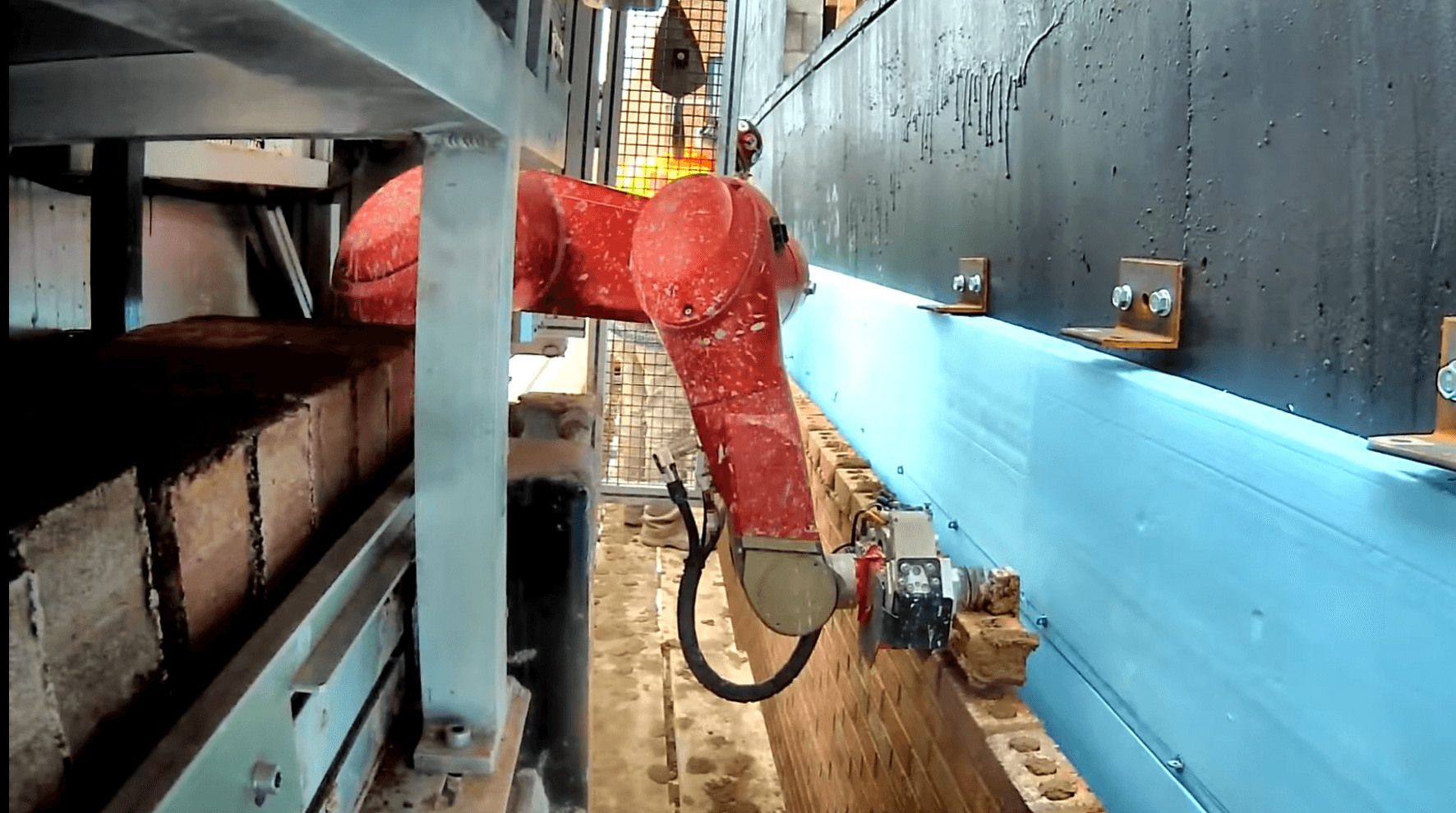
New York City is running out of room — and out of bricklayers. The tri-state region faces a shortage of roughly 540,000 housing units, and city lawmakers have responded with aggressive rezoning plans and tax incentives designed to accelerate construction. But the pipeline has a human bottleneck that no zoning change can fix. The median age of a U.S. construction worker is 42.8 years, and the industry is short roughly 350,000 workers every month. In masonry alone, the gap is staggering: a skilled bricklayer can lay around 400 to 500 bricks in a grueling day. The SAM100, a semi-automated bricklaying robot built by Construction Robotics of New York, can lay over 3,000 bricks in the same time — a sixfold productivity gain.
The technology exists. The need is urgent. And yet construction robotics adoption in the United States remains painfully slow. The reason isn't engineering. It's labor law, union strategy, and a political calculus that makes robots a toxic word in an election year. This is the story of how the construction industry — one of the oldest, most fragmented, and most resistant sectors on earth — is being forced to confront the same automation question that already reshaped manufacturing. And it raises an uncomfortable parallel: could construction's robot wars end up looking like the early days of ride-sharing, where technology outpaced every institution designed to govern it?
THE LANDSCAPE
A Robot for Every Task — And a Union for Every Robot
Before diving into the political battles, it helps to understand just how many different jobs exist on a modern construction site. Construction is not a single trade. It is dozens of them, each with its own skill set, its own union, and its own relationship to automation. Bricklaying is the most visible example — and the one where robotics is furthest along — but it represents only one slice of a much larger puzzle.
The main categories of construction work where robots are now being developed or deployed include: bricklaying and masonry (SAM100, Hadrian X); steel rebar tying and cutting (automated rebar machines can process 12-meter bars that weigh over 120 kilograms); welding (Shimizu's Robo-Welder systems); concrete floor finishing and leveling; painting and plastering (now being deployed across public housing projects in Singapore); site layout and line marking (Dusty Robotics' FieldPrinter); and tile installation. Each of these tasks is repetitive, physically demanding, and — critically — already short on skilled labor. Each is also a potential flashpoint with a different union.
The SAM100 is the clearest case study. Launched commercially in 2014 by Construction Robotics, it pairs a motorized carriage, a robotic arm, a conveyor belt, and a concrete pump into a system that travels along a scaffold, climbing a mast on the side of a commercial building. It is not fully autonomous. A human mason still works alongside it to smooth mortar and handle quality checks. But the machine does the heavy lifting — literally. It reduces manual lifting by over 80 percent and can increase daily output by 400 percent at firms that have adopted it, such as Willhelm Construction in Indianapolis.
Yet for all its efficiency, SAM100 has struggled commercially. An IMD business school case study — which won the 2020 EFMD Case Writing Competition — analyzed the robot's disappointing sales and identified the culprits: high upfront cost (around $500,000 per unit), limited functionality on buildings with complex geometries, low awareness among contractors, and — most significantly — regulatory and union barriers that made deployment unpredictable and legally risky. The technology works. The market doesn't yet move to meet it.
THE CORE TENSION
Why Construction Unions Fight Harder Than Auto Unions
To understand why construction robots face stiffer resistance than their manufacturing counterparts, you need to understand the structural difference between the two industries. It comes down to one word: permanence.
Project Work vs. Permanent Employment
An auto factory is a permanent workplace. Workers show up at the same plant, on the same line, for years or decades. When Toyota introduces a new welding robot, the union negotiates terms at that specific facility. The jobs that disappear are visible, countable, and grievable. Construction is fundamentally different. A builder moves from project to project — a downtown office tower in March, a suburban school in June, a warehouse in September. Workers are hired and released in waves. Unions in construction don't control permanent workplaces; they control entry to the trades. Getting a job on a unionized construction site in the United States typically means going through a union apprenticeship program and holding a union card. The union is the gatekeeper, not just an advocate.
This creates a paradox for contractors. A developer who signs a Project Labor Agreement — the standard pre-hire collective bargaining framework for large construction projects — gains access to a reliable, skilled workforce. But that same agreement typically gives the union authority over what equipment and technologies can be used on site. Introduce a robot that performs "bargaining unit work" — work traditionally done by union members — without negotiating first, and you are potentially in violation of the agreement.
The Legal Gray Zone
Under the National Labor Relations Act, employers generally have the right to make fundamental entrepreneurial decisions about their business — including introducing new technology. But when an established company with a unionized workforce wants to change how its work is performed, it may have an obligation to bargain with the union over the effects of that change. This is not a hypothetical concern. Las Vegas hospitality workers have threatened strikes over automation. UPS package delivery workers negotiated explicit protections against drones and self-driving vehicles into their collective bargaining agreement. In construction, the stakes are even higher because the work itself is the union's domain.
The result is a chilling effect. Contractors who want to pilot construction robots often face a stark choice: negotiate with the union first (which can take months or years and may result in outright rejection), deploy the robot on a non-union site (which limits the potential market), or wait for the technology to become so dominant that resistance becomes untenable — a strategy that works in theory but requires patience most construction schedules don't allow.
GLOBAL COMPARISON
Three Countries, Three Strategies
The tension between automation and labor is not unique to the United States, but the way different countries navigate it reveals fundamentally different assumptions about who should benefit from technological change — and how fast it should happen.
Japan: The Demographic Imperative
Japan's approach to construction robotics is inseparable from its demographic crisis. With the world's oldest population and a fertility rate that hit a historic low of 1.15 in 2024, Japan cannot afford to wait for labor markets to self-correct. The government has made robotics a national priority under its Society 5.0 vision, and construction is explicitly included. Major general contractors like Shimizu and Kajima have built internal robotics laboratories and developed proprietary systems — Shimizu's Robo-Welder for column welding, Robo-Buddy for multipurpose site tasks, and Robo-Carrier for autonomous material transport. Japan's Ministry of Economy, Trade and Industry allocated over 32 billion yen in its fiscal 2024 supplementary budget specifically to promote AI-robot R&D and strengthen the industrial ecosystem.
Crucially, Japan's labor unions have not mounted the same kind of resistance seen in the U.S. Research from Japan's Research Institute of Economy, Trade and Industry (RIETI) found that companies with labor unions are actually more likely to adopt service robots in Japan. The cultural framing matters: robots are perceived as social helpers addressing an existential demographic problem, not as competitors competing for jobs that young people don't want anyway.
The United States: Market Power, Union Friction
America's construction robotics story is one of technological capability colliding with institutional inertia. The market forces are real — a monthly shortfall of 350,000 workers, a housing crisis measured in hundreds of thousands of missing units, and an aging workforce with a median age approaching 43. But the institutional barriers are equally real. There is no federal program equivalent to Japan's targeted robotics subsidies for construction. Innovation happens at the company level, and its success depends entirely on the local union landscape.
Some unions are beginning to adapt. The International Union of Operating Engineers (IUOE), representing over 400,000 members, has signed a multi-year partnership with Built Robotics to train members on autonomous construction equipment. SMART Local 104 in Silicon Valley has partnered with Dusty Robotics to certify workers on the FieldPrinter layout system. These are not concessions — they are reframing automation as a skill upgrade. But these partnerships are isolated. Across the broader landscape, the dominant posture remains defensive.
Europe: The Social Dialogue Model
Europe offers perhaps the most instructive alternative. The EU's social dialogue framework — enshrined in Articles 151–156 of the Treaty on the Functioning of the European Union — requires formal consultation between employers and workers' organizations before changes that affect employment conditions. In practice, this means construction robotics in Europe tends to follow a three-stage path: pilot the technology on a limited basis, negotiate with works councils and trade unions about the implications, then scale if agreement is reached.
This process is slower than unilateral deployment. But research from the London School of Economics suggests it produces better outcomes. A 2022 study across 25 OECD countries found that countries with stronger cooperative labor institutions — works councils, sector-level agreements — actually adopted more robots, not fewer. The reason: when workers trust that the costs and benefits of automation will be shared equitably, and that retraining will be funded, they are more likely to support rather than resist technological change. Countries like Austria, Belgium, and Sweden — all with strong cooperative systems — use at least twice as many robots as countries like the UK, which lacks equivalent structures.
THE POLITICAL DIMENSION
Vote Counts vs. Competitiveness
Construction workers are a politically significant constituency — particularly in swing states where union membership still carries electoral weight. This creates a dilemma for politicians at every level. Publicly endorsing "robots replacing workers" is electoral poison. Privately, however, governments across the political spectrum are quietly advancing automation in construction through mechanisms that avoid direct confrontation with unions.
The Singapore Model: Government as Mandator
Singapore offers the most aggressive example of government-driven construction automation. Facing severe labor constraints and a heavy reliance on foreign workers, Singapore's Building and Construction Authority (BCA) has pursued a deliberate strategy of reducing foreign worker quotas while simultaneously mandating automation. The government tightened its Dependency Ratio Ceiling from 1:7 to 1:5 in 2024, directly forcing contractors to find productivity gains elsewhere. At the same time, the Housing and Development Board (HDB) announced that from 2025, approximately 50 percent of new public housing construction sites will adopt robotics solutions — including painting and plastering robots — targeting a 25–30 percent improvement in site productivity.
Singapore has no powerful construction unions to negotiate with. The strategy works precisely because the political calculus is different: in a city-state dependent on imported labor, automation is framed as a matter of national sovereignty, not worker displacement. The result is one of the most aggressive government-led construction robotics programs in the world.
The U.S.: Pilot Zones and Quiet Experiments
In the United States, the political approach is more circumspect. Federal infrastructure spending bills have included language encouraging "innovative construction methods" and "workforce productivity" without explicitly naming robots. At the state and local level, some jurisdictions have begun experimenting with "smart construction zones" — designated areas where new technologies can be tested under relaxed regulatory frameworks — though these remain limited in scope and visibility.
The political tension is sharpest at the intersection of housing policy and labor policy. New York's 485x tax incentive program — designed to unlock affordable housing construction — comes with prevailing wage requirements that push hourly rates above $72 for large projects. For developers, this makes the economic case for automation even stronger. But the same political environment that created 485x is also the environment in which union opposition to robots carries the most weight.
THE CENTRAL QUESTION
Will Construction Robots Follow the Uber Playbook?
The comparison to Uber is instructive — and uncomfortable. When ride-sharing platforms entered urban transportation markets, they did not ask taxi unions for permission. They deployed first, built a user base, and forced regulatory frameworks to adapt after the fact. The strategy worked because consumers adopted the technology faster than institutions could respond. Could construction robotics follow the same path?
There are reasons to think the answer is no — at least not in the same way. Construction sites are not apps on a phone. They are regulated environments governed by safety codes, permitting requirements, and labor agreements that have teeth. A contractor who deploys a robot in violation of a collective bargaining agreement doesn't just risk a fine — they risk losing access to the entire unionized labor pool in their region. The consequences of moving too fast are not just legal; they are operational.
But there are also reasons to think the parallel is more apt than it appears. The housing crisis is a forcing function. When a city desperately needs 540,000 new units and the construction workforce is shrinking, the political calculus eventually shifts. The Korea Herald's analysis of Hyundai's robot standoff captured this dynamic precisely: prolonged resistance may protect jobs in the short term, but if the core technology is proven elsewhere — in non-union U.S. sites, in Japan, in Singapore — the countries and companies that adopted early will hold a structural advantage that no amount of bargaining can close.
South Korea's President Lee Jae Myung made this point bluntly in January 2026, in remarks widely seen as responding to Hyundai's union standoff over its Atlas humanoid robot. He invoked the Luddites — the 19th-century English weavers who destroyed machinery they feared would eliminate their jobs — and observed that society eventually adapted to the industrial revolution not by winning the fight against machines, but by learning to work alongside them.
THE BOTTOM LINE
The Slowest Breakthrough. The Biggest Prize.
Construction is the industry where automation will arrive last. It is also the industry where the prize is largest. Housing, infrastructure, and public works represent trillions of dollars in annual spending worldwide, and the labor shortage in every country with an aging population is only going to worsen. The robots are ready — or close to it. The question is not whether they will transform construction, but who will change the rules first.
Japan is moving fastest, driven by demographics and cultural acceptance. Singapore is moving most aggressively, driven by government mandate and labor scarcity. Europe is moving most carefully, driven by social dialogue and cooperative institutions. The United States is moving most unevenly — pockets of innovation coexisting with deep institutional resistance — and the outcome will likely depend on whether the housing crisis creates enough political pressure to force a renegotiation of the terms on which robots enter the trades.
The construction industry's robot wars are not like the auto industry's robot wars. They are messier, slower, and more politically charged. But they are also, in many ways, more consequential. The next great wave of automation will not happen on a factory floor. It will happen on a construction site — and the battle lines are already drawn.
Sources referenced:
Korea Herald — "Hyundai Motor's humanoid push meets labor wall" (Jan. 30, 2026);
NYC Comptroller Office — Housing Supply Challenge Report;
National Association of Homebuilders — Construction Labor Market Report (Fall 2024);
Associated Builders & Contractors — Labor Shortfall Data; HDB Singapore — Press Release on Robotics Adoption (Oct. 2024);
Japan METI — AI Robotics Strategy Update;
London School of Economics — Cooperative Institutions & Robot Adoption (2022);
OECD Employment Outlook 2023 — Social Dialogue & AI; Jackson Lewis — "Is That Robot in the Bargaining Unit?";









Leave a comment