

Industry Briefing
A single destination for timely, editor-curated robotics news from around the world.

Hadrian Secures $1.4 Billion to Expand Manufacturing and Workforce Capabilities
Hadrian has successfully raised $1.4 billion to enhance its manufacturing footprint and workforce. The company operates a 'factories as a service' model, utilizing its AI platform, Opus, to provide fully automated manufacturing facilities. This funding will support the establishment of new facilities, including a $200 million factory in Mesa, Arizona, and a $2.4 billion facility in Cherokee, Alabama, focusing on U.S. munitions and submarine production. This expansion is critical as the U.S. military faces a reported weapons shortage, particularly amid ongoing conflicts. Hadrian's initiatives, including a contract with the U.S. Army valued at up to $80 million, aim to bolster advanced manufacturing capabilities. The collaboration with Lockheed Martin to enhance production rates for missile systems further underscores the importance of this funding in addressing national defense needs. Looking ahead, Hadrian's partnerships with Lockheed Martin and space startup Fortastra signal a commitment to innovative manufacturing processes. The company's focus on rapid technician training and advanced production methods will be crucial in meeting the demands of the defense sector. No further timeline was disclosed at the time of publication.

Embodied AI Introduces Robotic Solutions to Address Europe's Manufacturing Challenges
Embodied AI, a start-up based in Lausanne, has launched to tackle the pressing automation challenges facing European manufacturing. As high-volume production shifts to Asia, Europe risks losing its competitive edge in manufacturing, leading to a decline in industrial capacity. Embodied AI aims to develop intelligent robots capable of performing complex tasks in real-world environments, moving beyond traditional automation methods. The significance of this initiative lies in its potential to enhance productivity and quality in European manufacturing. With global competitive pressures and evolving supply chains, the need for effective automation solutions is urgent. Embodied AI's approach focuses on creating a European Embodied AI ecosystem that connects academic research with industrial expertise, reinforcing Europe's technological leadership in next-generation robotics. Looking ahead, Embodied AI is collaborating with global industrial players to implement its solutions in critical applications such as electronics production and flexible cable handling. The company is developing a platform for training custom AI models that ensure operational efficiency and adaptability. No further timeline was disclosed at the time of publication.
Artificial Intelligence Features Manufacturing artificial intelligence embodied ai european manufacturing
MISUMI Americas Reports on Record U.S. Manufacturing Growth and Workforce Challenges
MISUMI Americas has released its report titled "The Rise of U.S. Manufacturing," highlighting that domestic manufacturing value reached a record $2.91 trillion in 2024. The report also indicates that the ISM Manufacturing PMI hit 54 in May 2026, marking the strongest performance since 2022. Additionally, factory-construction spending more than doubled from 2021 to 2024, while foreign investment in U.S. manufacturing reached $2.42 trillion, surpassing all other sectors. The report emphasizes a significant challenge facing this growth: a workforce shortage. MISUMI notes that there are currently 409,000 open manufacturing positions, with projections indicating that 1.9 million jobs may remain unfilled by 2033. This workforce gap is identified as the primary constraint on the growth cycle of U.S. manufacturing, despite the influx of foreign investment, particularly from Japan, which accounts for over $819 billion of the total. Looking ahead, the report discusses the relationship between automation and workforce development. As facilities become more automated, the demand for skilled workers who can operate and troubleshoot advanced systems increases. The skills required for these roles are evolving, and initiatives like H.R. 9097 aim to address the training gap by sending American workers to countries with established automation training programs. No further timeline was disclosed at the time of publication.
Business Intelligence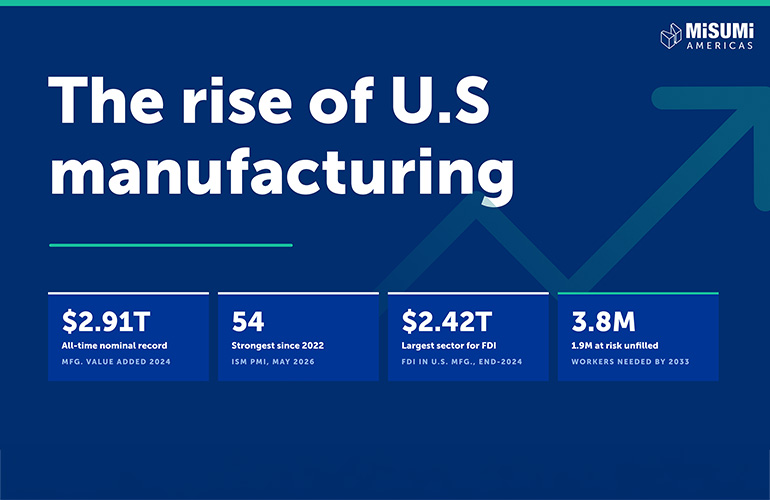
MISUMI Americas Unveils Reshoring Report Highlighting U.S. Manufacturing Growth and Workforce Needs
MISUMI Americas has released a report detailing the rise of U.S. manufacturing, which reached a record value of $2.91 trillion in 2024. The report highlights the ongoing reshoring trend driven by labor shortages and a push for national self-reliance. It notes that the manufacturing sector will require 3.8 million additional workers by 2033, with 1.9 million positions potentially remaining unfilled due to demographic shifts. The significance of this report lies in its emphasis on the challenges faced by manufacturers in attracting and retaining talent, which has been identified as the primary business challenge by over 65% of manufacturers. The report also points out that foreign direct investment in U.S. manufacturing has reached $2.42 trillion, making it the largest sector for such investments. The growth in factory construction spending, particularly in semiconductor and electric vehicle battery plants, underscores the industry's expansion. Looking ahead, the report indicates that while there has been a notable increase in vocational training enrollment, it still falls short of the workforce needs projected for 2033. No further timeline was disclosed at the time of publication.
Educational Manufacturing News education Education & Training Fictiv
Training and Upskilling, Not Automation, Key to Productivity Growth in Manufacturing
Recent insights indicate that while innovation in automation and robotics is ongoing, the immediate solution to productivity growth does not stem from these technologies. Instead, the focus should be on training and upskilling the workforce, which is becoming increasingly critical for manufacturers in the automotive and machine-building sectors. This emphasis on workforce development highlights a significant challenge for manufacturers, as the lack of skilled labor may hinder their ability to fully leverage technological advancements. As industries evolve, the need for a well-trained workforce will become a bottleneck, impacting productivity and competitiveness in the market. Looking ahead, companies must prioritize investment in training programs to address this skills gap. No further timeline was disclosed at the time of publication, but the ongoing shift towards upskilling suggests that manufacturers will need to adapt their strategies to ensure they can meet future demands effectively.

Hershey Company Leverages AI to Enhance Workforce Efficiency in Candy Manufacturing
The Hershey Company is implementing AI-driven digital transformation in its candy factories through a connected-worker platform developed by Augmentir. This initiative aims to enhance workforce efficiency by providing intelligent guidance and support to workers, addressing challenges such as labor shortages and skills gaps. The integration of Augmentir’s AI-powered platform, known as 'Augie,' allows Hershey to tailor technology to its specific needs, capturing valuable data on worker performance. This data-driven approach helps identify areas for improvement, such as machine maintenance and worker training, ultimately leading to better operational outcomes. As manufacturers increasingly adopt AI technologies, the focus will be on how effectively they can integrate these solutions into their workforce processes. No further timeline was disclosed at the time of publication.
Factory / Digital TransformationRobotics needs a service framework.
RSF defines a common language for robot service capability, lifecycle operations, certification pathways, and service-provider networks.
Join the RobotToday community on LinkedIn
Daily robotics news, in-depth analysis, conference highlights, and discussions with professionals worldwide.







