Industry Briefing
A single destination for timely, editor-curated robotics news from around the world.

Gravis Robotics Secures $200 Million from SoftBank for Autonomous Construction Technology
Gravis Robotics has received a significant $200 million investment from SoftBank, aimed at enhancing its construction technology. The startup focuses on retrofitting existing excavators and heavy machinery to incorporate autonomous and semi-autonomous capabilities, which are essential for modern infrastructure projects. This investment underscores SoftBank's confidence in the potential of physical AI, particularly in the automation of earth-moving equipment. Such advancements are crucial for improving efficiency in infrastructure development, including roads, quarries, and mines, where heavy machinery plays a vital role. Looking ahead, the industry will be watching how Gravis Robotics leverages this funding to further innovate in the construction sector. No further timeline was disclosed at the time of publication.
Bedrock Robotics Introduces Autonomous Driving Technology for Construction Equipment
Bedrock Robotics is implementing autonomous driving technology in construction by retrofitting excavators and heavy machinery with advanced sensors and software. The company’s CEO, Boris Sofman, highlighted the significance of these innovations during a discussion on Bloomberg Tech, emphasizing the potential to mitigate the skilled labor shortage in the industry. This development is crucial as the construction sector faces increasing demand for data centers and infrastructure projects, which creates a pressing need for efficient and effective solutions. By integrating AI-driven autonomous equipment, Bedrock Robotics aims to enhance productivity and speed up construction processes across the United States. Looking ahead, the company has initiated its first paid commercial deployments, marking a significant milestone in its journey. No further timeline was disclosed at the time of publication.
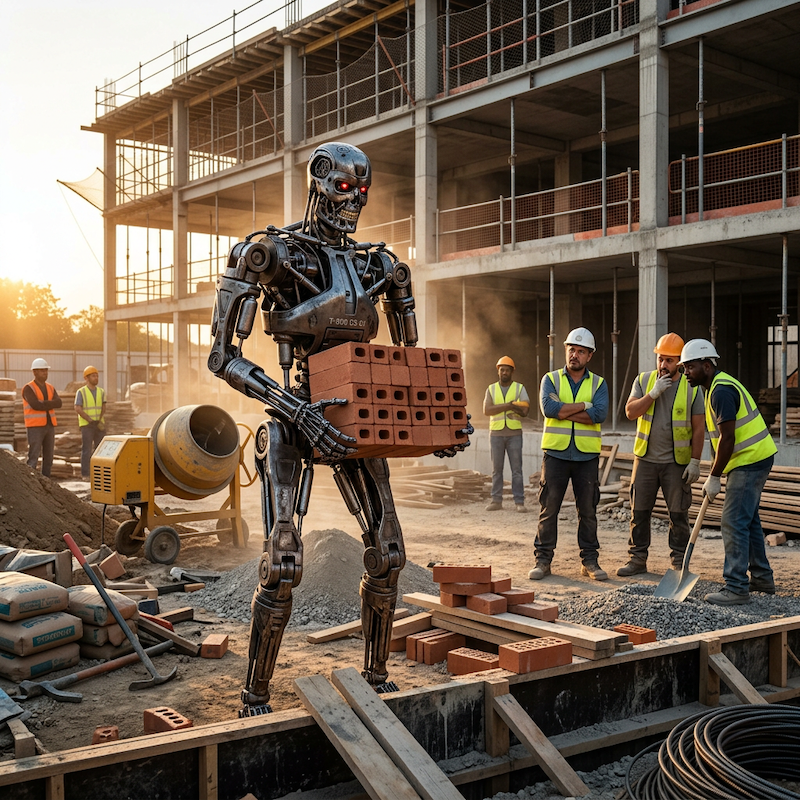
Exploring How Robots Utilize SLAM Technology to Navigate Construction Sites
Autonomous robots are increasingly being deployed on construction sites, where GPS signals are unreliable due to environmental factors. Instead of relying on external positioning, these robots utilize Simultaneous Localization and Mapping (SLAM) technology to create real-time maps using cameras and LiDAR. This capability allows them to navigate effectively around moving crews and changing site conditions. The importance of SLAM technology in construction cannot be overstated, as it enables robots to adapt to the dynamic nature of building sites. Unlike warehouse environments, where layouts remain relatively stable, construction sites frequently undergo changes, making it essential for robots to operate with updated maps. SLAM allows robots to determine their location and understand the current layout of the site, ensuring they can perform tasks accurately. Looking ahead, the integration of SLAM technology in robotics will continue to evolve, enhancing the capabilities of autonomous machines in construction. As construction sites become more complex, the need for real-time mapping and localization will grow, driving advancements in SLAM and related technologies. No further timeline was disclosed at the time of publication.
Features Robotics autonomous navigation Autonomous robots BIM boston dynamics
Starmind's Orbital Compute vs. Terrestrial Data Centers: Analyzing Resource Advantages
Starmind's orbital compute technology presents a significant advantage over traditional ground-based data centers by eliminating constraints related to land, water, and grid permitting. While terrestrial data centers are currently cheaper and faster to construct, with U.S. data center spending reaching $85.3 billion in 2026, Starmind's approach focuses on addressing the growing resource limitations faced by hyperscale facilities. The significance of Starmind's technology lies in its ability to sidestep the increasing challenges of land and water usage. For instance, a 100 MW data center can consume approximately 530,000 gallons of water daily for cooling, while Starmind's AI1 utilizes deployable liquid radiators that require no water. This structural advantage could resonate with investors as the demand for AI computing continues to escalate, potentially leading to annual water withdrawals of up to 1.7 trillion gallons by 2027. Looking ahead, Starmind's next milestones include the launch of AI1 prototypes scheduled for early 2027. However, the technology's claims regarding cooling efficiency and operational reliability remain unverified until real flight data is available. As the industry evolves, the competition between orbital and terrestrial solutions will become increasingly relevant, particularly in the context of resource management and sustainability.
Robotics needs a service framework.
RSF defines a common language for robot service capability, lifecycle operations, certification pathways, and service-provider networks.
Join the RobotToday community on LinkedIn
Daily robotics news, in-depth analysis, conference highlights, and discussions with professionals worldwide.