

Industry Briefing
A single destination for timely, editor-curated robotics news from around the world.

Royal Navy Tests Robotic Boat for Autonomous Drone Launching in Maritime Surveillance
The Royal Navy is conducting trials of a robotic boat designed to autonomously launch and recover drones at sea, enhancing uncrewed maritime surveillance capabilities. This initiative, in collaboration with ACUA Ocean and Teledyne FLIR Defense, aims to improve persistent aerial reconnaissance while minimizing risks to personnel. The system integrates an uncrewed surface vessel (USV) with a tethered uncrewed aerial system (T-UAS), allowing for extended surveillance operations. This development is significant as it represents a new approach to maritime surveillance, combining aerial and surface capabilities into a single autonomous system. The SkyCarrier and SkyRanger R70 drones, utilized during the trials, are equipped with advanced AI and imaging technologies, enabling them to perform demanding surveillance missions. The ability to maintain a stable tether connection allows for longer operational durations and continuous power supply, which is crucial for effective surveillance in challenging sea conditions. Looking ahead, the Royal Navy's exploration of this technology could lead to enhanced capabilities in anti-submarine warfare, mine countermeasures, and the protection of critical maritime infrastructure. No further timeline was disclosed at the time of publication.
AI and Robotics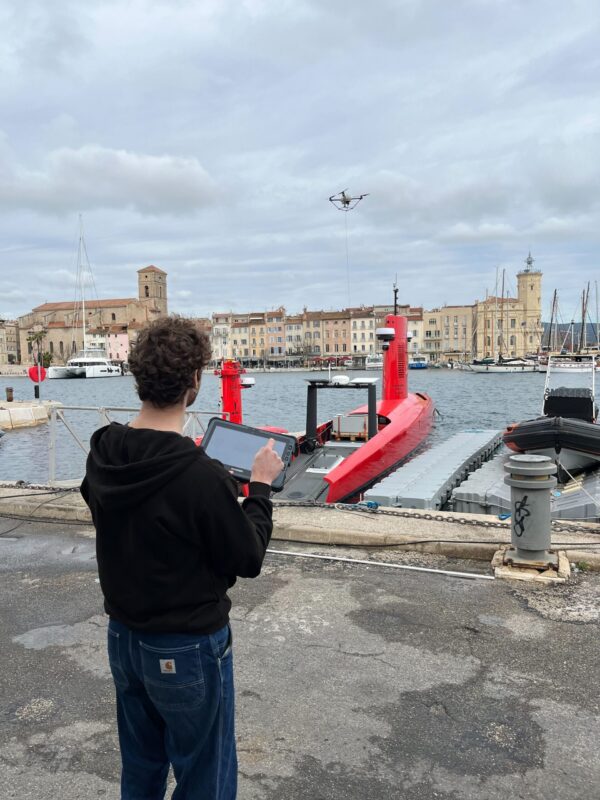
Elistair and Exail Collaborate on Tethered Drone Maritime Surveillance for Autonomous Vessels
Elistair has partnered with Exail to integrate its Khronos DroneBox with Exail's DriX unmanned surface vessel, enabling tethered drone maritime surveillance. This collaboration allows operators to maintain a persistent aerial view from shore, enhancing capabilities for naval, coast guard, and port security operations. The integration of the Khronos DroneBox with the DriX vessel marks a significant advancement in maritime surveillance technology. The tethered drone can operate for up to 24 hours at a height of 60 meters, providing real-time, encrypted video feeds even in challenging environments. This capability extends surveillance beyond traditional surface radar limits, making it ideal for various applications including coastal surveillance and search and rescue missions. Looking ahead, the partnership between Elistair and Exail is expected to evolve as they explore further applications of the Khronos system in maritime contexts. No further timeline was disclosed at the time of publication.
Drone News Drone News Feeds News safety and security seadrones Security
Helsing Unveils Lura and SG-1 Fathom for Autonomous Mass Surveillance
Helsing, a prominent European defense technology firm, has introduced two innovative systems, Lura and SG-1 Fathom, aimed at enhancing maritime security and digitalizing ocean monitoring. Announced today, these advancements draw on the company's extensive expertise in air and land defense to transform maritime surveillance. Lura, a sophisticated software platform powered by advanced artificial intelligence, is designed to rethink traditional approaches to maritime threat detection. It employs autonomous technologies that are both scalable and cost-effective, enabling the identification of potential threats beneath the ocean's surface. This initiative reflects Helsing's commitment to leveraging cutting-edge technology to safeguard maritime environments.
helsing lura sg-1 fathom autonomous mass surveillance
New sub-450-gram mini drone system sustains autonomous surveillance despite GPS jamming
As military forces seek innovative solutions to enhance soldier safety and situational awareness, recent advancements in technology are being explored. These developments aim to provide troops with better protection while ensuring they remain alert to their surroundings. The initiative comes in response to the increasing challenges faced by soldiers operating in high-stress environments, where the balance between safety and awareness is crucial. By integrating cutting-edge wearable devices and advanced communication systems, armies are working to create a more effective and responsive combat experience. This effort is particularly relevant in light of ongoing conflicts and the evolving nature of warfare, which demands that soldiers be both protected and informed. The implementation of these technologies is expected to improve operational efficiency and reduce risks on the battlefield, ultimately enhancing the overall effectiveness of military missions.
Military
Massimo Group Launches AI Intelligent Patrol Platform Initiative Integrating Autonomous Patrol Vehicles, Spherical Security Robots and Drone Systems
Massimo Group has officially launched the prototype development of autonomous patrol electric vehicles, aiming to penetrate the $50.4 billion U.S. security services industry. This initiative, which began in October 2023, focuses on integrating artificial intelligence into patrol and intelligent security mobility systems. By leveraging advanced technology, the company seeks to enhance security operations and improve efficiency in monitoring and response capabilities. The move is part of Massimo Group's broader strategy to innovate within the security sector, addressing growing demands for smarter and more effective security solutions.

Xpeng Targets 2026 for Autonomous Humanoid Robot 'Iron' Mass Production
At its recent Global Brand Night, Xpeng unveiled significant advancements in its 'Iron' humanoid robot, highlighting the company's ambition to achieve full autonomy rather than relying on remote control. This initiative reflects Xpeng's belief that robotics presents greater challenges than automobile manufacturing, necessitating Level 3 autonomy for mass production. The company aims to initiate factory pilot programs by 2026 to test these capabilities. The Iron robot is equipped with 62 degrees of freedom and powered by a Turing AI chip, enabling it to perform complex tasks, including potential collaboration with human workers in industrial settings.
XPeng IRONRobotics needs a service framework.
RSF defines a common language for robot service capability, lifecycle operations, certification pathways, and service-provider networks.
Join the RobotToday community on LinkedIn
Daily robotics news, in-depth analysis, conference highlights, and discussions with professionals worldwide.







