

Industry Briefing
A single destination for timely, editor-curated robotics news from around the world.

ModuTech Secures Pre-A Funding to Advance Touch Perception in Robotics Market
ModuTech, a Shenzhen-based company, has completed a Pre-A funding round worth several million yuan, led by Falcon Investment and Yihua Capital. This funding will support the expansion of their research and development team, production lines, and global business outreach. ModuTech aims to address the challenges of touch perception in robotics, which is crucial for tasks requiring fine manipulation. The touch perception market for humanoid robots is projected to exceed $320 million by 2026, with a growth rate of over 160%. This segment is recognized as the fastest-growing within humanoid robot components. ModuTech differentiates itself by integrating sensor technology with data collection and tactile modeling, creating a comprehensive system that enhances robotic capabilities in precision tasks. As the industry faces challenges with fragmented tactile data, ModuTech's approach includes a multi-modal data system that aligns tactile, visual, and robotic state data. This innovation transforms physical interactions into high-quality, task-level data, enabling sensors to evolve from mere hardware to valuable data sources that inform decision-making in robotics.
Touch Perception Humanoid Robots Industrial Robotics Sensor Technology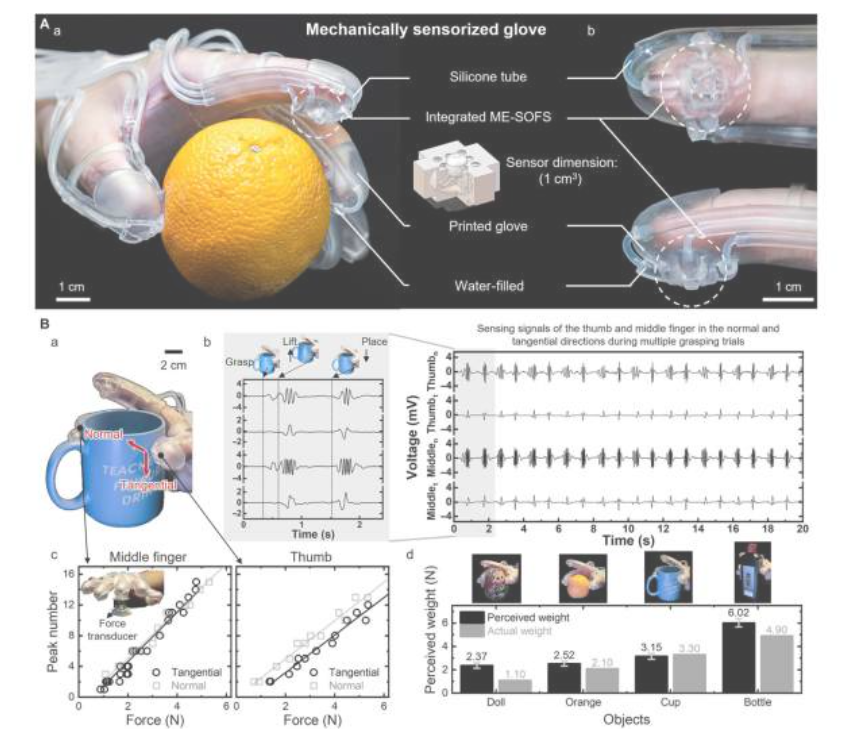
Singapore Team Develops ME-SOFS: A Mechanical Sensor for Touch Perception Without Electronics
A research team from the National University of Singapore has introduced a groundbreaking soft force sensor called ME-SOFS, which converts touch into fluid-driven motion without any electronic components. This innovative sensor features a 3D-printed soft porous structure with a central pillar connected to five fluid-filled chambers. When pressure is applied, the pillar tilts, compressing the corresponding chamber and driving fluid to actuators, enabling the detection of forces in multiple directions. The significance of ME-SOFS lies in its ability to operate without electronic interference, making it ideal for applications in medical training and elderly care. The sensor can generate readable signals through integrated magnets and coils, allowing it to measure force without external power. This technology has been successfully demonstrated in a soft glove that detects grip strength and predicts object weight, as well as in a tactile feedback system that enables operators to control robotic arms through force feedback. Looking ahead, the ME-SOFS sensor demonstrates robust performance under extreme conditions, such as high temperatures and underwater pressures. Its unique design allows it to function effectively in various environments, making it a valuable tool for soft robotics that require safe interaction with humans. No further timeline was disclosed at the time of publication.
Soft Robotics Fluid Sensors Mechanical Systems Robotics Technology
The New Era of Robot Perception: How CoRMA Enables Machines to Truly "Understand Touch"
Researchers have unveiled a groundbreaking advancement in robotic technology with the introduction of CoRMA, a new system designed to enhance machines' ability to perceive touch. This innovative development, announced in October 2023, aims to bridge the gap between human-like sensory experiences and robotic capabilities. Located at a leading technology research facility, the CoRMA system utilizes advanced algorithms and sensory data to enable robots to interpret tactile information more effectively. The motivation behind this initiative stems from the growing demand for robots to perform tasks that require a nuanced understanding of touch, such as delicate assembly work or providing care in healthcare settings. By integrating sophisticated sensors and machine learning techniques, CoRMA allows robots to not only detect pressure but also differentiate between various textures and materials. This advancement is expected to significantly improve the functionality of robots in diverse applications, from manufacturing to personal assistance. The development of CoRMA represents a significant leap forward in the field of robot perception, potentially transforming how machines interact with their environment and enhancing their ability to perform complex tasks that require a human-like touch.
Robotics Automation AIRobotics needs a service framework.
RSF defines a common language for robot service capability, lifecycle operations, certification pathways, and service-provider networks.
Join the RobotToday community on LinkedIn
Daily robotics news, in-depth analysis, conference highlights, and discussions with professionals worldwide.







