Industry Briefing
A single destination for timely, editor-curated robotics news from around the world.

The Classical Advances Needed to Make Quantum Computers Tick
Quantum computers are poised to tackle problems beyond the capabilities of today's most advanced supercomputers, but their operation relies heavily on classical computing infrastructure. As the industry prepares for the anticipated scale of quantum computing, major players like Nvidia, Q-CTRL, IBM Quantum, and Google Quantum AI are developing innovative classical hardware and software solutions to support these machines. In April, Nvidia unveiled AI-based software designed to enhance the classical tasks essential for quantum computing. Sydney-based Q-CTRL has created an automatic calibration algorithm that utilizes Nvidia’s system to streamline the calibration process, which is crucial for maintaining the reliability of qubits—quantum bits that are inherently unstable and require regular adjustments. Calibration involves a meticulous two-stage process that traditionally demands significant time and expertise, prompting a push for automation. Q-CTRL's intelligent software analyzes calibration data in real-time, allowing for dynamic adjustments to improve efficiency. Additionally, quantum error correction is a critical focus, as it enables the detection and compensation of errors in qubits, a process that must occur rapidly to maintain quantum states. While AI is gaining traction in simplifying hardware control, challenges such as latency and computational expense remain. Experts suggest that a hybrid approach combining traditional and AI methods may be necessary to optimize performance. As quantum technology evolves, the demand for robust classical support will grow, necessitating new strategies to manage the increasing complexity of quantum systems.
Quantum-computers Quantum-error-correction Internal-calibration Nvidia Quantum-computing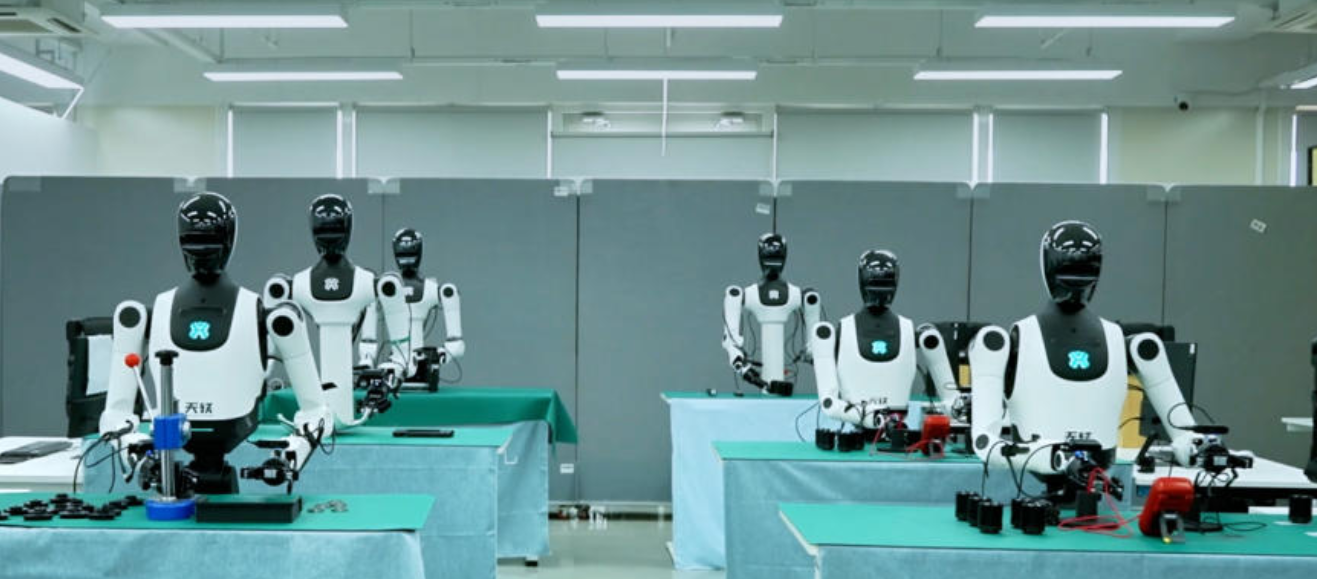
Launch of Robo-ValueRL: The First Open-Source VLA Reinforcement Learning Framework for Robotics
The Beijing Humanoid Robot Innovation Center and Renmin University of China's Gaoling Artificial Intelligence Institute have launched the Robo-ValueRL open-source framework. This initiative aims to enhance humanoid robots' decision-making capabilities in precision tasks, such as semiconductor assembly, by addressing challenges in data quality, control precision, and adaptability in dynamic environments. Robo-ValueRL introduces a value estimation mechanism based on historical observations, enabling robots to autonomously assess their actions. This closed-loop learning process—observation, value estimation, correction, and iteration—allows for improved accuracy and reduced instability in operations. The framework is fully open-source, providing access to core algorithms, evaluation tools, and standardized protocols for universities, research institutions, and manufacturers. The open-source nature of Robo-ValueRL significantly lowers the barriers for small and medium-sized manufacturers to implement reinforcement learning in specialized fields like semiconductor production and medical device manufacturing. This development marks a shift in humanoid robotics from laboratory experiments to practical industrial applications, paving the way for robots to evolve their decision-making capabilities independently.
Humanoid Robots Reinforcement Learning Precision Manufacturing Open Source Technology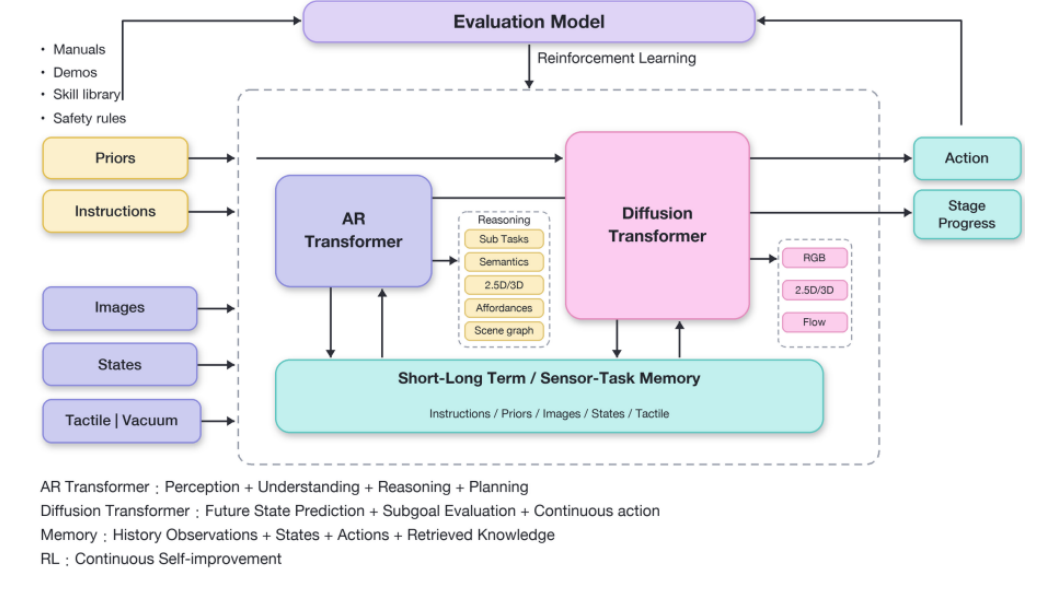
Gravity Develops Unified Framework for Long-Range Complex Robotic Tasks
Gravity has introduced a unified embodied intelligence framework designed for long-range and complex robotic tasks. This framework, built on a Mixture-of-Transformers (MoT) architecture, integrates visual language models (VLM) for instruction and scene understanding, task reasoning, and world modeling to predict future states and evaluate sub-goals. It also incorporates tactile and force feedback, prior knowledge, and multi-modal supervision to enhance task execution and adaptability. The significance of Gravity's framework lies in its ability to improve the success rate of complex operations that require precise contact and autonomous error correction. By combining AR Transformer and Diffusion Transformer, Gravity enables robots to simulate multiple strategies and assess risks before executing tasks. This advancement shifts robotic capabilities from reactive responses to proactive planning, making it suitable for applications in precision assembly, complex sorting, and flexible manufacturing. Looking ahead, Gravity aims to further develop its complete system, having already implemented components like Gravity VLA and Gravity 4D WAM. The focus will be on enhancing the framework's ability to learn from real-world experiences, thereby creating a continuous feedback loop that improves operational efficiency and adaptability in various industrial contexts. No further timeline was disclosed at the time of publication.
Robotic Frameworks Embodied Intelligence Task Automation Machine Learning RoboticsRobotics needs a service framework.
RSF defines a common language for robot service capability, lifecycle operations, certification pathways, and service-provider networks.