



EXECUTIVE SUMMARY
The 2026 World Artificial Intelligence Conference (WAIC), held July 17–20 in Shanghai, marks a structural transition in China's robotics and AI industry: from capability demonstration to industrial delivery. For the first time, embodied intelligence was elevated as a co-equal track alongside AI computing infrastructure. The exhibition floor displayed 208 embodied intelligence terminals, more than 300 operational robots, 108 domestically developed AI chips, and 261 foundation models — with over 300 products making their global debuts. The dominant engineering narrative was not locomotion or model scale, but sustained operation in real production environments.
INDUSTRY CONTEXT
WAIC has tracked China's AI trajectory since 2018. In 2025, humanoid robots occupied a secondary exhibitor tier. In 2026, embodied intelligence exhibitors expanded from approximately 80 to more than 200 companies — a 2.5× year-over-year increase. Total exhibition area exceeded 100,000 m², with 1,100+ exhibiting companies and 3,000+ displayed technologies across four dedicated venues.
The industry consensus framing at this year's conference was precise: 2026 is the "deployment-state inaugural year" for embodied intelligence. The benchmark criterion that unified exhibitors was no longer peak torque or locomotion agility — it was whether a system can operate continuously for eight hours on an actual production line without human intervention.
TECHNOLOGY
Humanoid Platforms
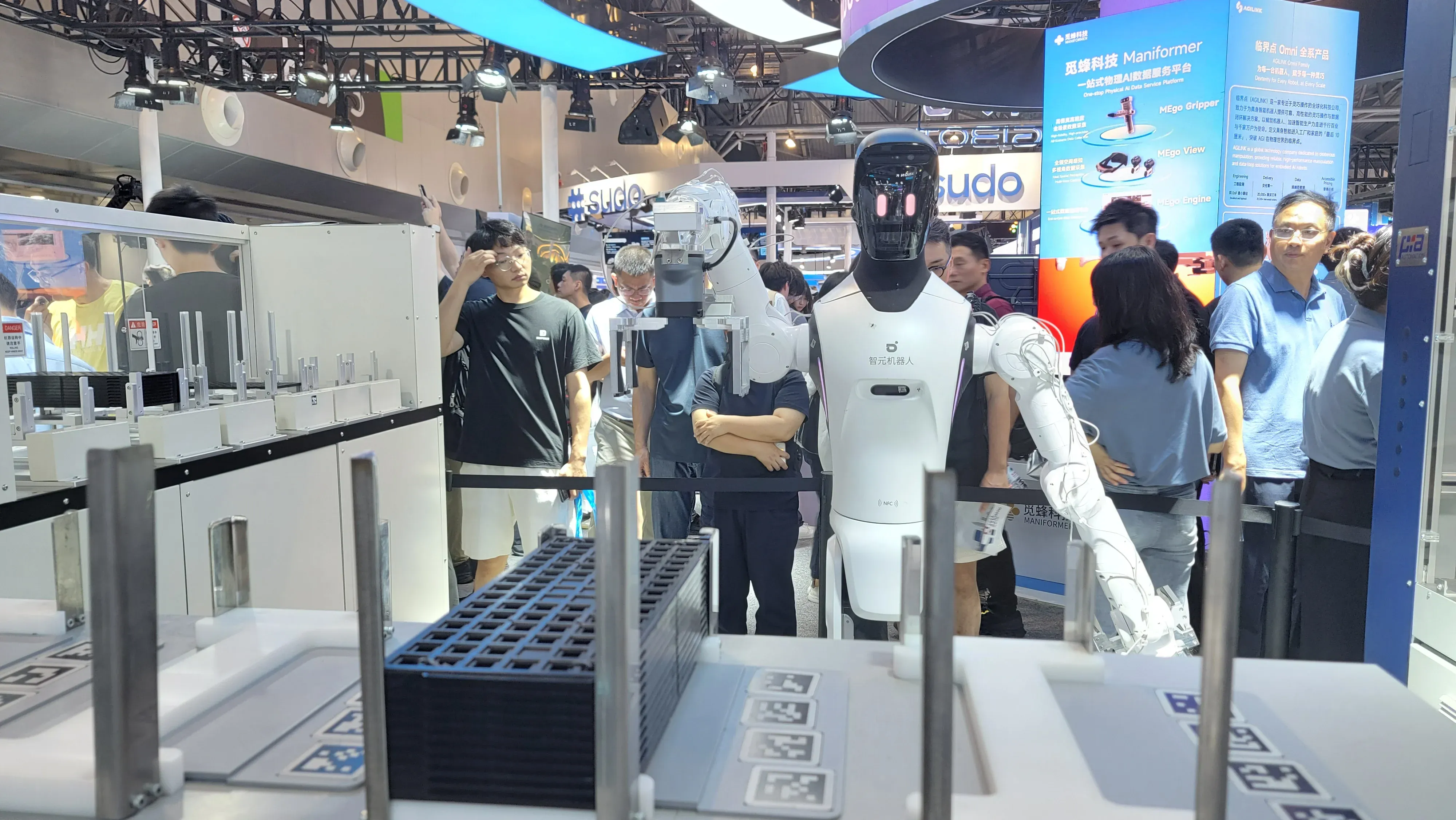
Agibot's Yuanzheng A3 Ultra was named the sole embodied intelligence product among WAIC 2026's ten "Flagship Exhibits". The platform stands 174 cm — anthropometric standard for human-facing workspaces — and integrates a 360° multi-modal perception system fusing visual and LiDAR inputs. On-board compute is rated at 700 TOPS. The system supports autonomous charging and unmanned operations, having undergone thousand-unit-scale production validation.
Booster Robotics debuted the T2, built around the NVIDIA Thor SoC delivering 2,070 TFLOPS of compute — the highest publicly disclosed on-board processing capacity for a full-size humanoid platform to date. The T2 is paired with Booster Studio, an integrated development environment supporting simulation, algorithm development, and real-robot deployment. The platform recently swept all bipedal humanoid categories at RoboCup 2026.
ZTE's Xingzai targets commercial services with an atypical specification: 1.6 m height, sub-30 kg total mass — the lowest published figure for a full-size humanoid — achieved through a tendon-driven lightweight actuation architecture and a flexible lattice skin layer.
Qiyuan Robotics T1 implements a Transformer cross-embodiment unified architecture that enables autonomous switching between wheeled-bipedal and quadrupedal configurations, addressing the trade-off between terrain adaptability and manipulation reach without requiring separate control stacks.
Dexterous Manipulation and Tactile Sensing
For the first time in WAIC's official program, AI dexterous hands were listed as a standalone product category — a structural signal that the industry's technical focus has shifted from locomotion to manipulation. Three systems are engineering-notable:
Agibot OmniHand 3 Ultra-M: 20 degrees of freedom, visual-tactile sensors integrated into all five fingertips, distributed 3D tactile sensing across the palm. Designed for contact-rich manipulation and teleoperation data capture.
Critical Point Robotics: Demonstrated stable bimanual dexterous coordination using the DUET dual-layer embodied contact intelligence architecture — the only public demonstration of bimanual balloon folding at the show.
Fudan University: Self-developed visuo-tactile sensor with ~40,000 sensing points per cm² at the fingertip, applied to precision automotive headlamp assembly. Tashan Technology extended tactile sensing to a full-body stack covering arm, torso, and foot sole.
AI Computing Infrastructure
Huawei's Atlas 950 supernode scales from a minimum 64-NPU-card configuration per cabinet to 8,192 NPUs, targeting trillion-parameter model training and inference. The Atlas 950 is a domestic compute solution positioned against Nvidia's NVLink-based dense GPU clusters at a time when US export controls limit Nvidia H100/H200 availability in China. The Zhangjiang venue hosted 100+ chip companies representing ten competing domestic GPU architectures. Zhipu AI launched GLM-5.2, ranking in the top three on the Artificial Analysis benchmark alongside Anthropic and OpenAI models.
ENGINEERING ANALYSIS
The dominant architectural convergence visible across exhibitors was "one brain, multiple embodiments": a shared foundation model or control policy driving robots of different morphologies. Pudu Robotics formalized this as its Physical Agent architecture. Ant Group's Lingbo unit demonstrated a cross-embodiment foundation model driving robots from different manufacturers to complete a shared pharmacy picking task.
Fourier Intelligence CEO Gu Jie articulated the key engineering split: "In 2026, the hardware architecture of embodied robots has clearly converged. What has not converged is the brain." The hardware supply chain — actuators, structural components, perception modules — is approaching component-level commoditization. The differentiating variable is the visuomotor policy: the Vision-Language-Action (VLA) model that maps sensor input to motor commands.
Siemens debuted the Eigen Engineering Agent for the Chinese market — an industrial automation AI agent operating end-to-end across engineering planning, execution, and validation without manual intervention. It generates PLC code, HMI configurations, and drive parameter optimizations. Siemens reports 2–5× execution speed improvement over manual workflows, 50% engineering efficiency gain, and 80% solution quality improvement. This positions autonomous engineering agents — not copilot assistants — as the near-term industrial software deployment target.
COMMERCIAL PROGRESS
The most commercially significant deployment at WAIC 2026: Agibot G2 Max with JD Logistics — the first confirmed deployment of a humanoid robot in an operational third-party logistics warehouse. Dual-arm peak payload: 50 kg. The system supports 7×24-hour unmanned palletizing operations.
Ant Group's Lingbo pharmacy solution is operational in Shanghai Guoda Pharmacy retail locations — a live deployment, not a pilot. The cross-embodiment foundation model drives picking workflows across heterogeneous robot teams.
Weiyi Intelligent Manufacturing confirmed its multi-arm embodied quality inspection system is running on production lines in China, the US, and Germany for top-tier automotive OEMs — China-originated embodied AI entering global Tier-1 manufacturing at the quality-control layer.
MARKET PERSPECTIVE
Volume production capability — demonstrated through thousand-unit manufacturing process validation — is becoming the competitive separator. Horizon Robotics Developer Ecosystem VP Hu Chunxu stated: "Previously people asked whether a robot could dance. Now they ask whether it can work continuously for 24 hours. Whether it can repeat an action ten thousand times." The dexterous hand, tactile sensor, and embodied model supplier ecosystem is reorganizing as structurally independent supply-chain nodes — mirroring the EV supply chain's trajectory from vertical integration toward component specialization.
CHALLENGES
Three bottlenecks were consistently identified across exhibitor and conference discussions:
1. VLA model on-robot deployment: Current frontier VLA model parameter counts exceed the memory and compute budget of embedded edge processors. Cloud inference introduces latency incompatible with closed-loop motor control. Model distillation, on-chip inference acceleration, and hierarchical fast/slow control architectures are active engineering responses — none yet dominant.
2. Multi-sensor data synchronization: Multi-camera and LiDAR streams require spatial and temporal alignment. Coordinating dozens of joints with sub-millisecond latency across heterogeneous sensor buses compounds as morphological complexity increases.
3. Post-deployment generalization and stability: Problems that appear algorithmic in the field frequently resolve into production management or system integration issues. One exhibitor stated directly: "After completing the demo, there is no continuity. That is the real problem we see in industrial deployment."
ROBOTTODAY ANALYSIS
Technical Significance: WAIC 2026 confirms hardware architecture convergence in full-size humanoid platforms is real and accelerating. The differentiation layer has shifted to the visuomotor policy — specifically, whether a VLA model can generalize across unstructured task variations with the consistency production environments demand. Dexterous hands and tactile sensing elevated to a standalone engineering category reflects the correct diagnosis: locomotion in structured indoor environments is a solved problem; contact-rich manipulation is not.
Commercial Significance: The Agibot–JD Logistics warehouse deployment and Ant Lingbo's operational pharmacy installations are the most commercially credible data points from the show — real operational environments, not proof-of-concept labs. Neither company disclosed operational uptime metrics or total cost-of-deployment figures that would allow independent economic evaluation versus incumbent automation.
Remaining Challenges: Post-demo operational continuity is the industry's unresolved engineering problem. A system that performs well in a 30-minute controlled demonstration and one that operates reliably across three production shifts are different problems. The industry has not produced transparent, third-party-validated sustained deployment metrics.
Industry Outlook: The next 12 months will be defined by which platforms publish production-environment operational data — uptime, task success rate, mean time between failures, and retraining cadence. Companies that can close the loop between in-field failure modes and model iteration will separate from those that can only demonstrate in controlled settings. WAIC 2027 will likely be the first conference where that data is commercially material.
WAIC Review 2/4: World Models vs. VLA: Robotics' Next 'ChatGPT Moment'







Leave a comment