

Industry Briefing
A single destination for timely, editor-curated robotics news from around the world.

North Carolina State University Develops Infrared Light-Powered Soft Robots with Endless Jumping Ability
Researchers at North Carolina State University have developed innovative teardrop-shaped soft robots that can continuously leap upward or forward when exposed to infrared light. This breakthrough showcases a novel mechanism for self-resetting jumping behavior in soft robotics, allowing the robots to maintain their jumping motion as long as the light source is available. The significance of this advancement lies in its potential applications in various fields, including search and rescue operations, environmental monitoring, and soft robotics research. The ability to create robots that can autonomously jump indefinitely under specific conditions opens new avenues for exploration in robotics and automation, enhancing the versatility and functionality of soft robotic systems. Looking ahead, the ongoing research may lead to further enhancements in the design and capabilities of soft robots. No further timeline was disclosed at the time of publication, but the implications of this technology could pave the way for more sophisticated robotic applications in the near future.
Robotics
North Carolina State University Develops Soft Robot for Continuous Jumping Without Electronics
Researchers at North Carolina State University have developed a soft robot capable of continuous jumping without electronic control. This innovation utilizes geometric structures and light-responsive materials to enable the robot to autonomously jump under constant infrared light, overcoming previous limitations that required manual resets or external stimuli for each jump. This advancement is significant as it opens new pathways for the movement of micro soft robots, allowing them to navigate diverse environments without the need for complex electronic systems. The robot, named the annular jumper, can adapt to various terrains, achieving vertical jumps up to 80 times its size and horizontal jumps exceeding three times its length, showcasing its potential for real-world applications. Looking ahead, the research highlights the importance of physical intelligence in robotics, where movement logic is embedded in material properties and geometric configurations. While the current prototype is still in the concept validation stage and faces challenges such as reliance on infrared light and material fatigue, it lays the groundwork for future developments in low-cost micro soft robots that could be deployed in swarm formations for environmental exploration and disaster response.
Soft Robotics Autonomous Systems Light-Responsive Materials Geometric Structures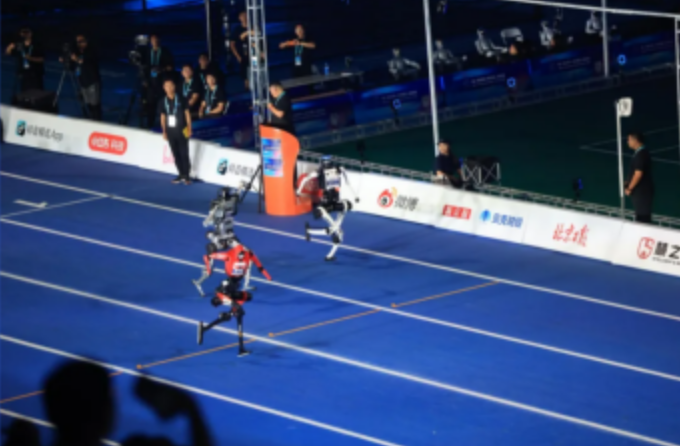
Humanoid Robots Achieve Breakthroughs in Speed and Jumping at World Championships
On August 22, the National Speed Skating Hall hosted the grand opening of the second World Humanoid Robot Games, featuring 666 teams and 2056 robots from 16 countries. The Tian Gong Ultra humanoid robot set a new speed record of 9.32 seconds for the 100-meter dash and achieved a high jump of 2.8843 meters, surpassing human athletic limits. This event signals a significant shift in the robotics industry, showcasing advancements in autonomous capabilities. Key racing events like the 400-meter and 1500-meter races eliminated manual remote control, requiring robots to rely on their sensors for environmental perception, obstacle recognition, and autonomous route planning. While humanoid robots are not yet ready for large-scale human replacement, the integration of competition and production is accelerating the commercialization of technology. As these robots transition from the competition arena to industrial applications, the transformation of the robotics sector is just beginning.
Humanoid Robots Robot Autonomy Sports Robotics Industrial Automation
North Carolina State University Develops Infrared-Powered Soft Robots for Continuous Jumping
Researchers at North Carolina State University have created innovative soft robots capable of continuous jumping when exposed to infrared light. These teardrop-shaped robots autonomously leap upward or forward without needing external mechanisms to reset after each jump, thanks to a unique design that harnesses energy from infrared illumination. This advancement is significant as it allows soft robots to perform repetitive movements without motors or complex controls, making them suitable for various challenging terrains. The robots utilize a photothermally responsive liquid crystal elastomer ring and a rigid V-shaped tail, enabling them to store and release energy efficiently during jumps. Looking ahead, the researchers have demonstrated that these soft robots can navigate diverse surfaces, including slopes and obstacles, and even operate across water-land interfaces. Future developments may focus on optimizing the robots' design for enhanced performance and exploring their applications in environments where traditional robots struggle.
AI and RoboticsRobotics needs a service framework.
RSF defines a common language for robot service capability, lifecycle operations, certification pathways, and service-provider networks.
Join the RobotToday community on LinkedIn
Daily robotics news, in-depth analysis, conference highlights, and discussions with professionals worldwide.







