

Industry Briefing
A single destination for timely, editor-curated robotics news from around the world.

Dexory Implements SimScale’s Engineering AI to Enhance Autonomous Robot Design
Dexory, a robotics and warehouse data intelligence company, has implemented SimScale’s Engineering AI to improve the engineering workflows for designing and testing autonomous warehouse robots. This deployment builds on Dexory's existing use of SimScale’s AI-native cloud simulation platform, enabling engineers to quickly identify structural component failures and explore various design options through simulation. The significance of this development lies in the growing demand for faster product development cycles in warehouse robotics, projected to reach a market value of $117 billion by 2034. As engineering teams face pressure to maintain performance and reliability, the integration of AI into engineering processes is becoming increasingly vital. Dexory's use of Engineering AI aims to streamline investigations into structural failures and enhance simulation reporting, making it easier for teams to analyze and share results. Looking ahead, Dexory's program will allow engineers to conduct parameter sweeps and capture simulation knowledge, creating a searchable engineering memory. This initiative not only focuses on productivity but also aims to identify where AI can provide the most value in engineering, establishing best practices for future AI adoption. No further timeline was disclosed at the time of publication.
Automation & Robotics
BQP and Modovolo Transform Aerospace Design with Quantum-Inspired Software
BQP and Modovolo have announced a significant advancement in aerospace design through the use of quantum-inspired computing. By leveraging BQP's advanced computing platform, Modovolo has managed to bypass traditional lengthy design cycles, achieving remarkable performance in drone manufacturing. This collaboration is crucial as it highlights the potential of quantum-accelerated simulation software to revolutionize heavy engineering sectors. Modovolo's ability to produce high-performance drones at drastically reduced costs signifies a shift in the aerospace industry, enabling faster innovation and deployment. Looking ahead, the impact of this technology on engineering practices will be significant. Stakeholders should monitor how BQP's quantum-inspired solutions continue to influence design processes and the broader implications for manufacturing efficiency. No further timeline was disclosed at the time of publication.

HP Additive Manufacturing Enables EIVIE to Create NDAA-Compliant Drone with Unique Design
EIVIE, a US drone manufacturer, has successfully developed an NDAA-compliant drone using HP's additive manufacturing technology. This innovative approach allowed EIVIE to overcome the challenges of conventional manufacturing, which often requires extensive tooling and engineering for even minor design changes. The significance of this achievement lies in EIVIE's commitment to maintaining an aerodynamic design while adhering to regulatory requirements. Co-founder and CEO Damjan Zabovnik emphasized that the flexibility of additive manufacturing enables continuous design improvements without the delays associated with traditional manufacturing processes. Looking ahead, EIVIE plans to leverage this adaptability as regulations and technology evolve. Zabovnik noted that the ability to quickly update designs will enhance their competitiveness in the market. No further timeline was disclosed at the time of publication.
DL Exclusive Drone Manufacturing Drone News Drone News Feeds News additive manufacturing
NVIDIA Enhances Agent Toolkit with PhysicsNeMo and CUDA-X for Advanced Engineering Solutions
NVIDIA has announced an expansion of its NVIDIA Agent Toolkit, incorporating NVIDIA PhysicsNeMo and CUDA-X libraries to enhance engineering capabilities. This development aims to address the complexities of modern chip and system design by enabling the creation of autonomous AI engineers that utilize physics, simulations, and performance analysis. The integration of these tools is expected to significantly improve the efficiency and accuracy of engineering workflows. The introduction of PhysicsNeMo provides AI physics skills essential for training and deploying models, while the CUDA-X libraries offer accelerated solvers and quantum chemistry capabilities. According to Timothy Costa, NVIDIA's vice president of computational engineering, this toolkit empowers developers to build AI agents that can reason with physics and generate high-fidelity data, thus driving innovation in chip design. As industry leaders like Cadence adopt these new tools, they are already witnessing substantial improvements in their engineering processes. Cadence's use of NVIDIA's technologies has reportedly led to up to 20 times faster multiphysics performance in PCB design. The ongoing development and application of these advanced tools will be crucial for future engineering projects, although no further timeline was disclosed at the time of publication.
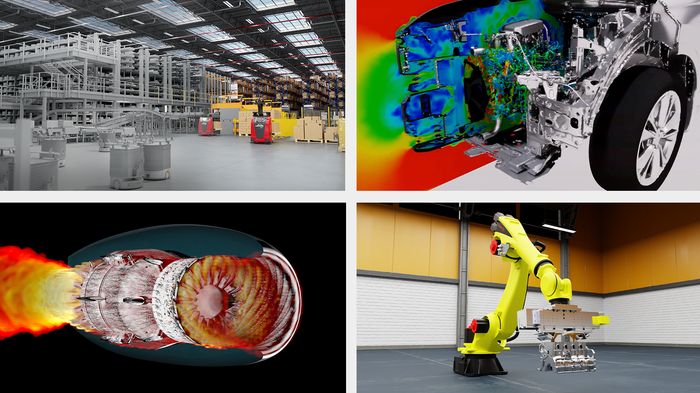
NVIDIA and Global Industrial Software Giants Bring Design, Engineering and Manufacturing Into the AI Era
NVIDIA has partnered with leading global industrial software companies, including Cadence, Dassault Systèmes, PTC, Siemens, and Synopsys, to enhance industrial software and tools through its CUDA-X™ and Omniverse™ platforms. This collaboration aims to integrate GPU-accelerated technologies into the operations of major manufacturers such as FANUC and HD Hyundai. The initiative, announced today, seeks to drive innovation and efficiency in industrial processes by leveraging advanced computing capabilities. By combining NVIDIA's cutting-edge technology with the expertise of these software leaders, the partnership is set to transform the landscape of industrial automation and design, ultimately improving productivity and performance across various sectors.

Into the Omniverse: How Industrial AI and Digital Twins Accelerate Design, Engineering and Manufacturing Across Industries
Companies across various industries are increasingly leveraging industrial AI, digital twins, AI physics, and accelerated AI infrastructure to enhance their design, simulation, and optimization processes. This technological shift allows organizations to refine products, processes, and facilities in a virtual environment before actual construction begins. By adopting these advanced tools, businesses aim to improve efficiency, reduce costs, and accelerate time-to-market for new innovations. The integration of these technologies is seen as a crucial step in staying competitive in a rapidly evolving market, enabling firms to make data-driven decisions and optimize their operations effectively.
Robotics needs a service framework.
RSF defines a common language for robot service capability, lifecycle operations, certification pathways, and service-provider networks.
Join the RobotToday community on LinkedIn
Daily robotics news, in-depth analysis, conference highlights, and discussions with professionals worldwide.







